Showing posts with label Tim Cartmell. Show all posts
Showing posts with label Tim Cartmell. Show all posts
Saturday, February 11, 2012
Tim Cartmell's "Ground Proofing" DVD
Some of the absolute best martial arts seminars I have been to were with Tim Cartmell when he visited Seattle. Over several years I attended Tim's Bagua, Taiji and Xingyi sessions, and one on MMA for the street. Tim lived, trained and competed in Asia for many years, returned to the States and earned his Black Belt in Brazilian Jiu Jitsu.
He has also authored and co-authored many valuable books on Chinese martial arts, some of which I have.
Above is a sample of Tim's "Ground Proofing" video, which he says is designed for the non-grappler to get a handle on what to do when a fight goes to the ground.
Watch how Tim moves in a relaxed fashion with efficient, controlled skill. He outlined many devastating throwing techniques in his book "Effortless Combat Throws", and it has been said that Tim has a "heavy body" for his size. This is clearly because of his intense knowledge of leverage and scientific principle while manipulating opponents bodies.
You can get a copy of this DVD as well as others (I have his excellent video on Standing Grappling) at his website for Shen Wu at this link.


Monday, September 12, 2011
Great Video Interview With Tim Cartmell
Video Link
Rolled Up Epsiode 27: The Never-Ending Path of a Martial Artist with Tim Cartmell
Here is a really, really good video interview with Tim Cartmell, one of the absolute best instructors I have trained with.
Readers may know I met Tim through Jake Burroughs of Three Harmonies Martial Arts in Seattle. I learned more in a half-dozen seminars with Tim than in any two years of past Karate training. Most of the seminars dealt with application of Tai Chi Chuan, Xingyi and Bagua - with a heavy influence on knock-downs and throws.
As you will see in the interview, Tim was an expert in Chinese martial arts (he trained for years in Taiwan) and has now focused on Brazilian Jiujitsu.
Watch the way Tim moves in the mat work with the interviewer at the end, complete relaxed power.
Tim Cartmell's "Shen Wu" website
Rolled Up Epsiode 27: The Never-Ending Path of a Martial Artist with Tim Cartmell
Here is a really, really good video interview with Tim Cartmell, one of the absolute best instructors I have trained with.
Readers may know I met Tim through Jake Burroughs of Three Harmonies Martial Arts in Seattle. I learned more in a half-dozen seminars with Tim than in any two years of past Karate training. Most of the seminars dealt with application of Tai Chi Chuan, Xingyi and Bagua - with a heavy influence on knock-downs and throws.
As you will see in the interview, Tim was an expert in Chinese martial arts (he trained for years in Taiwan) and has now focused on Brazilian Jiujitsu.
Watch the way Tim moves in the mat work with the interviewer at the end, complete relaxed power.
Tim Cartmell's "Shen Wu" website
Sunday, December 26, 2010
Versions of Stand-up Grappling
Mike Martello demonstrates Chin na
The late Mike Martello was one of the favorite instructors I have trained with. Part class clown, part mad scientist working over lab rats, and all martial artist. As you can see, Mike was very short, but very powerful. He had to perfect body dynamics because he simply did not have the mass to out-muscle the big guys. As a result, Mike was able to teach very well and was a ton of fun to train with. Additionally, he had a very high level of body control in form work, which was beautiful to watch. I had a few long e-mail exchanges with Mike between his visits to Seattle, where we learned a bit about each other and life in general. Mike is missed by students on at least four continents throughout the world.
Wally Jay demonstrates Small-Circle Jujitsu
Aside from Wrestling in school, I studied Aikido for two years and got a great overview of spiral energy and joint locking. My training partner Corey was fortunate to have trained extensively with Wally and Leon Jay of "Small-Circle Jujitsu". I was able to attend a pretty wild seminar with Leon Jay in Portland some years back. I dislocated a guy's finger, Corey got seriously knocked out by Leon, and we learned a lot about energetics. In the short interview with Wally above there is mostly some pain-compliance that looks good for the camera. But let me tell you, the Jays can get really rough. They say "Pain makes believers".
Tim Cartmell demonstrates Chin na
And then there's Tim Cartmell.
The seminars I have attended with Tim on combat Bagua, Taiji and Xingyi application and stand-up grappling have been some of the most influential in my recent training years.
I wish there was more video available of Tim but he stays pretty much below the radar on YouTube.
For those that don't know, Tim was a successful fighting champion in Taiwan and authored and translated many books on martial arts including the classic "Effortless Combat Throws". Tim is a "grappler's grappler", now a Black Belt in Brazilian Jiu Jitsu. During the time I have met and talked with Tim, he has dispensed with the notions of metaphysics and Chi in favor of good old leverage and mass-in-motion. His principles are proven in combat, both on the street and on the mat.
As you can see, Tim's techniques in this video resemble those Make Martello uses in the first video. I only wish there was more available. Fortunately, I have hours of the seminars I attended recorded, which is an invaluable asset. I look forward to training more with Tim in the future.
Special thanks to my friend and instructor Jake Burroughs for bringing Tim Cartmell and Mike Martello to Seattle, and for the continuing training Jake provides me.
The late Mike Martello was one of the favorite instructors I have trained with. Part class clown, part mad scientist working over lab rats, and all martial artist. As you can see, Mike was very short, but very powerful. He had to perfect body dynamics because he simply did not have the mass to out-muscle the big guys. As a result, Mike was able to teach very well and was a ton of fun to train with. Additionally, he had a very high level of body control in form work, which was beautiful to watch. I had a few long e-mail exchanges with Mike between his visits to Seattle, where we learned a bit about each other and life in general. Mike is missed by students on at least four continents throughout the world.
Wally Jay demonstrates Small-Circle Jujitsu
Aside from Wrestling in school, I studied Aikido for two years and got a great overview of spiral energy and joint locking. My training partner Corey was fortunate to have trained extensively with Wally and Leon Jay of "Small-Circle Jujitsu". I was able to attend a pretty wild seminar with Leon Jay in Portland some years back. I dislocated a guy's finger, Corey got seriously knocked out by Leon, and we learned a lot about energetics. In the short interview with Wally above there is mostly some pain-compliance that looks good for the camera. But let me tell you, the Jays can get really rough. They say "Pain makes believers".
Tim Cartmell demonstrates Chin na
And then there's Tim Cartmell.
The seminars I have attended with Tim on combat Bagua, Taiji and Xingyi application and stand-up grappling have been some of the most influential in my recent training years.
I wish there was more video available of Tim but he stays pretty much below the radar on YouTube.
For those that don't know, Tim was a successful fighting champion in Taiwan and authored and translated many books on martial arts including the classic "Effortless Combat Throws". Tim is a "grappler's grappler", now a Black Belt in Brazilian Jiu Jitsu. During the time I have met and talked with Tim, he has dispensed with the notions of metaphysics and Chi in favor of good old leverage and mass-in-motion. His principles are proven in combat, both on the street and on the mat.
As you can see, Tim's techniques in this video resemble those Make Martello uses in the first video. I only wish there was more available. Fortunately, I have hours of the seminars I attended recorded, which is an invaluable asset. I look forward to training more with Tim in the future.
Special thanks to my friend and instructor Jake Burroughs for bringing Tim Cartmell and Mike Martello to Seattle, and for the continuing training Jake provides me.
Sunday, November 28, 2010
Video Review: Tim Cartmell's "Standing Grappling"

It's amazing how things can come full-circle.
In my martial training, I started out as a wrestler, and most of my fights went to the ground. In Tae Kwon Do I trained kicking techniques for years. Later in Kenpo we practiced nasty hand strikes and Western Boxing. Aikido and Small-Circle Jujitsu re-introduced grappling techniques. The last ten years have been spent practicing the Chinese Internal Arts, and in an amazing way, it has brought me back to wrestling.
Attending seminars with Tim Cartmell has been a revelation in martial experience. Tim is undoubtedly the best grappler I have learned from, and his background in traditional Chinese Martial Arts is legendary. Many of you know that Tim has become a skilled competitor and coach in Brazilian Jiu Jitsu as well.
In his video "Standing Grappling", Tim covers escapes and counters to many of the most common grappling techniques seen in common street fights. These include things as simple as wrist grabs, but the meat of the video is on dangerous techniques such as headlocks, chokes and body locks used to slam an opponent.
Tim first introduces the proper way to properly perform these chokes, headlocks, etc. Then he shows how to prevent someone from gaining such a hold on you, and
how to escape if you do get caught in these types of holds and locks.
The difference in Tim's method is that he asserts that striking, kicking and elbowing will simply not cause an extremely strong opponent to release their grip.
Instead, Tim demonstrates very logical and scientific ways to use body leverage that nobody can resist. For instance, he suggests you can not use isolated muscle groups in the arms alone to break holds. Through subtle angles and body positioning, you can force your opponent to have to contend with your entire body weight, the use of torso, back and waist in unison as opposed to isolated arm muscles.
Within each counter-technique is redundancy, that is a "plan B" for every attempt. What to do if the first part of the escape is not successful. What to do if the opponent changes his tactic or positioning. And what to do if the opponent maintains the lock on you after you have successfully thrown him and you both go down together.
There are plenty of opportunities to loosen the hold, strike the opponent and get away. But Tim sticks strictly to grappling techniques that work and can be practiced safely with training partners at near-full strength. Options to many of the techniques include breaking the hold and getting away, or following with a submission such as an arm bar, shoulder lock or choke.
There is probably nothing more dangerous in a street fight as being choked out or slammed to the ground on a hard surface. In "Standing Grappling", Tim demonstrates some very common-sense methods to defend yourself if you are ever caught in a head lock, body lock or choke by an opponent that may be bigger and stronger than you.
Great stuff, and it includes many out-takes of Tim with some incredible BJJ competition moves, and his students at "Shen Wu" sparring and grappling with many of these techniques. I highly recommend this video;
Tim Cartmell's "Shen Wu" website is at this link
and all his videos are available here.
Monday, November 1, 2010
Modern Combat Concepts with Tim Cartmell
After a good five-hour thrashing:
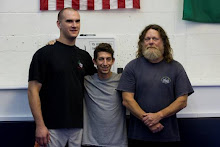
From Left- Jake Burroughs, Me, and Tim Cartmell

MMA Training Group, c/o Terry, thanks

Yesterdays Seminar in Seattle with Tim Cartmell was one of the best I've been to, and my 51 year-old ass held up pretty good. I think the extra conditioning and a preview of Tim's "Ground-proofing" concepts with Jake a couple of weeks ago gave me a heads-up on what to prepare for.
As always, Tim's presentation was brilliant. Tim has experienced the concepts he teaches intellectually, physically, and in highly stressful competitive fighting. Tim knows what will work when the shit hits the fan, and it's no surprise that simpler is better. I've got two pages of notes and had plenty of time to mentally review the seminar on the way home.
As explained, every human will react predictably to given stimulus, like when the hands come up as someone pokes at their eyes. This can be used both ways, in attacking and defending, but let's focus on defense. The key is to take those gross motor skills and morph them into simple and natural reactions that fit a self-defense or fighting concept.
I have to say, this seminar- which was billed as "Intro to Mixed Martial Immersion", made me rethink a lot about how I have been training. That's what a good seminar is supposed to do, and it's sinking into my thick skull.
Tim always keeps his guard in a "boxers triangle" close to his head. He never reaches out to block anything, but rather pats jabs down "monkey paw" style, absorbs hooks against his head with forearms, and blocks body punches with movement and smothering the punches with forearms and elbows, which remain close to the body.
While it may sound like you would take a lot of punishment in this position, it is actually a great protective guard. I asked him if the extended guard of classical styles is still useful in any way, and he said it was just for training. When his master instructors in Taiwan actually fought or sparred, they reverted to this protective position. The idea is, once someone has crossed into punching range, they can work around or knock down an extended guard. The extended guard may work against drunk Rubes, but against anyone that can stand in and throw punches, this is the only guard that will protect you.
Here is where Tim made the distinction between ring fighting and street martial arts. There is no rule set on the street. So when you throw boxing punches, you can not over-rotate and expose your flank, as pro boxers do in the ring at times. You must always remain facing the opponent, so the punches need to be modified.
From the feet Tim moves in to the clinch range, where most fights go anyway. He seeks inside control on the bicep lines and then sets up the take down.
In his way of thinking, even a great kick boxer can get knocked out if the fight keeps on going, and he believes the quickest way to end the fight is to slam the opponent on a hard surface.
Sprawling to prevent leg dives, protecting yourself if you are on your back, and the technical rise to your feet were all covered in detail.
Tim, who wrote the book "Effortless Combat Throws", is an expert in high, damaging throws. But what he teaches are mostly off-balancing knock-downs, ankle picks and the occasional hip throw. Most of the take downs are more like tipping over a large cow; if you use simple angles and leverage it is possible to topple something much larger than yourself.
Those of you who read Dojo Rat regularly know I have a deep passion for the traditional Chinese Internal Martial Arts, especially the meditative and health aspects they provide.
But Tim provided a clear summary of the evolution of martial arts as they stand today. While very, very few of us train for ring fighting, we should not ignore new technology that actually makes survival in a violent confrontation possible.
This seminar will give our little Dojo a ton of new material to work on, in stand-up fighting, clinch work, and if all else fails, how to protect ourselves on the ground and safely return to our feet.
Great stuff from a great instructor, special thanks to my friend and Xingyi instructor Jake Burroughs for hosting the seminar.
From Left- Jake Burroughs, Me, and Tim Cartmell

MMA Training Group, c/o Terry, thanks

Yesterdays Seminar in Seattle with Tim Cartmell was one of the best I've been to, and my 51 year-old ass held up pretty good. I think the extra conditioning and a preview of Tim's "Ground-proofing" concepts with Jake a couple of weeks ago gave me a heads-up on what to prepare for.
As always, Tim's presentation was brilliant. Tim has experienced the concepts he teaches intellectually, physically, and in highly stressful competitive fighting. Tim knows what will work when the shit hits the fan, and it's no surprise that simpler is better. I've got two pages of notes and had plenty of time to mentally review the seminar on the way home.
As explained, every human will react predictably to given stimulus, like when the hands come up as someone pokes at their eyes. This can be used both ways, in attacking and defending, but let's focus on defense. The key is to take those gross motor skills and morph them into simple and natural reactions that fit a self-defense or fighting concept.
I have to say, this seminar- which was billed as "Intro to Mixed Martial Immersion", made me rethink a lot about how I have been training. That's what a good seminar is supposed to do, and it's sinking into my thick skull.
Tim always keeps his guard in a "boxers triangle" close to his head. He never reaches out to block anything, but rather pats jabs down "monkey paw" style, absorbs hooks against his head with forearms, and blocks body punches with movement and smothering the punches with forearms and elbows, which remain close to the body.
While it may sound like you would take a lot of punishment in this position, it is actually a great protective guard. I asked him if the extended guard of classical styles is still useful in any way, and he said it was just for training. When his master instructors in Taiwan actually fought or sparred, they reverted to this protective position. The idea is, once someone has crossed into punching range, they can work around or knock down an extended guard. The extended guard may work against drunk Rubes, but against anyone that can stand in and throw punches, this is the only guard that will protect you.
Here is where Tim made the distinction between ring fighting and street martial arts. There is no rule set on the street. So when you throw boxing punches, you can not over-rotate and expose your flank, as pro boxers do in the ring at times. You must always remain facing the opponent, so the punches need to be modified.
From the feet Tim moves in to the clinch range, where most fights go anyway. He seeks inside control on the bicep lines and then sets up the take down.
In his way of thinking, even a great kick boxer can get knocked out if the fight keeps on going, and he believes the quickest way to end the fight is to slam the opponent on a hard surface.
Sprawling to prevent leg dives, protecting yourself if you are on your back, and the technical rise to your feet were all covered in detail.
Tim, who wrote the book "Effortless Combat Throws", is an expert in high, damaging throws. But what he teaches are mostly off-balancing knock-downs, ankle picks and the occasional hip throw. Most of the take downs are more like tipping over a large cow; if you use simple angles and leverage it is possible to topple something much larger than yourself.
Those of you who read Dojo Rat regularly know I have a deep passion for the traditional Chinese Internal Martial Arts, especially the meditative and health aspects they provide.
But Tim provided a clear summary of the evolution of martial arts as they stand today. While very, very few of us train for ring fighting, we should not ignore new technology that actually makes survival in a violent confrontation possible.
This seminar will give our little Dojo a ton of new material to work on, in stand-up fighting, clinch work, and if all else fails, how to protect ourselves on the ground and safely return to our feet.
Great stuff from a great instructor, special thanks to my friend and Xingyi instructor Jake Burroughs for hosting the seminar.
Tuesday, October 26, 2010
Tim Cartmell's Shen Wu
Well I'm getting ready for a big Tim Cartmell seminar in Seattle this weekend, so I thought we'd take a spin through some of his videos.
This one is from our buddy and fellow Dojo Rat from the north, William, who visited Tim in 2008.
Notice the diversity of training, Tim's guys are very well-rounded fighters. The one thing that I have realized through Tim's instruction is how many options you have in standing grappling. See how he demonstrates that if any given technique doesn't quite work, you can maintain a superior position by changing angles or direction of intent.
This weekend I am told we will work on some flow drills. These will start at hitting range, go to the clinch, take down, submission attempt, counter to submission, safely return to feet, and reverse rolls.
Shit, many of the guys will be almost twenty years younger than me. It'll probably take a case of Beer and two days to recover...
For information on the Seattle seminar, go to Jake Burroughs website "The Ground Never Misses".
Monday, October 18, 2010
Sun-style Tai Chi Chuan with Tim Cartmell
Many of you out there are familiar with Tim Cartmell, who just came out with a DVD series on Sun-style Tai Chi Chuan.
For those who don't know, Tim lived and trained in Taiwan and China for years, winning Asian fighting tournaments and becoming an expert in the Chinese Internal Martial Arts and Brazilian Jujitsu. Tim has authored "Effortless Combat Throws", "Xingyi Nei Gong", and translated many books on related subjects.
Tim was fortunate to have studied with the Daughter of Sun Lu-Tang, one of the most famous Chinese masters of the last century. So Tim's presentation of Sun-style Tai Chi Chuan is as close to the bone as you can get.
As you can see in this video excerpt, Tim has a very skilled way of presenting material. No hocus-pocus, just strong emphasis on structure and method. Even though I study Yang-style, the principles and application are completely transferable.
I've been to a handful of Tim's seminars in Seattle and plan to attend another at the end of October. Tim teaches with a balance of patient transmission of knowledge and the ability to slam the crap out of you.
More on Tim's upcoming Seminar in Seattle later, for those interested in this video and others produced by Tim Cartmell, visit his Shen Wu website at This link.
Friday, August 13, 2010
Tim Cartmell On "Double Weighting"
Principles, Analysis and Applications of Effortless Combat Throws

Lately I've been reviewing information from seminars I attended with Tim Cartmell, author of the book above on "Effortless Combat Throws". The Chinese Internal Martial Arts have fewer high throws as in Judo, and lean more to the leg entanglement and knock-downs of Chinese wrestling. Here is what Tim has to say about "double-weighting", a practice warned against in the Tai Chi classics:
"It is clear that the masters of old considered double weighting to be a serious problem. double weighting is usually defined as the condition of standing with the weight evenly distributed between both feet (as in the classic "horse" stance).
This however, is not necessarily the case, Whether or not double weighting occurs is not determined directly by the relative distribution of weight between an individuals feet, but rather by whether or not one has joined centers with the opponent."
(D.R.)--Let me summarize an otherwise long and heavily detailed explanation of what Tim means; If you meet your opponent with force against his force, you have your weight and he has his weight and you are "double weighted".
Tim continues:
"Whether throwing, applying joint locks or striking, maximum efficiency depends upon the avoidance of double weighting. When setting up a throw, the most efficient technique is the one which allows you to join and subsequently control an opponents center in the shortest time, preferably immediately on contact."
(snip)
"Finally, it may be helpful to realize that there is really only one angle at which you are double weighted, and that is the angle at which your force clashes directly with the force of another. Applying force to an opponent at any other angle allows you to avoid the fault of double weighting."
(From appendix A-14, "Effortless Combat Throws")
(D.R.)-- Tim is a freakin' genius. Thank goodness I have hours of notes and video on his seminars, they go by so fast and are loaded with so much information that I really have to review to retain it all.
More on Combat throws in Bagua, Xingyi and Tai Chi Chuan coming soon...

Lately I've been reviewing information from seminars I attended with Tim Cartmell, author of the book above on "Effortless Combat Throws". The Chinese Internal Martial Arts have fewer high throws as in Judo, and lean more to the leg entanglement and knock-downs of Chinese wrestling. Here is what Tim has to say about "double-weighting", a practice warned against in the Tai Chi classics:
"It is clear that the masters of old considered double weighting to be a serious problem. double weighting is usually defined as the condition of standing with the weight evenly distributed between both feet (as in the classic "horse" stance).
This however, is not necessarily the case, Whether or not double weighting occurs is not determined directly by the relative distribution of weight between an individuals feet, but rather by whether or not one has joined centers with the opponent."
(D.R.)--Let me summarize an otherwise long and heavily detailed explanation of what Tim means; If you meet your opponent with force against his force, you have your weight and he has his weight and you are "double weighted".
Tim continues:
"Whether throwing, applying joint locks or striking, maximum efficiency depends upon the avoidance of double weighting. When setting up a throw, the most efficient technique is the one which allows you to join and subsequently control an opponents center in the shortest time, preferably immediately on contact."
(snip)
"Finally, it may be helpful to realize that there is really only one angle at which you are double weighted, and that is the angle at which your force clashes directly with the force of another. Applying force to an opponent at any other angle allows you to avoid the fault of double weighting."
(From appendix A-14, "Effortless Combat Throws")
(D.R.)-- Tim is a freakin' genius. Thank goodness I have hours of notes and video on his seminars, they go by so fast and are loaded with so much information that I really have to review to retain it all.
More on Combat throws in Bagua, Xingyi and Tai Chi Chuan coming soon...
Thursday, June 3, 2010
William's Historical Study Of Chinese Martial Arts
Fellow Dojo Rat William filmed this video on a training visit to Tim Cartmell's "Shen Wu" school in California. As you can see, Tim includes a huge amount of grappling in his training, but his foundation is in Chinese internal martial arts. You can spot William in the private training session with Tim, William is in the black t-shirt.
William and I trained together in Seattle when Tim came up for training sessions with Jake Burroughs, and as you can imagine, there was lots of throwing.
William has been writing in to Dojo Rat as "Tianshanwarrior", and has put together a thorough history of Chinese martial arts. Take a look at William's past articles at his Chinese Martial Arts site, LINKED HERE.
And here's a few paragraphs he posted in the comment section of one of our last discussions:
"Tianshanwarrior said...
There is however a good starting point for the transformation of martial arts to a more holistic approach during the transition between the Ming and Qing dynasties that both Shahar and Ma Mingda agree on. The internal classification is, as Tim Cartmell points out, fairly new, starting with the publication of the Epitaph of Wang Zhengnan at the start of the Qing, as was revealed by Hening and Wyle. To say that there is such thing as internal or external only goes against the theory of Ying and Yang. There are examples of the application of both in military texts like the Jianjing written by Ming general Yu Dayou or the tale of the Lady of Yue, were the hard and soft complement each other.
During the republican period martial skills were emphasized in order to prepare against the Japanese; after the opening of the Central National Arts Academy, Zhongyang Guoshu Guan, two national examinations were organized. The examinations, according to professor Ma “placed an equal demand on set-performance and combat training and emphasized the integral relationship between the two, stressing that one should, (Xian Zi Wu, Hou Bi Shi, 先自舞 後比試); first dance on his own, then engage in competitive matches, which included both empty-hand and armed martial arts”. No theatre or religion were never part of the curriculum (unless we want to include the fact that pupils of the academy had to attend a morning Christian service). Several practitioners of the “internal” art of Xingyi Quan placed in the finals of the examinations. Martial arts, specially the so called “internal” martial arts had been hijacked by those who are too afraid to test their skills for real, and instead prefer to live in fairy land. Just my two cents."
And William and his wife are involved in other writing projects:
"I have been researching quiet about CMA, and have more material including primary sources. My wife and I recently published a survey book in Spanish on CMA history based on English and Chinese material scatter everywhere. We have been also blessed with the frienship of scholars like Stanley Henning, Meir Shahar, Andrew D. Morris, Dennis Rovere, Ma Lianzhen and his father, Brian Kennedy and Elizabeth Guo who have helped us a lot. We are working on publishing a few articles and a book on the Central National Arts Academy in English.
CMA is a very interesting topic that requires thorough research from many sources."
Good luck with your projects William,
And it's always good to touch bases with a training partner that has thrown me to the mat a few dozen times!
Friday, May 28, 2010
Martial; Where "Art" Thou?

The last couple of posts (Is Western Boxing An Art? and Western Boxing Influence In Asian Martial Arts) has sparked a lively debate in the age-old question of "what makes an art?" in general.
Let's take a further look; first of all, the reality of my past Karate, especially Tae Kwon Do, sucked until I took up boxing hand drills. My friend Tom brought his past boxing experience to our Dojo, and it improved our fighting skills by huge leaps and bounds. Western boxing is undoubtedly the easiest learned and fastest path to fighting skills that I have practiced.
Now, let's examine the historical development of the so-called "Asian Martial Arts".
Not long ago I was at a training session with Tim Cartmell. People familiar with Tim recognize him as a very capable authority on traditional Chinese martial arts as well as a champion Brazilian Jujitsu competitor.
I asked Tim what he thought about the trigrams in the Bagua symbol and how they related to the practice of Baguazhang.
Tim pretty much shrugged it off. He told me that the interjection of Taoist symbology in the fighting art was a relatively modern phenomenon, supported by Chinese intellectuals in a time of relative peace. This helped spread the practice of "internal" arts and the element of mysticism appealed to the upper middle-class.
Tim's student (and my Xingyi instructor) Jake Burroughs added these comments in the previous post:
"JAB said...
LOL! Got news for you brother, the Chinese fit their fighting arts to their philosophies. Originally there were three fists in Xing Yi, but that did not fit the five elements so two more were added.
Traditionally there were three palm changes, single, double, smooth body palm... did not fit the philosophies of the I Ching, so they added 5 more to make eight.
Qi is a Chinese word for energy. Energy is in every living thing regardless of that things awareness, nor how any of us define it. Trust me... boxers have PLENTY of qi when they hit!
Meditation is a religious, personal endeavor. To link it to "art" is not contextual.
Of course this is all subjective. Is boxing dangerous... of course it is! Does not negate the art does it? All MARTIAL arts are inherently dangerous if practiced properly. We minimize risks, but they still exist.
To watch the greats like Ali, Fraser, Louis, Foreman, Mayweather, pacman..... to watch them move, strike, slip, step is simply beautiful IMO! The athleticism and ability to perform a skill with such intent and focus is not an art form? By your definition no Olympic sport is an art, BJJ is not an art, pretty much everything that does not have an asian-mystic-metaphysic-religious slant on it is not an art according to your definition. Hell even art is not art in most cases according to your definition!
Cheers
JAB
Jake makes some good points. But if I stay true to my position, I will say that when I was our high school's all-around gymnast and on the wrestling team, I was practicing a sport, not an art.
Additionally, I think what we understand about the Chinese internal arts in particular, is that they have evolved from pure pugilism to a holistic practice combining all the elements of physical and mental health, self-defense applications (even though they may not be the most cutting-edge in effectiveness), and lineage to an ancient historical perspective. Think about how ritual dance in tribal times reflected the success of the hunt or victory in combat.
As I wrote in the last post, I'm reading Brian Kennedy and Elizabeth Gou's book "Chinese Martial Arts Training Manuals; A Historical Perspective". The author's speak directly to this subject:
From "Religion, Morality, and Martial Arts", page 85
"The idea that martial arts were linked to either Taoist or Buddhist philosophy came about when martial arts stopped being a practical trade and started to be a form of recreation for the upper and middle classes. This process began in the late 1800's and accelerated at the start of the Republican era (1912).
To enhance the image of their arts, teachers started connecting up Chinese philosophy with the study and practice of their styles. Doing so brought an intellectual element to what had previously been a physical trade or skill".
So we see that the intellectual, philosophical element in Chinese martial arts has been included in their training for over one hundred-years!
That's a pretty good track record for me. I consider it evidence of the evolution of Chinese martial arts in a time of increasing industrialization. A connection to something greater than life prattled away in a factory job and the hustle of modern society.
I've really appreciated all the comments in the past few posts, everyone had great perspectives.
As promised, I will soon have a review of Kennedy and Gou's "Chinese Martial Arts Training Manuals", I want to give it a solid read first.
For more thoughts on this subject, see "Why Do I Train In Ancient, Obscure Arts?"
Wednesday, May 26, 2010
Western Boxing Influence In Asian Martial Arts

In our recent review of the book "Chin Na Fa", we read that author Liu Jinsheng held Western boxing in great regard:
""Those who have practiced these (edit-Chinese martial) arts twenty or thirty years have never defeated anyone who has practiced Western boxing or Judo. Why is this? It is because the practitioners of Shaolin and Wudang styles only pay attention to the beauty of their forms - they lack practical methods and spirit and have lost the true transmissions of their ancestors. Hence, our martial arts are viewed by outsiders merely as rigorous dancing."
In a discussion in the comments section, I brought up the theory that Western boxing had influenced the development of Wing Chun Kung Fu. This is something I had heard and read about, but never confirmed.
Sean Ledig, who writes from "Tales From The Carport Kwoon",
"DR,
Karl Godwin, a Wing Chun instructor in Altamonte Springs, Fl., wrote an article about that idea for Black Belt in 1986.
I can't remember which issue, but Google books has a complete collection of Black Belt from the first issue to present day.
Karl hypothesized that Wing Chun was a synthesis between Western Boxing and Taijiquan.
I've heard similar things. I'm sure there's some cross-pollination between fighting arts. Good teachers and good fighters, no matter what country they're from or what time they live, are always on the lookout for anything that they can add to their arsenal."
As it happens, I just started reading "Chinese Martial Arts Training Manuals - A Historical Survey" by Brian Kennedy and Elizabeth Guo (review to follow).
In a short chapter on Western boxing, the authors write:
"Noted Chinese martial arts researcher and teacher Tim Cartmell wrote, "When the Chinese army was researching and developing their hand-to-hand combat, (which later evolved into the modern San Shou/San Da tournament fighting popular today) they researched all the popular forms of martial arts, including their own. The conclusion was that Western boxing hand techniques, when it came to developing practical striking and defensive abilities in a reasonable amount of time, were superior to all others, including their own".
So it appears that there is no doubt that Western boxing had a great influence on Asian martial arts, especially after 1900.
However, in my opinion, Western boxing is not necessarily in the "Art" category. Western boxing combines exercise, sport and combat skills. It is perhaps the most effective and easily learned fighting method, but it lacks the philosophical grounding that would put it in the "Art" category for me.
Combat brings necessary pain. Art necessarily brings pleasure.
This opens the door to a future discussion, also fueled by Kennedy and Guo's book "Chinese Martial Arts Training Manuals" on the integration of religion, morality and the martial arts.
Review to follow soon.
You can read Sean Ledig's training log and martial musings at "Tales From The Carport Kwoon"
Monday, May 24, 2010
Review: Chin Na Fa

Chin Na Fa, first published in 1936 is the first modern look at the grappling arts of China. Originally written by Liu Jinsheng and Zhao Jiang, this new edition is translated by martial artist and grappling expert Tim Cartmell.
As Cartmell describes in the preface, "This work represents primary source material of ancient combat techniques designed to restrain, control, injure, or kill an opponent in hand-to-hand combat."
Cartmell goes on to say that the intent of this book is to provide historical documentation for ancient techniques that have been modified for competition and self-defense.

With that in mind, techniques shown in this book will be familiar not only to Chinese martial arts practitioners, but to those who study Judo, Aikido, Jujitsu and similar arts. Perhaps being somewhat Chinese-centric, the author provides us once again with historical evidence that Chinese Grappling arts pre-dated those of Japan:
"During the Ming Dynasty, Chen Yuanbin traveled to Japan and taught the skills of seizing and locking as well as wrestling."
Another startling revelation author Liu Jinsheng provides, referring to traditional Chinese martial arts:
"Those who have practiced these arts twenty or thirty years have never defeated anyone who has practiced Western boxing or Judo. Why is this? It is because the practitioners of Shaolin and Wudang styles only pay attention to the beauty of their forms - they lack practical methods and spirit and have lost the true transmissions of their ancestors. Hence, our martial arts are viewed by outsiders merely as rigorous dancing."
Whew!
That's a pretty strong indictment of traditional arts, coming from a master of those arts.
"Chin Na Fa" was written for the battlefield soldier and policemen. The techniques can indeed cripple or kill.
As I stated earlier, this book is important in it's historical context. There are generally only one or two pictures of each technique, but the text reads clearly and it's easy to follow. There are however, no contemporary names or numbers for the acupressure and vital points, which only have Chinese names in their description. People familiar with the points shown will recognize them by their description.
Grapplers in other methods will also see techniques they practice, some that have interesting entries and counter-techniques. There's lots of tearing, ripping, choking, and even techniques for tying people up with a belt.
While it's not the most comprehensive book I've seen on the subject, it provides an honest historical view of combat arts in the time of trench warfare. Practitioners of Chinese martial arts as well as other grappling arts will find the book useful.
You can find "Chin Na Fa" and hundreds of other martial arts titles at the website for Blue Snake Books, LINKED HERE.
Tuesday, February 9, 2010
Rise, Drill, Fall, Overturn- Part 2
Above we see Tim Cartmell demonstrating Xingyi's Pi Chuan, or splitting fist.
There's a lot of information in this clip, which includes the rising, drilling, falling and overturning of the palm.
This sequence however, has more to do with unified body movement than just an overturning palm.
Here's what famous author and martial historian Robert W. Smith had to say about Rise, Drill, Fall, Overturn:
"The fundamental tactic- and one the masters practice by the hour- is the same as in Pa Kua: rise, drill, fall, overturn. Twist as you rise and overturn as you fall. Twist as your head pushes up and overturn as your head contracts. Twist while your hands stretch out and overturn while they lower. Twist as your foot goes foward and overturn as it drops in place. Your waist rises as you twist and falls as you overturn. Rise equals go, fall equals strike. Together they mean to strike like a rolling wave. Each part must be clearly differentiated: all must be done like lightning. This is facilitated by keeping the body relaxed until the last instant. A cardinal principle of Hsing-i is that all movements must be done lightly and briskly without the heavy muscular contraction of Karate."

Mike Patterson in Pi Chuan, Splitting Fist
Monday, February 23, 2009
William Visits Tim Cartmell @ Shen Wu
Fellow Dojo Rat William made a trip from Canada to Tim Cartmell's Shen Wu school for some great training. I had met William at Jake Burroughs' seminars in Seattle, and he put together a nice video of the type of training at Tim's school.
After studying for years in Taiwan, writing and translating several books on Chinese martial arts, Tim found a weakness in traditional arts. They had no ground game at all. Tim went on to excell in Brazilian Jujitsu, winning the Copa numerous times and winning a silver medal at the '05 Mundials in Brazil.
As you can see, Tims "Shen Wu" combines the stand-up fighting of Xingyi, Bagua and Tai Chi Chuan with BJJ.
Monday, February 9, 2009
Scenes From Tim Cartmell's Internal Art Seminar

The Gang
Well, I survived another two-day seminar on Internal Arts with Tim Cartmell, king of the Combat Throw. Tim is one of the best instructors on body mechanics I have been to, with subtle methods and adjustments that make tossing your 200-pound training partner - well, "effortless". I think this is my third seminar with Tim.

Tim demonstrates application of "Peng" with Jake Burroughs
The Saturday session focused on the last two animal forms of the Sun-style Bagua system, the Monkey and the Phoenix. The Monkey is a fairly straight-foward neck break technique, while the flowing movements of the Phoenix employed the Fan Jang (overturning palm), wrapping and coiling methods. These of course, led us to a variety of throws as Tim's Bagua instruction is based on grappling techniques.

Tim demonstrates Chin Na elbow lock and projection on Terry
Day two began with Bagua applied combat theory. This had a lot of work on stepping patterns that allow the fighter to seek a superior position against the opponent, a factor that not only allows use of whole-body power but is the key to making those throws "effortless". These techniques (as well as many others) were off the opponent's jab, cross or hook punch.

The final session was an examination of the foundational hand methods (Peng, Fan, Heng) of Tai Chi Chuan, Bagua and Hsing-i. All of these arm structures are similar, but rely on different energies, angles and intended result.
Many of the throws we practiced could truely be devestating without a forgiving mat, I can imagine what would happen on concrete or being rammed into an object like a car. Tim is patient and informative with his instruction, and provides the detail that makes these techniques practical when the gap is closed from kicking and punching to grappling.
- As always, the seminar was generously hosted by Jake Burroughs. You can reach Jake for information on future master instructors visiting the Seattle Area at his "Three Harmonies Chinese Martial Arts Center", the Website is found HERE.
Tim Cartmell's Shen Wu Website is linked HERE.
Thursday, October 16, 2008
Low Pass - "Mopping The Eyebrow"
This is a technique taught to us by Tim Cartmell and is out of the Sun-style Bagua system.
The idea is to circle away from the power of the hook punch, striking at the face or eyes with the free hand. The opponent's punch is passed low and fed into your free arm. Try to root the person in and down, begining to turn his body with the arm drag. Then use the forearm to smash into the jaw and/or cheek, turning the head. This is the key; if the head turns, the body turns. Step to your rear and circle the opponent to the ground, with your knee smashing the ribs and your palm pushing his head into the ground. Many other options occur here.
You should start with a circle moving away from the power, circle the arm down and across, circle the opponent's head, and circle to your rear for the takedown. Circle, circle, circle.
This technique is called "Mopping The Eyebrow".
Tuesday, May 1, 2007
Sun-Style Bagua With Tim Cartmell


Well, the Dojo Rats made the journey from our Secure Island Hideout to the Mean Streets of Seattle for a great seminar on Sun-style Bagua with Tim Cartmell and Jake Burroughs. Cartmell trained for over ten years in Taiwan and China, and has extensive background in Xing-I, Bagua, and Tai Chi as well as Brazilian Jujitsu. Jake Burroughs hosted the seminar and was the designated fall guy for Tim's heavier throwing techniques.
We definately picked up some finer points of this complex system, designed by the famous Master Sun Lu-Tang. Here is a brief summary of some great information:
Tim demonstrated a basic posture in the form, in this case "Green dragon turns it's head", and suggested this: If you look at this posture and try to categorize it as one technique, like choping with knife hands, that's all it will ever mean to you. However, at long range it may indeed be a chop. At medium range it may be a Peng (ward-off) as in Taiji. At close range it is a takedown. Tim proceded to demonstrate various applications for that same move or posture. This concept was tantamount to the theme of the entire seminar, as well as the function of the art of Bagua itself.
Another significant point was about the grappling nature of the art. Sun Lu-Tang was taught Bagua by Cheng Tinghua, who was himself a master of Chinese wrestling. Tim demonstrated that after a bridge and entry, one can certainly strike. But to achieve a deep knowledge of the bodywork in this art requires the whole-body utilization involved in takedowns. I believe this is similar to the idea of Tai Chi Chuan students learning push-hands before moving on to advanced striking techniques. Needless to say, the seminar involved a lot of takedowns, and Jake Burroughs took a lot of falls (as did the students that attended the previous seminars on Brazilian Jujitsu and Xing-I).
We came away with concepts that will improve the Bagua stepping patterns we had already been practicing, as well as many new techniques and applications from the Sun system. Tim Cartmell provided excellent instruction and Jake Burroughs was a generous host.
Anyone in the Seattle area that is interested in upcoming events can contact Jake Burroughs at 206-941-3232, or check out his Three Harmonies Chinese Martial Arts website at www.threeharmonies.com
Tim Cartmell's website is www.shenwu.com
Subscribe to:
Posts (Atom)