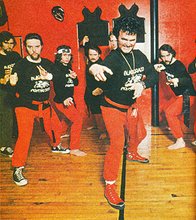
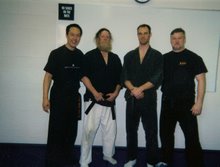
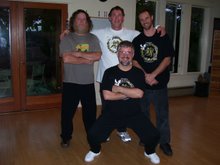
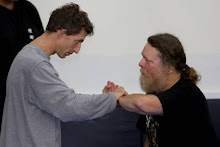
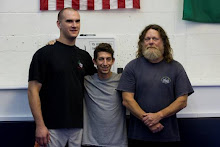
We attended another great seminar with our Tai Chi Chuan instructor Michael Gilman this weekend. In this session we completed the traditional 54-move sword form, but more on that later this week.
After the seminar several of the students gathered at our favorite watering hole, slammed beer and talked about the Chinese Internal Martial Arts. One of our friends came up with this quote from her instructor that was so good I wrote it down:
In Xingyi you wait for the opponent to come to the door, then you kick it in.
In Tai Chi Chuan, you wait for him to come outside, then you steal his key and let yourself in.
In Bagua you ignore the front door and move around the house to go in through a side window or back door...
Well said, well said!
More on the wild night of the "Super moon" and the crazy stuff that happened that night coming soon...
Onisaburo (left) and Morihei Ueshiba (right) shackled in Mongolia
Jonathan Bluestein has started a great thread over at "The Rum-Soaked Fist", speculating that Aikido founder Morihei Ueshiba may have picked up Bagua techniques and incorporated them in his Aikido. As expected this is a hotly contested claim, and one I have also written about in "Is Aikido of Chinese Origin?" While it's obvious that Aikido's roots are in Daito Ryu Aikijitsu, I see a valid explaination for Aikido's softer, more circular movement as strikingly similar to Bagua.
Here's an excerpt from the article I wrote (linked above) with comments by Ellis Amdur:
(Amdur): However, Ueshiba did observe Chinese martial arts. Takeda Hiroshi studied Ruyi Tongbei ch'uan from He Zhenfang in the 1920's and 1930's. Takeda published the first book on Tongbei ch'uan in 1936. Tongbei is a martial system that uses a very flexible upper body and whipping techniques with the arms, as if there is an axle from one shoulder to the other. Although I do not know if this is true in Takeda’s line, some Tongbei ch’uan traditions have staff and/or spear training with fajin practice as part of their system. According to the following website,
www.tongbei.homestead.comHistoryQiShiStyles.html,
"Interestingly, although the content in certain portions of the book are very clear, other parts are very puzzling and strange. Many believe the reason is that Master He did not really want to teach Takeda, and so he diverted the teaching on purpose. There is speculation that this happened because of the political situation between China and Japan at that time." In any event, Takeda stated in an interview in a Japanese martial arts magazine in the late 1980’s, that his home became a center, not only for practitioners of Chinese martial arts, but also for visiting Japanese martial artists, and among them was Ueshiba Morihei, who visited him in 1936. According to Okumura Shigenobu, “Yes, he went to Peking too. He saw various Chinese martial arts. There are good martial arts in China. Ueshiba sensei was impressed by them.” Let me be very clear here. I am not saying that I believe that Ueshiba studied under Takeda Hiroshi - or anybody else in Beijing. But it is possible that, in his visit to Beijing, that he observed such training either by Takeda Hiroshi or by some of his other compadres, and saw something of value that he could "steal." Remember, Ueshiba was the man of whom Sugino Yoshio stated that he could observe something once and see exactly what they were doing. In sum, what I am saying here is that the type of force-building and expression that I am loosely referring to as “fajin,” may have been something that Ueshiba did observe in China and integrate in his own way into his art — either as something new or as a augmentation or variation to what he had already learned."
I just love to watch this guy move. Su Dong Chen was trained in Taiwan by Hung I Hsiang in Taiji, Xingyi and Bagua. since then he has developed his own variations and blends of these arts. Here is a little background on Su from his website "The Essence of Evolution":
“Essence of Evolution” is a research-based approach, specializing in evolutionary developmental processes based on the essence of martial arts and physical movement/exercise. EOE’s founder, Master. Su Dong-Chen, is an eminent authority of martial arts. The Martial Arts Philosophy developed by Master. Su has as its cornerstone the study of physical phenomenon as they actually manifest, a kind of philosophical positivism. This is based upon and tested through actual fighting experience, as well as Master Su’s mastery in his background arts, the Chinese Internal Martial Arts styles Xing Yi Quan, Ba Gua Zhang, and Tai Ji Quan. Mr. Su is also well-versed in Southern and Northern, Shaolin Kung-fu, and the various martial arts and fighting sports of Japan and the West. He has specialized in developing and carrying out experimental proof of technical principles, as well as the research and application of tactical thought. For more information about Mr. Su and his philosophy, please refer to his biography. In looking beyond the boundaries of any style or any school, as a result of unrelenting quest for evolution, and through research of the essence of martial arts, Mr. Su’s martial arts philosophy gradually formulated a uniform system of theory: “Consistent Technique” in defense, striking, and throwing/joint locking; and a comprehensive relationship of the principles “Point, Line, Cross, and Spiral."
His website has lots and lots of information, you can check it out HERE.
This demonstration puts the "art" in "Martial Art".
Here, our local Tai Chi Chuan and Bagua master, T.Y. Pang runs through the eight stepping methods of Sun Xikun lineage Bagua. I studied with one of Mr. Pang's top students, Joel Chung, every Sunday for a year. The foundation of the style comes from Cheng Ting-Hua, a renowned wrestler in his day. Tim Cartmell has told us that in order to seek the applications of Bagua, especially Cheng lineage, is to imagine your body right next to the opponent's body. Within these stepping methods are grappling takedowns, sweeps, arm drags and close striking methods. Seattle internal art instructor Andrew Dale stated in a 1991 issue of the "Pa Kua Chang Newsletter" that:
"Pang's Pa Kua was the most intricate he had ever seen." "Seeing Pang do Pa Kua was like watching a powerful snake coiling, attacking, twisting, darting, spinning and turning."
I know for myself, that Tai Chi Chuan balances my yin and yang most effectively. Xingyi raises my yang energy and is the most direct expression of power. But Bagua provides the most stimulation and has the appeal of whole-body Yoga. This method articulates and opens every joint in the body and is the most physically expressive of all the internal martial arts I have practiced.
Combat brings necessary pain, Art necessarily brings pleasure...
It's a pleasure to see our local Tai Chi Chuan master T.Y. Pang in this demonstration from Amsterdam in 2009. Mr. Pang doesn't teach much anymore, but I visited him at his house a while back and hope to again soon. Pang is among the few living students of Tai Chi master Dong Jinye and Bagua master Sun Xikun. Look how supple his body is, he's well into his seventies. His Yang-style Tai Chi Chuan is what I practice, as taught by his long-time students Jack Greene and Joel Chung. Same with the Bagua, Sun Xikun lineage. I spent a year walking the circle every Sunday with Joel. Mr. Pangs longevity is a testament to the health and physical skill his Taiji and Bagua produce. Here, he begins with the opening of the Yang form, slides into freestyle mode, and finishes with some Bagua. Great stuff...
Well, the guys over at "The Rum-Soaked Fist" sure have a good eye for picking out exceptional masters of the internal arts. This one is on a thread highlighted above. The guy is a Japanese Master practicing Chinese Internal Arts, which is a curiosity. A clip at the forum linked above shows his form movement, clearly exhibiting elements of Taiji, Xingyi and Bagua. This clip is of principles in application. Sure, it's a fairly static attack for this demo, but the Master is good at showing how some movement in the form is actually done in a different way in application. For instance, in bagua we walk in a circle performing a posture or movement. Now, in application you do not attempt to walk around your attacker, it is not possible. Instead, you use the principle in the form that turns the opponent's body. Also note that when he uses the slapping strikes, he is hitting vital or pressure point areas. Downward into the bowels and bladder in front, and coming up into the occipital protuberance or gallbladder 20 on the back of the head. These strikes don't look like a power punch, but they would overload the attackers central nervous system and that last shot to the head would be a knockout. People who practice Chinese Internal Arts will recognize Slant Flying, White Crane Spreads Wings, High Pat On Horse, The Bagua circling or Xingyi angle-stepping as in Pao Chuan. Good stuff! The guys on the RSF forum suggest the Japanese call this "Taikiken".
Well, it was time for "Drinking Dojo Productions" to produce another short video, this one on transitions in combat throws. These are three of the many, many variations of throws we learned from Tim Cartmell at seminars on Bagua, Xingyi and Tai Chi Chuan. These three work very well in a transition, changing strategy as an opponent resists a throw. The first is out of Bagua and is a spiral-type throw. First you move away from the arc of the opponents hook punch and counter at the same time. As you rock him with your simultaneous block/punch, you grab his arm tightly to you, joining centers. In this version I sweep his leg slightly, but you can simply plant the leg and use it as a fulcrum to spin the opponent around and down. The second is a Xingyi-type knock-down. The opponent throws a right cross. You parry that and counter with an arcing palm strike, If the opponent blocks, you step behind him as you entangle his arms. You sit into your Kua (hip inguinal crease) and rotate as you throw. A similar technique is also seen in Tai Chi Chuan "parting wild horses mane". The third Bagua technique is again against a hook punch. This time you pass the arm in a tight arm drag across the opponent's body. This turns his body on it's vertical axis. You then sling your arm in a heavy fashion over the opponent's shoulder/collarbone. This is a "sticky" technique that the Chinese call an "Ox Tongue". Once again you join centers with the opponent and this time spiral him back and down. After you are familiar with each technique, you try to transition between them (or others you know) and flow with your opponent. You fill up the space between you as he moves, and throw accordingly. I didn't want this video to run too long. There are tons of alternate throwing variations, but I think everybody will get the idea.
And here we have Mike Patterson showing some Bagua apps. I never thought of this kind of exercise with a staff that he shows at the beginning, I'll have to give it a try! One thing I see about his applications is he does demonstrate a knowledge of meridian acu-points. People have a misconception that palm or finger strikes to the body don't work. But if you have the correct angle in application, it can be devestating. Perhaps you have experianced this in sparring, where out of the blue an ordinary slap or punch really rocks you and you feel it in your intestines or bladder. Now think about what a well timed, well foucused and well angled hit would do with intent behind it. Granted, it's not easy to get to peoples vulnerable areas like that, but more often they present themself to you, and you have to seize the moment.
Well, this is some of my Bagua practice, Sun Xikun lineage as taught by T.Y.Pang. Video is such a great teacher, it allows us to be our own worst critics. I look stiff and old, but hey, I'm just stiff and old. Here's a comparison from winter 2007:
--So I guess I've made a few improvements. I've got more video coming up, but maybe somebody out there can help me with these questions: It's taking me over three hours to load a six-minute video. I tried for five hours last night to upload an 11-minute video to the Blogger video option. It never loaded. Will YouTube actually upload an 11-minute video, they say 10 is the limit. Any other ideas?
I just love this guys stuff. This video with Kent Howard is strictly Bagua applications, in others he talks about the techniques and methods. Kent is a great example of a teacher that really teaches. I know of some internal art Masters that say "just do it for 30 years, and you'll get it". That might have been the way in China 100 years ago, but not today. I know Tai Chi Chuan students, for example that have never pushed hands or learned a single applicaton. What I am really beginning to understand is that the Chinese Internal Arts work by developing "Shapes". These shapes are postures that show how to express power and stability in it's given form. Rather than being techniques themselves, the "Shapes" are archtypes or blueprints for techniques. This video of Kent demonstrating the "Whirlwind Palm" from the Wang Shujin Bagua system is a great example of translating "Shapes" into techniques, and watching him move helps me really understand my Bagua forms.
Last November I wrote about a visit with our local resident Tai Chi/Bagua Master, T.Y. Pang. For the most part, Mr. Pang is retired from teaching, but his wealth of knowledge is still available. At the time, no video footage of Mr. Pang was available, but I just came across this remarkable example of his Bagua from 1974 while he was living and teaching in Hawaii. Mr. Pang is a direct student of Sun Sikun, one generation removed from the famous Bagua master Cheng Ting-Hua. Pang's teacher, Bagua Master Sun Sikun Lineage: Bagua founder Dong Hai Chuan, to Cheng Ting Hua, to Cheng Yu Long, To Sun Sikun, to T.Y. Pang-- In the December 1991 issue of "The Pa Kua Journal", Seattle-based instructor Andrew Dale stated that "Pang's Pa Kua (Bagua) was the most intricate he has seen... Seeing Pang do Pa Kua was like watching a powerful snake coiling, attacking, twisting, darting, spinning and turning". Pang's stepping patterns are definately the most "Yogic" in nature of all the Bagua patterns I have practiced. The kind of energy release from this movement stimulates the spine as well as every joint in the body. Now of course, my old western-type body cannot come close to replicating Pang's precision movement and supple flexibility, but I come as close as I can. As I mentioned above, I cannot overstate the kind of energy release these movements provide. As far as application, Tim Cartmell has shown us that nearly all Bagua techniques are grappling-related, and while searching for application to imagine that you are in direct body contact with the opponent. With that in mind, you begin to see the siezing, sweeping, arm drags and other techniques. More importantly, the stepping patterns are archetypes of how to deliver power while snaking and coiling around an opponent. I hope people will take the time to watch this spectacular example of a Bagua master in his prime, Pang's demonstration puts the "Art" in Martial Art.
You can take a look at Mr. Pang's website at THIS LINK.
This guy's video's are fast becoming some of my favorite Bagua training information. Here, Instructor Kent Howard uses various sizes of rocks to explore more deeply the types of palm changes in Bagua. In our little Dojo, we have a big, two-handed rock we use like a medicine ball for core strength exercises. In this video, Kent handles the rocks loosely at first, balencing them in the palm to improve whole-body control in the palm change. He later moves to larger rocks that require grip strength to maintain control. So simple a caveman could do it... Here is THE LINK for Kent Howard's new book on Wang Shujin's Bagua system, and here is Kent's website for Nonviolent Self Defense.
Years ago, when the young Ratlet was in High School, I was a wrestler. Every fight ended up with someone on the ground getting pounded. Then came Karate and Tae Kwon Do. Check out those cool chuck Norris-style kicks! Kicking was the rage as I fought for years in TKD tournaments, and I was often outmatched by lanky kickers with longer legs. Then came Kenpo and Boxing drills, which finally brought my hands up to speed. Now, as I approach 50, I once again realize the importance of grappling skills and things are coming full-circle. In this video fight, Black is said to be a Bagua stylist, Yellow a Shuai Jiao wrestler. Now, Black is no slouch. He has a good sense of timing and has pretty good game. But the grappler just waits patiently until Black offers him a leg, and... Slam! Now, imagine if Tae Kwon Do tournaments were conducted like this.
**** Side note: I still am not sold on prolonged ground wrestling in a street fight, it's too risky. But, these type throws with a good stomping, I can go for that...
Leg Trap Once again, I've really been enjoying these video's produced by Bagua instructor Kent Howard. In this first one, he demonstrates leg traps using the T,L, and V steps from the Bagua palm changes. I used the inside trap during a freestyle push-hands match Monday, just to disrupt my partners balence followed with a push. I could have taken him off his feet completely if I chose to, and it reminded me how vital these traps are when you are in close quarters.
And here he demonstrates the counter to the leg trap with a nice little partner drill. Thanks Kent!
Here are some drills for the Bagua single palm change by instructor Kent Howard. The first one I learned years ago in Aikido, and we have been doing it pretty much as Kent presents it. The second drill is nice because of the Fan Jang aspect of the change. All of this guy's videos are well produced and have good information. The style is after master Wang Shujin, the barrel chested dude in the first picture in the video. The style is different than from what I practice in that he (1.) holds his elbows somewhat away from his body and a little higher than I like. I believe that may be because master Wang was so huge he held his arms away from his belly. Naturally, all his students would replicate that position. Jake Burroughs recently commented to me that he saw the same thing in the students of an obese Xingyi master. (2.)In the palm change, but not shown in this video is the high leg raise after the wrap and change of direction. I see the utility in leg sweep applications but is a little to high for me. All this guy's video's are very good however, and we may take a look at a few more later. Also, you might check out the website for Kent Howard's book on Wang Shujin Bagua at this link. - I'm off to a Tai Chi Chuan workshop with my instructor Michael Gilman this weekend, more on that next week.
Well, I survived another two-day seminar on Internal Arts with Tim Cartmell, king of the Combat Throw. Tim is one of the best instructors on body mechanics I have been to, with subtle methods and adjustments that make tossing your 200-pound training partner - well, "effortless". I think this is my third seminar with Tim. Tim demonstrates application of "Peng" with Jake Burroughs The Saturday session focused on the last two animal forms of the Sun-style Bagua system, the Monkey and the Phoenix. The Monkey is a fairly straight-foward neck break technique, while the flowing movements of the Phoenix employed the Fan Jang (overturning palm), wrapping and coiling methods. These of course, led us to a variety of throws as Tim's Bagua instruction is based on grappling techniques. Tim demonstrates Chin Na elbow lock and projection on Terry Day two began with Bagua applied combat theory. This had a lot of work on stepping patterns that allow the fighter to seek a superior position against the opponent, a factor that not only allows use of whole-body power but is the key to making those throws "effortless". These techniques (as well as many others) were off the opponent's jab, cross or hook punch. The final session was an examination of the foundational hand methods (Peng, Fan, Heng) of Tai Chi Chuan, Bagua and Hsing-i. All of these arm structures are similar, but rely on different energies, angles and intended result. Many of the throws we practiced could truely be devestating without a forgiving mat, I can imagine what would happen on concrete or being rammed into an object like a car. Tim is patient and informative with his instruction, and provides the detail that makes these techniques practical when the gap is closed from kicking and punching to grappling. - As always, the seminar was generously hosted by Jake Burroughs. You can reach Jake for information on future master instructors visiting the Seattle Area at his "Three Harmonies Chinese Martial Arts Center", the Website is found HERE. Tim Cartmell's Shen Wu Website is linked HERE.
I had a very nice E-mail from John Bracy the other day, asking me to check out his website "Chiarts.com", at THIS LINK. As you can see in the video above, Bracy is a skilled practitioner and instructor. He also has a new DVD on Internal Power available, and I hope to review it soon. My first introduction to Bracy was through his book "Bagua- Hidden Knowledge In The Taoist Internal Martial Art". I really found this book to be helpful in both historical aspects as well as a good overview of Chinese Internal Arts. From February 2007, here is my review of "Bagua" by John Bracy and Liu Xing-Han: Taoism And The Martial Arts I'd like to suggest anyone interested in the history of martial arts to get a hold of a copy of John Bracy and Liu Xing-Han's book, "Bagua: Hidden Knowledge In The Taoist Internal Martial Art". Books that show technique are great, but the innovation of video has surpassed the book in that area. Books that describe the philosophy, motivation, conflicts, successes and goals of the ancient masters is where we learn the universal truths about our art. This unique book includes both. Bracy describes in this book how the Taoists, mountain recluses with a history dating back to 500 B.C. influenced the Chinese intellectuals in 1800's China, and a new form of art was born. In ancient times, warriors were often unkempt and crude, and looked upon with disdain by the upper class. In early studies, the Taoists were, like other alchemists, in search of the elixer of life. That external search became modified into a view that the human body was a microcosm of the universe, and internal yogic alchemy, or "Nei Tan" was practiced. The elixer of life, and rightly so, was believed to be achieved within ones own body. For many centuries in remote areas Taoists practiced this goal, and began to weave the martial skills necessary for survival in with their yogic health traditions, alchemy and mysticism. It was in the chaotic times approaching 1900 that the intellectuals, generally Confucianist bureaucrats, realized that the "State" could no longer protect them and began to form secret societies and practice the martial arts. The deep analytical systemic thought of the Confucianists blended with the Taoist Yogic martial arts, (after all, why practice a mundane soldiers battlefield art?) and the clans of the upper class began a new level of martial study. It was at this time that the first publications about the internal arts began to emerge. Communism cast a sooty grey pall over the continent for several generations, and in the late 1970's China was again "open for business". Martial arts had been supressed by the authoritarian government, many masters had been killed through the various conflicts, and many of the ancient skills were nearly lost. Bracy suggests in his book that "Although there are some exceptions, a comprehensively trained, true senior master living in mainland China today must have achieved base proficenicy before 1937". In some ways, I believe it may at times be necessary to "re-invent the wheel". In our world today, we have more information available than at any other time in history. Our culture is not restrained any longer by narrow fundementalist thought and people are open to paths of enlightenment and deep introspective research. With these tools in hand, I trust we will keep the old traditions alive and integrate them with new ideas, and our new "wheel" will be better than it ever was. Bracy's book is widely published and available on Amazon.
Books and videos by John Bracy can be found at THIS LINK.
Last week I had the great opportunity to visit with Grandmaster T.Y. Pang. Mr. Pang lives in our area, however he has largely retired from teaching. Pang's martial lineage goes directly to some of the most famous masters of the last century. He trained with Taiji masters Dong Yingjie, Wu Tunan and Bagua master Sun Sikun (also spelled Xikun). Mr. Pang is one of their last surviving students. Pang's teacher, Bagua master Sun Sikun Lineage: Bagua founder Dong Hai Chuan, to Cheng Ting Hua, to Cheng Yu Long, To Sun Sikun, to T.Y. Pang ------ Much of my early Tai Chi Chuan and Bagua practice was with two of Pang's senior students Joel Chung and Jack Greene, and I attended a Chi Kung seminar taught by Mr. Pang many years ago. Pang generously accepted me to visit and discuss his Bagua system, which I had many questions about. Pang had just returned from China, which he said is moving and changing unbelievably fast right now. He said everywhere, everything is mechanized, and people are becoming more like machines. However, we are indeed living beings, and we should strive to feel what is going on in our bodies as we move. His example was picking up a coin: if you quickly toss it away, you can't feel what kind of coin it is. But holding it allows you to examine and feel the coin. It's a simple parable, but one that speaks to me as I approach fifty-years-old. I've done my share of tournament fighting, as well as brick, board and rock breaking. I'm entering a mindset where I want to explore the dynamics of movement, and Taiji and Bagua are the perfect roadmap for that. Another thing I began to understand from our conversation was how each master left their mark on the art by emphasizing their best skills. Much like the differences in the Yang Taiji form between masters, Pang's Bagua has it's roots in the Cheng lineage, but it is somewhat different than other versions of the Cheng style that I have seen and read about. In fact, in the December 1991 issue of "The Pa Kua Journal", Seattle-based instructor Andrew Dale stated that "Pang's Pa Kua (Bagua) was the most intricate he has seen... Seeing Pang do Pa Kua was like watching a powerful snake coiling, attacking, twisting, darting, spinning and turning". -- And that's exactly what it feels like. Meeting and discussing with Mr. Pang again has opened up yet another door of opportunity for me. I now have better understanding of Pang's Bagua system, his lineage and intent, and we discussed the possibility of having him teach another Bagua seminar. If you are interested in reading more about T.Y. Pang, and purchasing his newly released Bagua DVD video, you can check out his website at THIS LINK.
Here is the great Bruce (B.K.) Frantzis showing some Bagua applications. While this particulear video is not the best quality, it will give the viewer an idea of movement and application. This is an example of how similar Aikido is to Bagua, and one reason Uyeshiba may have been inspired to create Aikido after viewing Bagua in China. Here's what Frantzis has to say: "Everything changes. Every moment in time is unique unto itself. Every moment in time carries a shadow of the past and in many ways the future is nothing more than a projection of the past. What happened before is going to happen again, although in exactly what way is hard to predict. The nature of change is that you have to have the capacity for it. Whether you're trying to go from one chi gung movement to the next, from walking the ba gua circle to changing directions, going from one meditative state to another or going from one event in life to another, you must be able to change".
Here's another video from the brothers over at "Black Taoist" and their student Lance "Hispanic Palm" from an apartment deep in the South Bronx. While these guys may at times lack polished perfection, they more than make up for it in street practicality. The internal arts are often esoteric, with instructors coaxing students into "feeling the attacker's energy" and such. What it often boils down to is, in western terms, "muscle memory". As I've suggested before, I am dissapointed with students (and their instructors) that are competent at doing their forms but have no clue how to apply those skills demonstrated in the forms. One high level Tai Chi instructor I know has told myself and other students that; (A)"just do it for many years and you will understand it, and (B) you have to be Chinese to understand it". Another told me "There is no application, it's all circles". Screw that. I realize that the western mind has an overuse of mechanistic analysis, but that's how we "Get'er done". When a student sees application for an obscure technique in a form it re-wires that same technique through the brain in a seperate path to the same end goal. When the end goal is viewed in different ways we all have a deeper understanding of what we are trying to accomplish. With that in mind, aside from my regular Monday-Wednesday workouts with the Dojo Rats, I've been teaching a beginning Yang-style Tai Chi Chuan class on Thursday nights for over a year now. Several of the students (of which there are usually six to eight) have had previous but limited Tai Chi practice. The rest are middle aged adults with no training. The group is diverse and new people drop in all the time, so I have to balence the training so nobody feels left behind. Most of the group has a good handle on the long form now, and as things have progressed I have brought the partner training up to 50% of class time now. For instance, I've been starting each class with the long form, for the calming meditative qualities. Then we go into form correction and problems people are having. The last half of class is push hands. Now they are familiar with the basic rooting and yielding drills and have moved on to the Yang-style push hands pattern. Like a lightbulb going off in their heads, they now see how ward-off,push, press, rollback, rooting and yielding from the form really work. Last class I took it further and demonstrated some joint-locking techniques that can be integrated with push hands training, but they're not quite ready for it yet. The point is, they now have a much better understanding of their form since they have viewed applications, which gives them incentive to go further. That's why I love the guys at Black Taoist; they try to get down to what will work on the street...
A martial artist in transition, beyond youthful angst into middle-mellow; this Rat shares a dojo with similar vermin on an island off the coast of Washington State