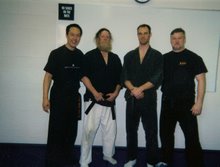
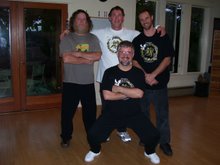
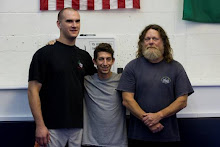
From Left- Jake Burroughs, Me, and Tim Cartmell

MMA Training Group, c/o Terry, thanks

Yesterdays Seminar in Seattle with Tim Cartmell was one of the best I've been to, and my 51 year-old ass held up pretty good. I think the extra conditioning and a preview of Tim's "Ground-proofing" concepts with Jake a couple of weeks ago gave me a heads-up on what to prepare for.
As always, Tim's presentation was brilliant. Tim has experienced the concepts he teaches intellectually, physically, and in highly stressful competitive fighting. Tim knows what will work when the shit hits the fan, and it's no surprise that simpler is better. I've got two pages of notes and had plenty of time to mentally review the seminar on the way home.
As explained, every human will react predictably to given stimulus, like when the hands come up as someone pokes at their eyes. This can be used both ways, in attacking and defending, but let's focus on defense. The key is to take those gross motor skills and morph them into simple and natural reactions that fit a self-defense or fighting concept.
I have to say, this seminar- which was billed as "Intro to Mixed Martial Immersion", made me rethink a lot about how I have been training. That's what a good seminar is supposed to do, and it's sinking into my thick skull.
Tim always keeps his guard in a "boxers triangle" close to his head. He never reaches out to block anything, but rather pats jabs down "monkey paw" style, absorbs hooks against his head with forearms, and blocks body punches with movement and smothering the punches with forearms and elbows, which remain close to the body.
While it may sound like you would take a lot of punishment in this position, it is actually a great protective guard. I asked him if the extended guard of classical styles is still useful in any way, and he said it was just for training. When his master instructors in Taiwan actually fought or sparred, they reverted to this protective position. The idea is, once someone has crossed into punching range, they can work around or knock down an extended guard. The extended guard may work against drunk Rubes, but against anyone that can stand in and throw punches, this is the only guard that will protect you.
Here is where Tim made the distinction between ring fighting and street martial arts. There is no rule set on the street. So when you throw boxing punches, you can not over-rotate and expose your flank, as pro boxers do in the ring at times. You must always remain facing the opponent, so the punches need to be modified.
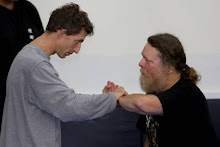
From the feet Tim moves in to the clinch range, where most fights go anyway. He seeks inside control on the bicep lines and then sets up the take down.
In his way of thinking, even a great kick boxer can get knocked out if the fight keeps on going, and he believes the quickest way to end the fight is to slam the opponent on a hard surface.
Sprawling to prevent leg dives, protecting yourself if you are on your back, and the technical rise to your feet were all covered in detail.
Tim, who wrote the book "Effortless Combat Throws", is an expert in high, damaging throws. But what he teaches are mostly off-balancing knock-downs, ankle picks and the occasional hip throw. Most of the take downs are more like tipping over a large cow; if you use simple angles and leverage it is possible to topple something much larger than yourself.
Those of you who read Dojo Rat regularly know I have a deep passion for the traditional Chinese Internal Martial Arts, especially the meditative and health aspects they provide.
But Tim provided a clear summary of the evolution of martial arts as they stand today. While very, very few of us train for ring fighting, we should not ignore new technology that actually makes survival in a violent confrontation possible.
This seminar will give our little Dojo a ton of new material to work on, in stand-up fighting, clinch work, and if all else fails, how to protect ourselves on the ground and safely return to our feet.
Great stuff from a great instructor, special thanks to my friend and Xingyi instructor Jake Burroughs for hosting the seminar.