Showing posts with label Blue Snake Books. Show all posts

Monday, August 9, 2010

Review: Hsing-i; Chinese Mind-Body Boxing


When it comes to martial arts, I am an information junkie. I want to see a wide variety of opinions and techniques to evaluate what I am learning and understand why a particular system developed as it did.
Which is what drives me so crazy about Hsing-i (Xingyi). Reportedly one of the oldest of the Chinese Internal Martial Arts, Hsing-i lacks the spectrum of information available in other martial systems.
So what's a guy to do? We go back to an old favorite.
Robert W. Smith is one of the most famous western authors to have trained with Chinese Masters from the 1950's-1980's.
Smith is an interesting cat. According to his Wikipedia bio, Smith spent many years in an orphanage, joined the Marines at 17 and fought in the Pacific. He later graduated from The University of Washington with a M.A. in Far Eastern Studies. After a brief stint in The Red Cross, Smith signed on with the CIA. Smith served as a liaison to the government of Chiang Kai-Shek which fled to Taiwan when the Communists took over the mainland in 1949. He studied with many Chinese Masters during those years, as described in his book "Chinese Boxing; Masters and Methods".
But I digress; back to "Hsing-i".
Smith's book on Hsing-i is the foundation of knowledge for western practitioners. He provides us with a sound history, along with some of his own profound opinions and statements. From page 22:

"If the motivation in learning the art is primarily to gain skill in boxing, then motivation will impede learning. To learn combatives because of their self-defense value is a confession of weakness, of being being unable to resolve interpersonal problems rationally. But if the internal is viewed, as it should be, as a form of meditation that in time bequeaths boxing skill and other useful values, then progress will be more rapid. For the internal emphases meditation and exercise, out of which the combat technique emerges, but the combative is always under control of the meditative".

Now that's a guy who is seeking a very deep level of martial art. Smith's book details early masters, has a pictorial summary of forms and techniques, and concludes with advice from the masters, in their own words.
If you are interested in Hsing-i (Xingyi) or Chinese boxing in general, this is the book you should start with.
Originally published in 1974, the book is in re-print from North Atlantic Books, and available at the website for Blue Snake Books.

Monday, July 26, 2010

Review: Chinese Martial Arts Training Manuals


Perhaps the single most mysterious endeavour of man is identifying the true history of classical Chinese Martial Arts.
OK, maybe particle physics, gravity and understanding women rate pretty high also.
- But in their book "Chinese Martial Arts Training Manuals - A Historical Survey", Brian Kennedy and Elizabeth Guo have peeled back the veil and peered into the murky legends as well as the actual people and events concerning Chinese Martial Arts.
Kennedy and Guo place significant emphasis on the quality of translation in evaluating ancient training manuals. Interestingly, they suggest some of the most useful and informative resources on the subject come from modern and even (gasp) -Western authors.
Kennedy and Guo painstakingly deconstruct martial myths and piece back together a rational history not only of masters and training manuals, but of the very culture itself. They rely heavily on the few legitimate martial historians of the time, best represented by a man named Tang Hao. Here's an example:

"Tang Hao's commitment to, as he phrased it, "attacking the lineage myths: distinguishing real and fake" is perhaps best demonstrated with his academic work on the origins of Taiji. Regrettably, his myth busting was largely ignored and his calls for a more realistic approach to the historiography of the various Chinese martial arts systems seem to have fallen on deaf ears."

In fact, the authors state that various martial clans plotted to attack Tang Hao, perhaps assassinate him because of his methodology and myth-busting. There is no evidence that ever happened however.
The second part of the book profiles various masters, and the training manuals they produced.
"Chinese Martial Arts Training Manuals" has become a personal favorite of mine. I appreciate the straightforward reporting and the authors opinions.
For people interested in the diversity of Chinese Martial Arts and the history and culture of the time, this is the book for you.

You can find this book and hundreds of other martial arts titles at the website for Blue Snake Books

Monday, May 24, 2010

Review: Chin Na Fa


Chin Na Fa, first published in 1936 is the first modern look at the grappling arts of China. Originally written by Liu Jinsheng and Zhao Jiang, this new edition is translated by martial artist and grappling expert Tim Cartmell.
As Cartmell describes in the preface, "This work represents primary source material of ancient combat techniques designed to restrain, control, injure, or kill an opponent in hand-to-hand combat."
Cartmell goes on to say that the intent of this book is to provide historical documentation for ancient techniques that have been modified for competition and self-defense.

With that in mind, techniques shown in this book will be familiar not only to Chinese martial arts practitioners, but to those who study Judo, Aikido, Jujitsu and similar arts. Perhaps being somewhat Chinese-centric, the author provides us once again with historical evidence that Chinese Grappling arts pre-dated those of Japan:
"During the Ming Dynasty, Chen Yuanbin traveled to Japan and taught the skills of seizing and locking as well as wrestling."
Another startling revelation author Liu Jinsheng provides, referring to traditional Chinese martial arts:

"Those who have practiced these arts twenty or thirty years have never defeated anyone who has practiced Western boxing or Judo. Why is this? It is because the practitioners of Shaolin and Wudang styles only pay attention to the beauty of their forms - they lack practical methods and spirit and have lost the true transmissions of their ancestors. Hence, our martial arts are viewed by outsiders merely as rigorous dancing."

Whew!
That's a pretty strong indictment of traditional arts, coming from a master of those arts.
"Chin Na Fa" was written for the battlefield soldier and policemen. The techniques can indeed cripple or kill.
As I stated earlier, this book is important in it's historical context. There are generally only one or two pictures of each technique, but the text reads clearly and it's easy to follow. There are however, no contemporary names or numbers for the acupressure and vital points, which only have Chinese names in their description. People familiar with the points shown will recognize them by their description.
Grapplers in other methods will also see techniques they practice, some that have interesting entries and counter-techniques. There's lots of tearing, ripping, choking, and even techniques for tying people up with a belt.
While it's not the most comprehensive book I've seen on the subject, it provides an honest historical view of combat arts in the time of trench warfare. Practitioners of Chinese martial arts as well as other grappling arts will find the book useful.

You can find "Chin Na Fa" and hundreds of other martial arts titles at the website for Blue Snake Books, LINKED HERE.

Wednesday, May 12, 2010

Review: The Method Of Chinese Wrestling


In primitive times, unarmed combat was survived in two ways: running or wrestling. Wrestling is the natural way of dealing with an aggressor, perhaps more so than striking which is very specialized.
As legend has it, nearly all Asian martial arts came from India and spread throughout China to neighboring areas. There is much historical information to suggest that Chinese Wrestling is the basis for Japanese Jujitsu, Sumo, Hapkido and related arts-- From Tong Zhongyi:
"Wrestling arts were most popular among the Manchurians and Mongolians. Most of the northern martial artists are skilled at these wrestling arts. During the Ming Dynasty, the Japanese obtained a copy of a book on our comprehensive martial arts. This is the origin of Ju jutsu in Japan"
So begins "The Method of Chinese Wrestling" by Tong Zhongyi, translated by expert grappler and martial artist Tim Cartmell.

Culturally, in Northern China the climate is colder and heavier clothing is worn. This favored the grappling methods and the physically larger body types associated with the Mongols. My Korean Tae Kwon Do Master, the late Tae Hong Choi told me a story of his family traveling to a festival held by the Mongols when he was a very young boy. At night, they entered a large tent to witness this scene: Mongol warriors were wrestling everywhere. There were whole animals being roasted on spits over open fires. One huge Mongol approached young Choi; he was eating an entire leg of a sheep, grease dripping down the front of his chest and clothing...
This is the historical background for the type of wrestling favored by the Chinese, commonly called Shuai Jiao.
"The Method Of Chinese Wrestling" provides us with a fairly comprehensive view of the history, training methods, conditioning and techniques of this art.
For a reproduction of such an old book, the pictures are remarkably clear and the text is simple and readable. Tim Cartmell has done a very good translation, and the forwards by other masters provide context.
One thing that students of other grappling arts may find unique about Chinese Wrestling: they have solo forms, intended to be practiced by the individual. I have not seen other grappling arts use such form work. Additionally, conditioning methods use simple sticks, posts, weighted baskets and large barrels. Modern fitness buffs will be amused yet appreciate the simplicity of such training.
This book may also give Judo players another view of grappling, with variations of techniques such as entangling legs and knock-downs as well as common high throws.
Typically, Chinese Wrestling does not include ground fighting, so consider this strictly a book on takedowns.
From the historical aspect, elements of conditioning and use of techniques, this book will compliment the library of any grappling enthusiast, I enjoyed it quite a bit.

You can find "The Method Of Chinese Wrestling" and hundreds of other martial arts titles at the website for Blue Snake Books.

Wednesday, April 14, 2010

Review: "The Essence And Applications Of Taijiquan"


Yang-style Tai Chi Chuan is the most popular version of Taiji, practiced all over the world. Given the vast numbers of practitioners, it may also be the most popular "martial art" in the world.
With that said, it may also be the most misunderstood martial art in the world. As Tai Chi Chuan rose to it's familiar image as a "new age exercise", it lost the "Chuan", or "fist" within the art.
Countless knock-offs were created as a yogic practice for hipsters or a balance enhancement pattern for senior citizens. Part of the blame must also lie with the Chinese Communist Government, which attempted to standardize Tai Chi practice and made it into a mundane cross-cultural fitness program. The fighting system once known as "Grand Ultimate Fist" was almost lost.
When we want to return to the true roots of Tai Chi Chuan, no one source can deliver the information like the words of Yang Chengfu, the founder of the Yang style as it is meant to be practiced.
Louis Swaim has provided us an excellent translation of Yang Chengfu's "The Essence and Applications of Taijiquan". The book has an introduction by Swaim, followed by forewords by Zheng Manquing, Yang Chengfu, and his son Yang Shouzhong. Each movement in the long form is viewed with a picture of the posture and Yang Chengfu's description of the application and expression of the form. Each posture is also commented on by translator Swaim for clarity.
Following the form presentation, there is a chapter on push hands, the Da-Lu (Great Rollback) two-person form, and the poetic "Taijiquan Classics".
Nothing comes closer to the true intent of Yang Tai Chi Chuan than the words of the Master:

"There is only one school of Taijiquan: there are not two ways of learning. One may not make a show of one's cleverness by rashly making additions or deletions. The former worthies developed these methods. If alterations or corrections could be made, the ancestors preceding me would already have already put them into effect".

I highly recommend "The Essence and Applications of Taijiquan" as a valuable resource for Taiji players, with the actual words of Yang Chengfu to guide them in their practice.

This book and hundreds of other martial arts titles can be found at the website for Blue Snake Books.

Sunday, March 28, 2010

Review: "The Xingyi Boxing Manual"


"When drinking water one should ponder it's source". (Ciu Heqing, in the forward.)

The above quote is a good reflection on this small book about an art cloaked in antiquity and mystery.
"The Xingyi Boxing Manual; Hebei Style's Five Principles and Seven Words" is short and poetic, with plenty of room for "pondering". John Groschwitz has translated Jin Yunting's edited collection of Xingyi "songs" and historical references and biographies.
Xingyi, the hard-hitting cousin of Tai Chi Chuan and Baguazhang is often overlooked because of it's apparent simplicity. Belying that simplicity is a system complex in structure and effective enough to be the core empty hand and weapon art of the Chinese Army.
Xingyi is a "niche" art, and as so "The Xingyi Boxing Manual" is a "niche book" that will apply to practitioners of the art. Don't expect a manual on fighting applications, consider this book as sampling a fine aged tea.
Again, from one of the many forwards, this one by Sheng Jun:

"Aside from the cultivation of virtue and the cultivation of wisdom, I also value the cultivation of the body. There are many paths to cultivation of the body, but if you are seeking one that is simple and suitable for all ages, there is none like Xingyi boxing, because this art specifically takes qi cultivation as it's foundation. Splitting, Smashing, Drilling, Pounding and Crossing correspond to metal, wood, water, fire and earth and divide externally into the five postures. Internally they fill the five organs and are the natural, profound way to health".

"The Xingyi Boxing Manual" is a light, poetic read with profiles of Masters dating back to over 900 years ago. For the Xingyi boxers out there, this book will add to your collection.

This book was provided for review by Blue Snake Books. This title and hundreds of other martial arts titles are available at Blue Snake Books website, LINKED HERE.

Wednesday, March 10, 2010

Review: "The Gift Of Danger; Lessons From Aikido"


There are thousands of older, middle-aged folk out there that take up martial arts training, and Mary Stein is one of them.
In "The Gift Of Danger; Lessons From Aikido" Stein provides a social narrative on gaining confidence, partner interaction, and the path to self-improvement through the martial art of Aikido.
In this passage, she describes "finding a rhythm" with attackers:

"As they come, you can be there for the whole thing- the meeting, turning, and joining, the throw, their descent to the mat, all the way to the end, even if you linger there for only a fraction of a second before preparing for the next attack."

Stein continues on, comparing the action and rhythm on the mat with her struggle to learn Japanese from a audio tape, repeating each phrase, matching the rythym and moving immediately on to the next phrase.
In this way, Stein weaves the lessons from Aikido into her daily life.
"The Gift Of Danger" is inspirational for not only older people who take up martial arts, or women in martial arts, but to students of Aikido in general.
It's a short, sweet read that many may find of interest.

This book was provided for review by Blue Snake Books. You can find this and hundreds of other martial arts titles at their website highlited above.

Sunday, February 21, 2010

Review: "Martial Maneuvers"


"Martial Maneuvers" by Phillip Starr is a useful, yet paradoxical book.
Starr has a deep and varied background in martial arts, beginning in 1956. He opened his first school in 1973, and has developed a style he refers to as Yiliquan.
The subtitle of "Martial Maneuvers" reads "Fighting Principles and Tactics of the Internal Martial Arts". Here-in lies the paradox; this is not your typical Internal Martial Arts book.
Instead, Starr draws on his experiance in Kyokushinkai Karate and has written a book based on the elements of successful one-step sparring.
In fact, I think I only saw one technique familiar to Tai Chi Chuan; "Slant Flying". Admittedly there was more emphasis on footwork that reflects Xingyi and Bagua, but most techniques are right out of conventional one-step sparring that could be found in nearly any Karate system.
With that said, his presentation is thurough, and he does have good drills for this type of application. However, very little emphasis is placed on grappling and takedowns, let alone joint locking or other advanced techniques of the internal arts. Starr instead places his focus on squaring off with an opponent and punching. He does have useful tips on timing and footwork, but unlike the close-range work of Taiji and Bagua, Starrs drills are more representitive of sparring at Karate range.
This book would best serve students who face-off in one-step sparring or point fighting, as his drills apply to timing, footwork and strategy at that range.
It has a folksy smash-mouth presentation, but lacks the finer details of internal martial arts that advanced practitioners may be looking for.

This book was provided to me for review by Blue Snake Books, with this title and hundreds of other martial arts books available at their website at THIS LINK.

Sunday, January 31, 2010

Book Review: "Bagua Linked Palms"


It was with pleasure that I read Kent Howard's short (86 pages) yet concise translation and commentary on Wang Shujin's "Bagua Linked Palms". Martial journalist and writer Dan Miller has written that Kent Howard became one of his most reliable and trusted resources on Bagua Zhang, Chinese Culture, and Chinese language. Howard's treatment of "Bagua Linked Palms" reflects his experiance in all these aspects.

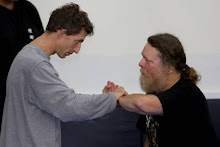
Above: Author Robert W. Smith punches Wang Shujin
Wang Shujin is one of the most interesting old-school masters I have read about lately. Recent enough to have living students and first-hand accounts, Wang still cloaked himself in a mysterious private life. Like many martial artists of the time, Wang fled to Taiwan ahead of Communist advances in mainland China. Kent Howard first unravels some of the myths surrounding Bagua founder Dong Hiquan, and then those that follow the life of Wang Shujin. The primary element of these mysteries appear to be Wang's involvement in a quasi-secret sect called "Yi Guan Dao" or "Way Of One Unity". His membership in this sect may have been the main reason for his fleeing the Communists, as well as his introduction to influential individuals in Taiwan.

Wang Shujin's Bagua Zhang is as authentic as it gets; His master Zhang Zhaodong was a direct student of Dong Haiquan. While I have studied Bagua Sun Xikun lineage, Sun Lu Tang lineage and a little Yin Bagua, Wang's presentation is slightly different but ultimately familiar. Kent Howard provides excellent commentary on Wang's original writing, and unlike some Bagua photo essays, the form is readable and the changes are evident.
Perhaps the most exciting development in Howard's treatment of the system is his upcoming instructional DVD that serves as a companion to the Book. Many of Kent's videos are available on YouTube, and I look foward to the release of his video.
Here's a sample:

Kent Howard has several websites dedicated to the Bagua of Wang Shujin, the first is found HERE , and a website that offers DVD sales and seminar information HERE.
Kent has yet another site that is dedicated to "Nonviolent Self Defense".


"Bagua Linked Palms" offers a historical view of Master Wang Shujin, and an overview of the form. Combined with his upcoming DVD and applications, this book will help inform both seasoned Bagua practitioners and students new to Bagua Zhang.
An interview with Kent Howard can be found HERE.

This book was provided to me for review, is available at the website for "Blue Snake Books", along with many other martial arts titles.

Tuesday, September 8, 2009

Interview With Jess O'Brien, Author Of "Nei Jia Quan"


What would it be like to meet and train with dozens of the top experts in the Chinese Internal Martial Arts? Can you imagine the vast knowledge, the combined years of wisdom and experiance these teachers could transmit to you?
Well, that's exactly what author Jess O'Brien did as he compiled interviews with master instructors of Tai Chi Chuan, Bagua, Xingyi and other related arts.
I've wanted to get my hands on this book for some time now, and I've dog-eared page after page with insights and instruction for future review.
O'Brien visited scores of instructors and whittled his compilation down to 16 interviews that are solid gold for students of the Chinese Martial Arts.
This book is not a "how-to" of technique and application, it is a collection of deep thought and personal experiances of some of the best martial artists of our time. As Chinese Internal Martial Arts are unique, this is a book of self-exploration.
Jess O'Brien was kind enough to describe his journey in writing "Nei Jia Quan", here's a few questions I asked him:

(D.R.): How did you choose the master instructors that you interviewed?
(J.O.): My boss said I could publish anything I wanted. So after I thought about it for a while, I started making a list of everyone I'd ever heard of that would be cool to talk to and train with. I think I had close to 200 names. After that it was a matter of luck and timing as I was on the lookout for visitors to the Bay Area as well as on my own travels. Unfortunately I wasn't able to go to Asia, so it was only people here in the states that I was able to access. Luck was with me and many good teachers either came through or were teaching here. So the book developed quite randomly. I wish I could have done it more systematically with a budget for time and travel, but that was impossible. I did about one interview a month for two years and picked from the best of them. I hope other people will interview their teachers and publish them, because this was just a tiny drop in a huge bucket.
What was really amazing was how open these teachers were to speaking with me. Most interviews were done after a day seminar or class, and often on my first meeting with the person. I was expecting to be turned down often, but virtually all of the teachers in the book were willing to go out of their way to speak with me. Furthermore they all answered honestly and with depth, never did anyone deny any of my questions, even about their own teachers! A number of times their students said to me that they were surprised at how much was said at the interview, as Chinese martial arts teachers are fairly conservative about what they say. Normally they only tell the student what would actually be useful during that stage of their practice. Since I was an outsider they could expound more deeply on the topics I mentioned, not speaking to me as an individual but to the public at large through me.
Many of the discussions I had in the book didn't make much sense to me at the time, but have gradually become more clear as I've trained more. Various things pop out at me and I go, wow why didn't I pick up on this before? Which is cool, I'm as much a reader of the book as anyone else, all I did was copy down what the teachers said, without trying to interpret it beyond editing for clarity.
My intention for the book was to follow on the footsteps of great writing like Pa Kua Chang Journal, RW Smith's books, BK Frantzis's books, and all the others out there that kept inspiring me whenever I got bored in training. Not focusing on the mystique and uniforms, but on the people, the history and the day to day training. PKCJ was especially a ground breaker. Dan didn't use the word master or grandmaster, only people's names, and that made a lot of sense to me. We are past the era of inflated expectations and mystical flying combat nonsense. Chinese martial arts offer very pragmatic and utilitarian training concepts, whether on a physical, mental or energetic level. That's plenty, we don't need to use the word "devastating" any more. We can speak of effective and useful, we don't need to carry the weight of being secret and deadly, that just leads to fear and frustration.
Part of the mystique of Chinese martial arts is this image of a wise, unapproachable master who sits above the crowd. I found the opposite to be true, all of the teachers I spoke with were gracious and friendly and open to questions. They didn't feel threatened at all by my questions. I hope readers of the book will seek them out. They were normal people who had trained to an extraordinary degree. They all emphasized cultivation and hard work, not short cuts or fantasies. However, each had a somewhat different take on the path. Some liked combat sports, some focused on chi, some were TCM oriented, some were fascinated by the intricacies of physical mechanics. Some were oriented toward mindfulness and awareness, some loved to fight in the street, and others gave me very cool lessons in history and culture. Chinese martial arts has all of these things and much more within it. I set out trying to find out how to define internal martial arts, but in the end the definition is much wider than any one person can ever uncover, in my opinion.

(D.R.): There is a wide variety of opinions from the Masters about the cultivation and use of Chi in the Internal Martial Arts. After meeting these Masters, have you formulated your personal thoughts on Chi?
(J.O.): I remain open to all ideas on Chi. Whether it is a substance, or a metaphor, whether it is at the core of IMA, or irrelevant. In Religious Studies we speak of simultanous truths. For Islam to be right doesn't mean Taoism is wrong. A Native American who believes in the Creator doesn't negate a Buddhist who doesn't believe in God. Both are right. I apply this thinking to martial arts as well. Our idea of what works and doesn't, our framework of how we construct our training and interactions contain multitudes of unspoken assumptions. That's how humans work, and trying to scientifically define everything and put it all in its correct place is somewhat futile on a grand scale. We can only pick our favorite worldview and work from it, while keeping an open mind. If it gets results, it works. What you want as a result may be radically different from someone else, however. So for me it's a constant process of allowing new insights to arise and keeping the ones I like.
If I learn a technique that doesn't use Chi, then that's how I practice it. If someone else teaches me something energy based, I follow those instructions to the best of my ability. It all doesn't have to fit together neatly in some unifiied theory of everything. I'm not smart enough to put it all togther. That's why I created this book, I couldn't define Internal Martial Arts, so I asked all these other folks to do it. When you look at the mosaic that their answers form, you can find things that you agree with and things that you don't. But all the teachers in the book are or were effective fighters, so that in itself is a lesson for me. Different paradigms can achieve great results.
All these different paths are to suit different personalities and inclinations, not because one way is better than the others. And I think that goes all the way back to historical Chinese martial arts. There have always been the mystics, the nerds, the soldiers, the bodyguards, the sport fighters, the calligraphers, the farmers, etc. Each one needs a martial art to suit them, and no one art will ever give everyone what they need. Different things inspire different people.

(D.R.): Has the openness of the West truely expanded the knowledge base of Internal Arts, or has something been lost from the age-old traditions and training methods?
And; given the popularity of MMA and grappling training, is there a strong future for the Chinese Internal Martial Arts in America?

(J.O.): Martial arts in the west is certainly an interesting situation. I think the initial appeal of Asian martial arts made a big splash here. It's something we didn't have, the culture of discipleship where a master helps a student forge himself. That's very cool and outside of sport it was hard to find such a situation here. It's part of human nature I think to want to experience such a mentorship. These Asian martial arts had new fighting methods as well, new ways of sparring and competing. They also had ideas about meditation, healing, and developing and training the body in new ways. The emphasis on self-cultivation rather than winning sport matches was also something new that appealed to many of us who were burnt on competitive sports. The focus on longevity and training for life was another new concept in the USA where we watch sports and don't participate as much. So Asian martial arts brought many cool things to the west that we've really come to enjoy. And I think the west is now influencing Asian martial arts with our emphasis on effectiveness in NHB and sport fighting in general. So it's come full circle in that regard. However new circles are being created as our medical and psychological world has become fascinated with the mindfulness and mind training that all Asian arts use as a base, including martial arts.
Working on this book really brought home to me how martial art and sport are two different worlds. As I've ranted on RSF and other message boards for years, they are simply different fruits, you don't get much out of comparing them. For instance, playing the flute and playing football both take time and effort and dedication. But flute is in the ear of the beholder, and football has stats that show who is better or not, clear cut, no BS. Art will always have this undefineable quality, for the creator and for the observer. Sport is great because it has rules and measures to determine quality. If you win the Superbowl, you are the best. If you sell a lot of albums, people may still hate your flute playing. There is no standard that applies across the board.
Many people are frustrated by this, and want to define martial arts in one way or another. Say, if it isn't good in the ring, toss it out and modernize it. However, you risk losing the baby with the bath water. The practices you toss out now, may have benefitted you in some other way down the road. Asian martial arts have many sides to them, sport fighting is one of them. But training the mind is another. Training your nervous system, training your knowledge of yourself, training your ability to heal, to survive. Not all of these things help you in a fight right this minute, but they could save your life in another context.
Nobody does forward rolls in the UFC, yet they've saved lives on the street in accidents. That's just one example. I have learned that martial arts are their own thing, and are not equivalent to sports. I think the term MMA is unfortunate, NHB is much better. Because martial arts is something my grandma or my son could do, and benefit from. NHB, probably not as much, it's emphasis on sport is a world of its own. To excell in sport requires tremendous dedication, resolve and unyeilding desire to win. A good sportsman has a huge high standard to reach if he wants to win a professional match. Whereas martial arts can be forms, meditation, healing or a million different things. It may annoy some people, but martial arts is not just what you want it to be, it is relevant to others in ways that it's not relevant to you.
Of course, martial arts and martial sports cross over. They both fight. And there is much to learn from a good fighter,no matter where he learned it. So this could be a golden age for Chinese martial arts. There are so many great sport fighters out there, we can all safely test ourselves in ways that the previous generation never could. We can win and lose against great practitioners, who are game to fight. Fighting under their rules may be frustrating, but it only makes you better in the long run. Gloves, ropes, pads, points, etc, all these things will limit your technique and help you refine what you have to a huge degree. Chinese martial artists who don't spar widely in this day and age are missing out on tremendous opportunities for growth.
That said, sport is only one aspect of Chinese martial arts. Sparring is a tool, but only one among many. Medicine, meditation are also tools. Forms and conditioning are others. These martial arts have much to teach, if you find the teacher and system that suits you. Some people want to define CMA as one thing or another, but again, from all the interviews I did, I'd never presume to speak for a tradition so vast and deep. There is much we in the West don't know about Chinese martial arts, so the time is premature for anything but hypothesis. A hundred years from now we will know more, and our understanding of it will be refined. Who knows what it will end up being at that point.
On the topic of fighting, one thing I noticed in the people I met was that the oldest guys who had fought in wars and seen people killed in battle and in gang fights all disliked sparring. To them it was like ping pong, a waste of time when training your body and mind is more important. I take their advice quite seriously. However, as a suburban dude from modern Northern California, I've never been in a fight in my life. So I must use sparring as a tool to learn about courage, how to take a punch, how to attack someone who is defending strongly. I've never had to fight for real, so I use play fighting as a way to get something of that adrenaline surge. However, being realistic, the people who I met that did fight for high stakes told me that there is utterly no comparison between a sport fight and a fight where your life is in danger. I'll take their word for it, and if I'm lucky I'll never have to find out if they are right about that.

My last word is to reiterate that Chinese martial arts are in their infancy here in the West. From hints I got in my interviews, there is much underlying these arts that we haven't yet been exposed to or understand. We may well reject these cultural underpinings or change them to suit us as westerners. But before we do that we will need decades of travel, translation, investigation and testing to begin to comprehend the depth of the well that these arts are drawn from. Chinese martial arts are a product of Chinese culture, and the way they look at these arts is not the same as how most of us do. There is vast diversity in the way they are trained and understood, so again, I feel that we need to continue to take them at face value and train them as directed. Over the next few decades many new insights will come to light and we'll have a much clearer idea of the whole tapestry that makes up Chinese martial arts, rather than the incomplete threads we've seen so far. Of course I could be wrong about this too, but I'd rather be conservative and work slowly than presume too much and miss the boat on some of the amazing aspects of this stuff that may not be apparent in the short term. There's a lot of good stuff in these arts, so it's an art I'll always be learning more from.

Thanks so much to Jess O'Brien,

You can find "Nei Jia Quan" and hundreds of other martial arts titles at the website for BLUE SNAKE BOOKS

Monday, July 13, 2009

Review: The Complete Taiji Dao


Now here is a book that arrived on my desk at exactly the right time!
"The Complete Taiji Dao - The Art of the Chinese Saber" by Zhang Yun is the most complete book on swordsmanship that I have seen yet. At a hefty 429 pages, this comprehensive study of the Chinese Saber is my new study material as I prepare to go to a weekend-long Wudang saber seminar with our Taiji instructor Michael Gilman.
While I have had training in the Japanese sword in Aikido, the Chinese sword is still new to me. Unlike the "Jian", the more delicate double-edged sword most often seen in Taiji practice, the Dao or saber is a large single-edged blade handled with powerful slashing motions.
In "The Complete Dao", Zhang Yun provides us with his background, and then procedes to explore the history of this weapon from crude jade and bronze models to the beautiful "Yao Dao", or slender waistcoat swords of the Royalty. As implied, there are many types of Dao, from heavy chopping cleavers to longer and narrower Dao's such as the ones used in Taiji practice. Zhang Yun explains this type allows him to more readily project his Chi to the end of the sabre, and is more nimble. Most Dao's are used single-handed, but Yun also demonstrates with a beautiful double-handed model with a ring pommel. (I want one!)
Zhang Yun provides very clear photos of all form work in the book, something that is usually difficult to read and put into practice. As the saber and spear were both the soldier's battlefield weapons, the applications from the form are against an opponent with a spear. Further in the book, the application work against both a heavier chopping broadsword and the slender "Jian" sword are demonstrated.
For me, this book arrived at a time when my interest in learning the Chinese sword is really growing. The book explains in great detail how Taiji principles are extended to weapon use as well as how the Taiji Dao is unique and different than conventional broadsword use. This book will stay with my collection forever.

You can read more about "The Complete Dao" at this link for Blue Snake Books, along with hundreds of other martial arts titles, please check it out!

Sunday, May 24, 2009

Review: Aikido - Exercises For Teaching And Training


Now here is a nice little training book for Aikido students, instructors, or anybody practicing "Internal" martial arts.
"Aikido Exercises for Teaching and Training" by C.M. Shifflett is not a picture book of complex techniques, it's a concept book of the type I look for. This book is out in a revised edition, I own the original as well and can appreciate the additions that have been included in the new version.
As an instructional manual for beginning students, the book outlines what Aikido is as far as a martial art, what to expect in training, and integrating Aikido in daily life.
For Aikido instructors, this book has lots of ideas for teaching, improvising training tools, and unique ways to explain concepts to students.
The revised edition has included more information on the pathways of Ki (Chi) through the Fascia tissues that connect all parts of the body. This appears to be a new understanding of meridian/energy theory that is recognized in a variety of recent books on Chi, such as "Wellspring", which I have reviewed HERE.
"Aikido Exercises for Teaching and Training" also includes more details on muscle/skeletal injuries, releasing tensions and general physical information.
The book not only contains valuable training information, but is clever and humorous. I especially like the quotes from famous martial artists, philosophers, and authors - these are great nuggets of wisdom and fit very well with the format.
Aikido instructors would benefit from recommending this to students as part of class training information, it's not only instructional, but an enjoyable read.

"Aikido Exercises for Teaching and Training" can be found at this link for Blue Snake Books, along with hundreds of other martial arts titles.

Thursday, March 5, 2009

Review: "Chi Gong" By Paul Dong and A. Esser


This review has been a long time coming, because I wanted to read this book carefully and understand the concepts and various investigations explored by the authors.
In this book, Paul Dong and Aristide Esser have come the closest to explaining the phenomenon of "Chi" that I have read yet. As Martial Artists, we are all familiar with the notion of "chi". However, not suprisingly the mysterious concept is avoided or even mocked by some, especially reality-based and fight-sport practitioners. Coincedently, those practitioners tend to be young, in very good condition and without concern for integrating meditative health practice into the fight-sport they participate in.
With this in mind, Dong and Esser explore the roots of Chi Gong (Chi enhancement) from ancient shamanism and the early theories of Chinese medicine. I found it very interesting that they fault the rise of Communism for supression of aspects of this study. For instance, for political reasons Chi research was rolled into Psychic (ESP) research. While this marginalized aspects of Chi research, it increased the pool of researchers in general. The authors do not shy away from discussion of "Empty force" (aka no-touch knockouts etc.) and openly suggest that nearly anyone that practices Chi Gong regularly will increase their psychic ability.
The good thing about this book is that it's focus is on the science of Chi research, and not heavy on the multitude of postures and training methods available. The authors present just a few simple techniques, such as the "standing stake/pole" practice, some visualization, but it is not overloaded with postures.
Instead, this book offers comparitive Chinese and western studies, including those reviewed by skeptical researchers. Modern testing equipment has been used to record the bioenergetic forces in the human body, such as infrared radiation, electromagnetic and static discharges, etc.
Yet there are certain things that remain unexplained. For instance, if Chi healing is psychosomatic or self induced, why does it also work on animals, which have no such human thinking process?
Dong and Esser go into detail about healing success with Chi Gong. They do admit there may be an element of self-hypnosis involved, but none-the-less, measurable changes in body chemistry (endocrine system, blood oxygen levels etc.) are apparent.
Perhaps the most interesting aspect of this study is the finding that transmission of Chi may involve "transfer of information", which may explain claims of enhanced psychic ability. A study of Chi by the Chinese Academy of Sciences concluded with this:
"It appears to us that qi (chi) is a much more complicated matter than we originally supposed it to be. Qi is probably a complicated organic combination of substance, energy and message. At present, substance, energy and message are studied seperately in science. Scientists are very unfamiliar both in theory and in experiments with what conditions will occur when these three produce effects at the same time".
And this from another group of researchers:
"We believe it is possible to conclude from all these findings that chi as a substance/force/messenger could well be hypothesized to exert it's function via the autonomous nervous system and the release of neuropeptides, following the meridian system or the previously mentioned psychosomatic network".
For skeptics, Dong and Esser's "Chi Gong" will provide food for thought with explanations in western medical terms. For those who already subscribe to the concept of Chi and Chi Gong healing, this book will offer clear and uplifting examples of how one's health, mental state and life in general can be improved by the practice of Chi Gong.
This book, and hundreds of other martial art-related titles can be found at this link for BLUE SNAKE BOOKS.

Monday, February 16, 2009

Review: "The Xingyi Quan Of The Chinese Army"


Now here's a book that may interest students of Xingyi (Hsing-i), Chinese military history, or just guys that like to play with rifles with fixed bayonets.
Xingyi Quan of the Chinese Army is authored by Dennis Rovere, with translation assistance by his wife Chow Hon Huen. Rovere was the first civilian to train with the Bodyguard Instructors' Unit of the Chinese Special Military Police. This overview of Chinese Military tactics and training are based on the 1928 publication by Huang Bo Nein's "Xingyi Fist and Weapon Instruction". This text, primaraly an instructors manual, became the manual for training soldiers at The Chinese Central Military Academy. This was at a time when hand-to-hand combat was quickly being replaced by combat with firearms. Rovere's Xingyi translates the original text, and offers contemporary explanation sand photos that suppliment those from the 1928 text.
Rovere's book offers a basic explanation of Xingyi's 'Five Element Theory", with the simple yet effective fighting methods. Those familiar with military training methods realize that there is a short window of training time for soldiers. They must be taught basic, large body motions that can be applied in a variety of conditions, wearing heavy clothing and packing gear.
As it is, the book shows the fist forms and fighting applications, but the second half of the book is designed for military enthusiasts with instructions on basic rifle/bayonet and sabre combat. On that note, I found the evolution of the Chinese combat sword interesting; it seems that the Chinese military sabre of the era looks very much like the Japanese Katana sword. Someone more knowledgable than me may have an opinion of that sword development.
"The Xingyi Quan of the Chinese Army" is somewhat of a "niche" book, of special intrest to practitioners of Xingyi for historical reasons, or for military enthusiasts.
Check out this book, and hundreds of other martial art titles at this link for Blue Snake Books!

Sunday, November 30, 2008

Review: "Black Belt Karate"


For me, browsing through "Black Belt Karate" by Chris Thompson was somehow familiar and comforting - like coming home to the smell of fresh baked bread on a winter day.
In these days of Mixed Martial Arts and exotic forms of all varieties, Chris Thompson has provided a no-nonsense overview of traditional Japanese Karate. Thompson, 8th Dan Black Belt and Chairman of the British Traditional Karate Association, covers the history and development of Karate from it's Chinese and Okinawan roots. He outlines the various contemporary Japanese styles currently in the WKF (World Karate Federation).
I have to say, the high production quality of "Black Belt Karate" is probably the best of any martial arts book I have seen recently. The large color photos are beautifully captured, and the layout of techniques and forms are easy to follow. This book would serve other authors well as an example of how to produce a readable, attractive presentation.
Thompson goes on to illustrate self-defense techniques, the rules of traditional point sparring, and how to judge in tournament competition.
As I stated above, it's heartening in these times of anything-goes martial arts to see a welcome example of pure, traditional Karate.
I would recommend "Black Belt Karate" as an inspiration to a beginning traditional Karate student, and it may be of real value in the libraries of schools and universities that have traditional Karate in their physical education programs.
You can find "Black Belt Karate" and hundreds of other martial arts titles at the link for BLUE SNAKE BOOKS.

Friday, October 3, 2008

Book Review: "Me, Chi, And Bruce Lee"


In 1963, writer George Plimpton, on a lark I presume, signed on for training camp with The Detroit Lions football team. A skinny thirty-six year-old, he totally sucked. He did however get some playing time, and got to hang out with the players, coaches and groupies. The result was his famous book "Paper Lion", which detailed his experiance in ways most football fans could only imagine.
Fast-foward to the present, we meet Brian Preston. Preston is an unasuming, polite "everyman", living on Vancouver Island, Canada. He has a taste for good Beer, and is most famous for his previous book "Pot Planet - Adventures In Global Marijuana Culture". Preston is definately a guy I'd like to have a Beer with.
After experiancing frustration with getting his views published in some venues, Preston's book publisher talks him into doing a book on Martial Arts, something Preston is unprepared and generally unsuited for. From there, we follow this self-described "cerebral, haphazard, unfailingly harmless pacifist" as he begins his "hero's journey" into the world of Martial Arts.
If anything, Preston's self-deprecating sense of humor really stands out, as he experiances a panic attack while being pinned by a sixty year-old grandma at Sifu Bob's Kung Fu school. Again as his ribs get broken when he meets Royce Gracie at a snowbound Canadian Jujitsu seminar. In China, he trains at Shaolin and during a bout of food poisening, he is preoccupied with worrying about shitting his white Kung Fu training pants. Preston is the consummate "hanger-oner" who always comes up with a good idea or solution. We experiance his disappointment at the blatant State-Capitalism that drives Shaolin under a new era of Communist/Capitalist rule. We relate to the training limitations of his middle-aged body.
But mostly, we benefit from Preston's personal experiances with people like the stoic Royce Gracie, historical expert Jarek Szymanski of the website ChinaFromInside.com , and of course, radical leftist-Christian-anarchist UFC fighter Jeff Monson.
Brian Preston compiles a thoughtful catalog of martial readings and colorful experiances from snowbound Canada to Wudang Mountain, from Shaolin to Las Vegas.
Through all this, our ungainly hero finally finds a martial style that suits him, one that he hopes to continue for the rest of his life.
"Me, Chi, and Bruce Lee" is a rollicking fun book, a great read that both takes us around the world and allows us to explore our own inner martial journey.
-Please check out this book, and hundreds of other Martial Arts titles at "Blue Snake Books", their website is available at THIS LINK... Check it out!