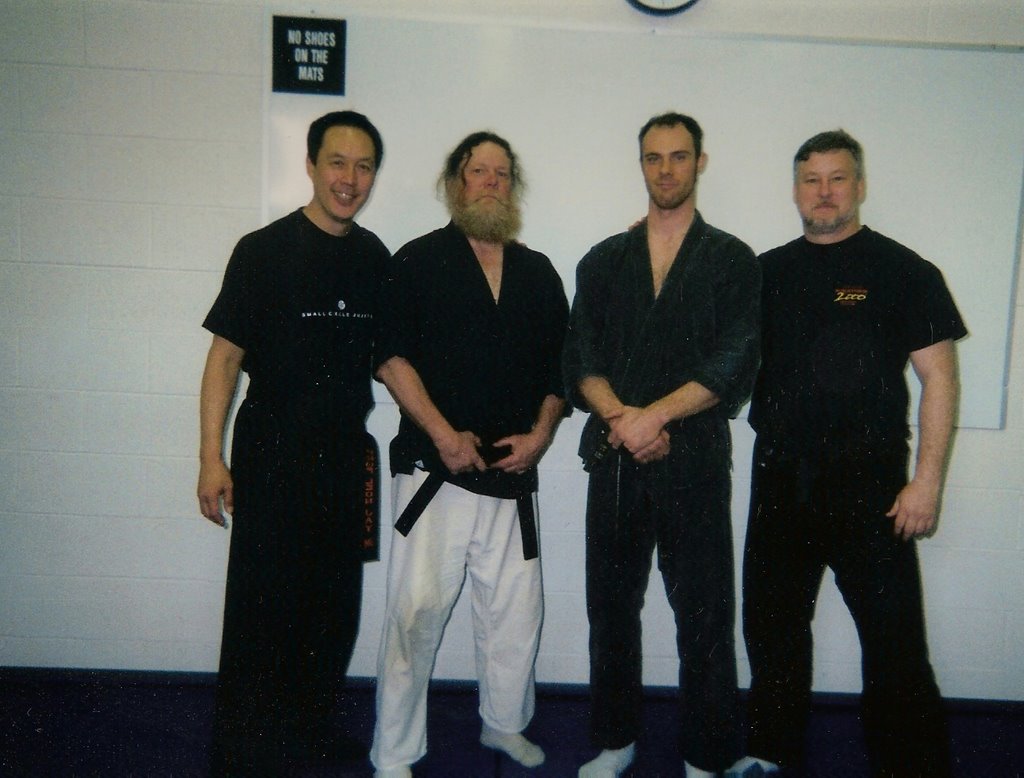
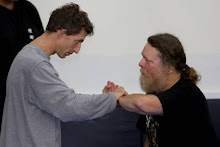
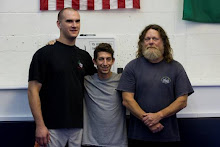
Jujitsu Master Leon Jay (left) The Dojo Rat "Away Team" (center) and Dojo owner Stan Miller (right), At a Seminar in Portland
There are two schools of modern Jujitsu: Brazilian Jujitsu (BJJ), which rose to cult status ten years ago, and there is "Small-Circle Jujitsu" (SCJJ). Of course, this is just my interpetation, but here goes: BJJ is great on a one-to-one fight when you have plenty of time and you're not going to get run over in a parking lot or have someone stick a knife in your back while you are rolling on the ground.
Jujitsu has evolved from a Samurai kill-or-be-killed art to a sport, the same sad legacy of modern Tae Kwon Do. After World War Two, G.I.'s and Marines were returning from service with a new and devestating combat art (jujitsu) which was generally practiced as modern Judo. The art has always employed throwing and locking techniques, although at a somewhat less sophisticated level than Aiki-jitsu and Aikido. Brazil, which had it's own "Wild West" culture, had a lot of Japanese immigrants, and "Vale Tudo" (anything goes) emerged as Brazilian challenge fights. The peak culminated with Mixed-Martial Arts, and most matches are won in submissions on the ground, crappy for streetfighting.
Ah!, you say, so tell us somthing new...
Enter Wally Jay, a tall Chinese-Hawaiian with powerful Judo skills. Wally Jay is responsible for refining jujitsu techniques to the most sophisticated level I have seen, and they have since found their way into every joint-locking system around. Wally Jay's jujitsu, and that of his son Leon, Ed Melaugh, Ron Ogi and others is not a roll-on-the-ground and choke art, it is STAND-UP FIGHTING. Through his innovation of the "small-circle technique", which rotates locks on the shortest possible axis, and other methods such as "thumb-wrist entry", Wally Jay created a stand-up jujitsu that allowed for repeated joint-locking flows, strikes, sweeps and throws.
The Jays are absolute masters at fingerlocking, and lead huge Black Belts around in complete agony. Moreover, they have developed methods for snatching fingers, wrists and neck chokes that most systems had never used.
The next level of development came when the Jay's began working with George Dillman of Ryukyu Kenpo, known for it's pressure-point knockouts. The two systems meshed prefectly, with the motto "Lock to strike, strike to lock" emerging. Further enhancement arrived with Ron Ogi. Ogi is the inheritor of James DeMile's system, DeMile being Bruce Lee's top student. Ogi, and subsequently Ed Melaugh added DeMile's Wing Chun striking and a modern hybrid art was born. Professor Remy Presas of Fillipino stickfighting fame influenced the system by adding flow drills, which allow the practitioner to move smoothly from lock-to-lock-to-strike-to-lock, etc. You have to see it to believe it. Jujitsu locking and takedowns, Ryukyu Kenpo pressure-point striking, Wing Chun centerline concepts, and Fillipino-based flow drills to practice safely. It's one hell of a hybrid system.
Up here at the Rat's nest, Shima Dojo, this is what we practice on the "hard arts" side. Myself and a couple of the other guys are also heavy into Tai Chi. That may not seem compatable, but it is. The Tai Chi smoothes everything out and helps keep it one continous flow. As I said in a previous post, I'm working on uploading some video of our flow drills, hopefully soon.