Showing posts with label Robert W. Smith. Show all posts

Monday, August 9, 2010

Review: Hsing-i; Chinese Mind-Body Boxing


When it comes to martial arts, I am an information junkie. I want to see a wide variety of opinions and techniques to evaluate what I am learning and understand why a particular system developed as it did.
Which is what drives me so crazy about Hsing-i (Xingyi). Reportedly one of the oldest of the Chinese Internal Martial Arts, Hsing-i lacks the spectrum of information available in other martial systems.
So what's a guy to do? We go back to an old favorite.
Robert W. Smith is one of the most famous western authors to have trained with Chinese Masters from the 1950's-1980's.
Smith is an interesting cat. According to his Wikipedia bio, Smith spent many years in an orphanage, joined the Marines at 17 and fought in the Pacific. He later graduated from The University of Washington with a M.A. in Far Eastern Studies. After a brief stint in The Red Cross, Smith signed on with the CIA. Smith served as a liaison to the government of Chiang Kai-Shek which fled to Taiwan when the Communists took over the mainland in 1949. He studied with many Chinese Masters during those years, as described in his book "Chinese Boxing; Masters and Methods".
But I digress; back to "Hsing-i".
Smith's book on Hsing-i is the foundation of knowledge for western practitioners. He provides us with a sound history, along with some of his own profound opinions and statements. From page 22:

"If the motivation in learning the art is primarily to gain skill in boxing, then motivation will impede learning. To learn combatives because of their self-defense value is a confession of weakness, of being being unable to resolve interpersonal problems rationally. But if the internal is viewed, as it should be, as a form of meditation that in time bequeaths boxing skill and other useful values, then progress will be more rapid. For the internal emphases meditation and exercise, out of which the combat technique emerges, but the combative is always under control of the meditative".

Now that's a guy who is seeking a very deep level of martial art. Smith's book details early masters, has a pictorial summary of forms and techniques, and concludes with advice from the masters, in their own words.
If you are interested in Hsing-i (Xingyi) or Chinese boxing in general, this is the book you should start with.
Originally published in 1974, the book is in re-print from North Atlantic Books, and available at the website for Blue Snake Books.

Tuesday, June 29, 2010

The Chatter In The Modern Urban Mind


In the last post we read a quote from Robert W. Smith on the use of the mind in Internal Martial Arts. So everybody is on the same page, here's the quote again:

"A system based solely on body mechanics remains forever at the level of calisthenics and rudimentary fighting. Functionally, such a system is limited by the fact that in the animal world man is something of a weak creature.
Except by recourse to his brain, he cannot stand physically with most of the other animals.
But the brain itself needs to be checked and trained. The trouble with urban cultures throughout the world is that man's brain is out of control. The internal imposes the restraint that, paradoxically, leads to freedom. The mind is king -remember this- and must be accorded priority over the body."

Our skeptical friend at Martial Development saw an inherent contradiction in this statement:

"The trouble with urban cultures throughout the world is that man's brain is out of control."

"The mind is king and must be accorded priority over the body."

(M.D.) "Are these contradictory statements? If not, why? And what does it mean for the mind to be accorded priority over the body?"

The disconnect was leaving out the brief sentence between those two themes:
"The internal imposes restraint that, paradoxically, leads to freedom."
In my opinion, Smith is making not one but two statements. The first is that the urban mind is on overload from stimulation. The second is that quieting the chatter in the mind is healthier, and is both a necessary product and component of the Chinese Internal Martial Arts.

Back in 1980 my friends and I built a shack in the deep coast range mountains out of Coos Bay Oregon. My friends grandparents had homesteaded the last private farm 26 miles up the Coos River. In the summer you could drive a truck across a shallow ford in the river, in the winter you pulled yourself across in a cable car high above the flood waters. Then we hiked in another two miles to where we built the shack.
Here's what I mean about the chatter in the urban mind:
We noticed that it took a full week for our minds, our bodies, our beings to settle into life in the forest. We were hunting and gathering food, there was constant danger of injury, being charged by elk, drowning, and a brush with Bigfoot.
We became like the animals. We smelled like the animals. We felt the heat in the summer and the driving rain in the winter. We didn't see a television for six months at a time.
Every now-and-then we'd take the truck to the University of Oregon in Eugene where we visited the girls and restocked our pot supplies. As we entered the city we'd literally feel the electrical energy. Power lines, noise, Yuppie assholes.
Before, our minds had been quiet and open to absorb every bit of information you need to live and hunt in the woods. What we felt is that as we entered the city we had to put up a mental wall, to shield us from the overload of stimulation. Most people go through their entire life in that condition and know nothing different. Later, when we returned to our shack in the woods it took another few days to decompress.
*****
This is what Smith is talking about.
Short of living like Thoreau at Walden Pond, we can quiet our minds with introspective, internal martial arts. We can live in the moment, setting aside concerns of past and future. Smith is talking about training the mind in this way to free it:
Yi (mind intent) leads Chi (energy), resulting in Jing (action).
In this context, Smith is correct and the trained mind is "king".

Monday, June 28, 2010

Robert W. Smith On Internal Martial Arts


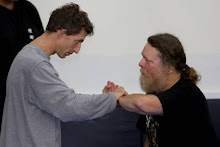
Robert W. Smith Punching Wang Shujin

From page 22, "Hsing-I, Chinese Mind-Body Boxing":

"A system based solely on body mechanics remains forever at the level of calisthenics and rudimentary fighting. Functionally, such a system is limited by the fact that in the animal world man is something of a weak creature.
Except by recourse to his brain, he cannot stand physically with most of the other animals.
But the brain itself needs to be checked and trained. The trouble with urban cultures throughout the world is that man's brain is out of control. The internal imposes the restraint that, paradoxically, leads to freedom. The mind is king -remember this- and must be accorded priority over the body."