Showing posts with label Xingyi. Show all posts

Monday, May 7, 2012

The Difference Between Xingyi, Tai Chi and Bagua


We attended another great seminar with our Tai Chi Chuan instructor Michael Gilman this weekend. In this session we completed the traditional 54-move sword form, but more on that later this week.

After the seminar several of the students gathered at our favorite watering hole, slammed beer and talked about the Chinese Internal Martial Arts. One of our friends came up with this quote from her instructor that was so good I wrote it down:

In Xingyi you wait for the opponent to come to the door, then you kick it in.

In Tai Chi Chuan, you wait for him to come outside, then you steal his key and let yourself in.

In Bagua you ignore the front door and move around the house to go in through a side window or back door...

Well said, well said!

More on the wild night of the "Super moon" and the crazy stuff that happened that night coming soon...

Wednesday, August 3, 2011

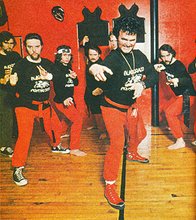
Bad Kung Fu Series #1: Tim Tackett Hsing-i Kung Fu


Here at Dojo Rat, we've had a chance to post reviews of some very high quality martial arts books. Most of the ones that don't quite rate I have avoided reviewing out of respect for the author and publisher.
But that's changing.
Sometimes you pick up a martial arts book and it leaves you scratching your head and going "huh"?
So I'm going to go ahead and review a few books which I will put under the "Bad Kung Fu" banner, regardless of what type of martial art it is.
Today we look at Tim Tackett's 1982 book "Hsing-i Kung Fu, Volume 2: Combat".

To begin with, it's pretty hard to find any literature about the traditional Chinese art of Hsing-i (Xingyi), so I was pretty excited to find this at a used book store. Because it is obviously out of print, I have not gotten a copy of volume one yet.

Tackett trained in Taiwan from '62-'65 and went on to train with Dan Inosanto in Bruce Lee's Jeet Kune Do method. That's important, because one of the main problems with this book is is not Hsing-i (Xingyi) at all.
None of the nomenclature of the traditional art, the stances, the Five Elements or animal forms are shown.
Most of the postures resemble bad Wing Chun stances and techniques. By that I mean weak, high center-of-gravity stances that are anything but Hsing-i. The punching has that typical off-balence rear-foot tip-toe front leg weighted off-line punching that looks like a grappler could just shove the guy over.
This is a great disservice to what I know off all the Chinese internal arts, let alone Hsing-i.
To his credit, Tackett attributes these modified stances and techniques to his instructor Chen Mei Shou:

"From the basic, formal positions, he encourages whatever modifications that assisted the hand movements and added speed and power to their delivery. Such modifications included transferring the weight to the lead foot to assist the forward motion of a strike, angling the body for better power and accuracy and pivoting one or both feet to "launch" the hands".

To which I say; fine, then the book should have been called "Wing Chun".

But, even a blind pig can find an acorn. I still found the book interesting if somewhat confusing. I suppose in 1982 Tackett was becoming enthused with Jeet Kune Do and wove such details into an art he had been practicing for some twenty years.
Despite being a sad disappointment to traditional practitioners, the book retains value as a period piece in the era of evolving American martial arts.
I'll probably look around to see if I can find a used copy of volume one to see how he presents the basics.

By the way, Tim is still around, giving seminars and working with small groups in California.

Saturday, May 28, 2011

Beautiful, Soft Xingyi


I have talked to other Tai Chi Chuan people who are both awed by the power of Xingyi and at the same time skeptical that it is an "Internal" martial art.
So often it is performed in a very aggressive "Kenpo" kind of way that people loose sight of the eb and flow and generally meditative beauty of the art.
I'm not sure of the lineage of this form, but I absolutely love it. This is more how my instructor teaches us to move. The problem with those who immediately try to access the power within Xingyi is that they can't feel the subtle "internal" aspects. Tai Chi Chuan forces us to recognize this. But because Xingyi is (As Tim Cartmell tells us) "mass in motion", the subtleties are overlooked by people trying to harness the power.
I just love this form.

Sunday, April 24, 2011

Su Dong Chen: Entering Method


Here's a nice way of setting up what Tai Chi Chuan calls "parting wild horses mane".
Su Dong Chen has a very eclectic version of Internal Martial Arts, and this looks a lot like some of the entries Tim Cartmell teaches also.
The problem many Tai Chi guys have is being nearly completely immobile. I think it comes from too much fixed step (stationary) push hands, where opponents stay rooted and try to off balance each other.
I recently had some e-mails from "Bob", who asked how to neutralize gut punches from his son while they are doing some light sparring. Bob does Yang Tai Chi Chuan and push hands.
I encouraged him to bring his extended guard in closer as the opponent closes, to slip and cover rather than reach out to parry when the opponent is in hitting range.
This is non-traditional for an art like Tai Chi Chuan, but we gotta' use what works.
The second bit of advice relates to what I mentioned above: Don't get stuck in a root. Move evasively and root when you hit.
Likewise, as Su Dong Chen demonstrates above, "Call to get a response" - that is open with a hand attack to get the desired response from your attacker.
The projection Chen does on the student is actually more like the Xingyi "Rooster announces the dawn", where "parting wild horses mane" rotates the opponent over your lead leg/thigh. The entry principle is the same.
It is also like "Slant Flying", but I believe slant flying usually has your arm above the opponent's arm rather than below.

Wednesday, April 6, 2011

Form Review


Ah, form review;

My training partners and I live in a isolated rural community. We draw on decades of shared martial arts experience and all have pretty solid backgrounds.
But when we seek new information it requires traveling to other instructors and seminars, often for days at a time.
You gotta' understand; I usually drive my pick-up about ten minutes through farm and forest to various job sites. I never get above third gear.
So Monday when I headed for the mean streets of Seattle to meet with my Xingyi instructor Jake Burroughs, I had to navigate a crowded highway on the rainiest day of the year. At one point I had semi-trucks on each side pressure-washing my truck to the point where I couldn't even see the road in front at 65 mph. I don't know how you fuckers that live in the city deal with that shit every day. It was probably the single-most dangerous thing I have experienced since I almost pulled the Maple tree over onto me with my tractor a month ago.
--------
Forms are a big part of my current fitness program, and I am addicted to the Xingyi forms I am learning right now. But I have noticed how they tend to morph into slightly different versions than they start out at. There's a couple of reasons for this. The first is that because we live in the country and only see our instructors occasionally, we develop bad habits or tend to import other similar techniques into the existing form. Sometimes we find things that actually improve the form, but that also changes it.
Other times the instructor changes an element of the form to something he finds better. This has happened repeatedly with the long 2-person fighting form our Tai Chi Chuan instructor has trained us in, and it's usually for the better.
So on Monday, I had quite a few corrections to my form as Jake patiently watched my movement and asked what the hell I was doing. I had realized that something I had learned in one of the animal forms was carried over into one of my basic 5-Element forms, and it wasn't quite right.
Now, to a beginning student this would probably be frustrating, but I completely realized what was going on.
Xingyi is at first glance a somewhat mundane style that does not get flashy until you learn some of the animal forms. The 5-Elements train vectors - vertical, horizontal, crossing, etc.
When I started learning Xingyi to complete the trinity with Tai Chi Chuan and Bagua, Jake said Xingyi was the easiest Chinese Internal art to learn, but possibly the hardest to master.
Xingyi, like the other arts mentioned requires perfect body structure to bring out the magic of the art. The seemingly simple postures exhibit frighteningly powerful whole-body movement. This requires building a foundation that is much more powerful than what is found in hard-style arts like Karate. It also requires seeking very tight, well targeted angles to disrupt the motion of the opponent. In this respect, it is similar to the vectors and energies in Tai Chi push hands. Very subtle yet effective infighting techniques are employed.
I just love when you think you know something and it is re-introduced to you in a fresh new way, only to get better.
We finished my lesson by starting on a short two-person Xingyi form called "Wu Hua Pao" or "Five Flower Cannon". It's a simple form, yet considering the subtleties described above it's going to take some time to get it right.
-----------
So for all you old Dojo Rats out there, don't get stuck in a "one art" rut. If you are an instructor, find some fresh meat to chew on. Pick a companion art, round out your striking and grappling game. Look at your art differently in the light of learning something new and see how your overall program improves. kind of like a "martial makeover", or falling in love all over again.

Thursday, February 10, 2011

Chang Tung Sheng: Yang Style Tai Chi Chuan


I ran across this video again and looked at it in a new light; this is how a true fighter interprets Yang-style Tai Chi Chuan.
Chang Tung Sheng is one of the most famous of Chinese Shuai Jiao wrestlers. It is said he was never defeated in challenge matches.

No silk pajamas.
No fancy stylistic flair.
Pure efficient movement.


Here's from Chang's Wiki bio:
"Nicknamed the "Iron Butterfly," Chang would go on to win numerous challenge matches before entering China's armed services - traveling across the Kuomintang controlled areas of China to seek out other shuai jiao practitioners in order to test his skills. He may also have first started learning xingyi in this period.
He taught as the youngest faculty member in the Nanjing Central Kuoshu Institute (中央國術館) and exchanged knowledge with other martial arts experts. He created his own variation of Tai Chi and xingyi, Chang Tai Chi, based on Yang style tai chi chuan, xingyi and his shuai jiao knowledge.
Throughout the Second Sino-Japanese War and World War II, of which China became a part, Chang instructed large numbers of Chinese Nationalist troops in Shuai Chiao (including the elite Red Wall paratroopers), while continuing to fend of numerous challenges. When not otherwise occupied, Chang visited several POW camps to test his Shuai Chiao against Japanese practitioners of judo, jujutsu and karate."


A couple of observations:
He moves through the form at about twice the speed that other masters do. That may be for the filming time length, or he may normally do it at this speed. This dispels the myth that Yang-style Tai Chi Chuan must be practiced at excruciatingly slow speed.
In the end, he demonstrates "Snake creeps down" in a relatively high posture with a bend in his lead knee. I read somewhere that he saw dangerous flaws in the traditional low ground sweeping method with the knee locked straight.

As far as martial tradition, Chang's method is similar to my studies: a wrestler who went on to train in Yang Tai Chi Chuan and Xingyi, a pretty formidable mix of traditional Chinese Martial Arts.

Sunday, December 19, 2010

Su Dong Chen Mixes It Up


I just love to watch this guy move.
Su Dong Chen was trained in Taiwan by Hung I Hsiang in Taiji, Xingyi and Bagua. since then he has developed his own variations and blends of these arts.
Here is a little background on Su from his website "The Essence of Evolution":

“Essence of Evolution” is a research-based approach, specializing in evolutionary developmental processes based on the essence of martial arts and physical movement/exercise. EOE’s founder, Master. Su Dong-Chen, is an eminent authority of martial arts.
The Martial Arts Philosophy developed by Master. Su has as its cornerstone the study of physical phenomenon as they actually manifest, a kind of philosophical positivism. This is based upon and tested through actual fighting experience, as well as Master Su’s mastery in his background arts, the Chinese Internal Martial Arts styles Xing Yi Quan, Ba Gua Zhang, and Tai Ji Quan. Mr. Su is also well-versed in Southern and Northern, Shaolin Kung-fu, and the various martial arts and fighting sports of Japan and the West. He has specialized in developing and carrying out experimental proof of technical principles, as well as the research and application of tactical thought. For more information about Mr. Su and his philosophy, please refer to his biography.
In looking beyond the boundaries of any style or any school, as a result of unrelenting quest for evolution, and through research of the essence of martial arts, Mr. Su’s martial arts philosophy gradually formulated a uniform system of theory: “Consistent Technique” in defense, striking, and throwing/joint locking; and a comprehensive relationship of the principles “Point, Line, Cross, and Spiral."


His website has lots and lots of information, you can check it out HERE.

Tuesday, October 5, 2010

XingyiMax: Xingyi to the Max

Xingyi Crossing Fist


We were at our Dojo last night discussing our training, and I had a revelation.
One style of martial art, or movement, informs others you may be studying.
There are only so many ways to move the human body, and similar martial arts have certain nuance's that allow for a greater understanding of the whole.

So it was with great interest that I found the website "XingyiMax". Despite being the most aggressive and powerful of the Chinese Internal Martial Arts, there is less information about this art, compared to Tai Chi Chuan for example.
XingyiMax is run by "Dennis", who lives in Malaysia and has studied martial arts in Australia, New Zealand, Malaysia and China. It's full of lengthy videos and historical information on the art and it's masters.

The video above is of Dennis' instructor demonstrating "Crossing Fist", one of the most misunderstood of the Five-Element forms. Look at his connection to the ground, the structure and power he is able to discharge. Great instruction on a difficult subject.

Xingyi (Hsing-i) has become an important study for me to round out my Yang-style Taiji and Bagua, and as I said, one art "informs" the other. The apparent simplicity of Xingyi belies the power and effectiveness of this art, and I am certainly addicted to it now!
If you study Chinese Martial Arts, XingyiMax will be a great resource. Check it out at THIS LINK.

Tuesday, September 7, 2010

Combining Taiji, Xingyi and Bagua


Well, the guys over at "The Rum-Soaked Fist" sure have a good eye for picking out exceptional masters of the internal arts. This one is on a thread highlighted above.
The guy is a Japanese Master practicing Chinese Internal Arts, which is a curiosity.
A clip at the forum linked above shows his form movement, clearly exhibiting elements of Taiji, Xingyi and Bagua. This clip is of principles in application. Sure, it's a fairly static attack for this demo, but the Master is good at showing how some movement in the form is actually done in a different way in application.
For instance, in bagua we walk in a circle performing a posture or movement. Now, in application you do not attempt to walk around your attacker, it is not possible. Instead, you use the principle in the form that turns the opponent's body. Also note that when he uses the slapping strikes, he is hitting vital or pressure point areas. Downward into the bowels and bladder in front, and coming up into the occipital protuberance or gallbladder 20 on the back of the head. These strikes don't look like a power punch, but they would overload the attackers central nervous system and that last shot to the head would be a knockout.
People who practice Chinese Internal Arts will recognize Slant Flying, White Crane Spreads Wings, High Pat On Horse, The Bagua circling or Xingyi angle-stepping as in Pao Chuan.
Good stuff! The guys on the RSF forum suggest the Japanese call this "Taikiken".

Monday, August 30, 2010

Breath Integration And Martial Movement


Last week I was working with one of the young Dojo Rats, going over some forms.
As I watched and made suggestions, I tried to see what he was missing but couldn't quite put my finger on it. Then, as I read this passage from Robert W. Smith's "Hsing-I, Chinese Mind-Body Boxing" It dawned on me- he lacked proper breath integration.
Robert W. Smith quoting Master Sung Shih-Jung (page 99):

"The Taoists have sedentary breathing exercises. In Hsing-i, hand and foot actions are coordinated with the breathing. Every actions follows a discipline, so we never get confused; that is, the movements are coordinated with the breathing so that boxing becomes like sedentary work. You should pay great attention to the breathing. Back and Forth, up and down, the air moves in a cycle with full regulation of breathing. In sedentary work, we try to settle down from action, but in boxing we move from inaction to action. Both of them reach the same goal: full calmness, full regulation of breathing, and full coordination of the body."

Sung is referring to the meditative regulation of seated or standing breathing as practiced (in this case) by Taoists. Sung states:

"(Hsing-i) is a martial art because its functions show how to fight another person. As a Taoist exercise, it is used to prolong life."

The chart at the top gives a pretty good example of the Yin and Yang of breathing and how it applies to shooting a firearm. In that case, the breath is briefly held to fire an accurate shot. If we tweak the chart a bit, the Yang or outward expression of power would coordinate with the exhale. There would be no holding of the breath in martial expression.
The beauty of Sung's quote on breathing is that the same technique used to damage an opponent is the same technique that can prolong ones life.
-- My advice to my young training partner was to exaggerate his breathing in very deep inhales and exhales, along with large martial movements. In time, these will become more subtle yet more efficient.

Tuesday, August 24, 2010

Foundation, Structure and Mobility

Let's examine this guy's stance:


Ahh, look; those nice old ladies just wanted to get a cool picture practicing Tai Chi in front of The Leaning Tower of Pisa and some big Goof pulls some Karate on them!
Even a structure as strong as The Leaning Tower of Pisa can have faults in it's foundation that may eventually bring it down. The old ladies are in a transition between movements in the picture, and they appear to be armchair martial artists, so I'll give them a break.
But let's look at the stance of the Karate guy.
This is definitely "old school". His lead fist is held palm up, it appears with extended knuckle (phoenix-eye fist). His rear hand is slightly forward and not in deep chamber, that is fine but it is held pretty high.
While he has more weight on the lead leg I would consider this a "double-weighted" stance. It is also extremely wide, preventing mobility. In order to move quickly, he must shift completely to one leg or the other. This is the kind of stance where you can basically only stand there and trade punches. It is so deep I think he might have trouble firing off a front kick with either leg, and his knee looks like a perfect target for a stomp or arcing round kick.
San Ti Stance From Xingyi

The above stance is also very old-school, but observe the difference in mobility. It is not as wide, the rear leg is slightly bent and spring-loaded. The practitioner can take a load into the root of the stance as well as discharge power back; borrowing the opponent's energy. The rear hand is ready to protect against a groin kick.
Yang Chen-Fu in "Raise Hands"

And here's another good stance for mobility, from the Yang-style Tai Chi Chuan system. Hands are held relatively high, lead leg ready to kick, very mobile.
- My preference is somewhere between the second two stances. In the Xingyi San Ti I can take a load in push-hands as well as move and hit. If the opponent closes I can cover with the "boxers triangle" or "shaving" type neutralization.
Good stuff, it works for me.

Thursday, August 19, 2010

More Proof Meditation Builds And Re-Wires The Brain


From Agence France-Presse, via "Raw Story":

A Chinese-influenced meditation technique appears to help the brain regulate behavior after as little as 11 hours of practice, according to a study released Monday.

Researchers at the University of Oregon and Dalian University of Technology charted the effects of integrative body-mind training (IBMT), a technique adapted in the 1990s from traditional Chinese medicine and practiced by thousands in China.

The research to be published in the upcoming issue of the Proceedings of the National Academy of Sciences involved 45 test subjects, about half of whom received IBMT, while a control group received relaxation training.

Imaging tests showed a greater number of connections in the anterior cingulate -- the part of the brain which regulates emotion and behavior -- among those who practiced meditation compared to subjects in the control group.

"The importance of our findings relates to the ability to make structural changes in a brain network related to self-regulation," said The University of Oregon's Michael Posner, a lead author on the study.

*Story continues at link highlighted above.*

And consider this, from "The Aquarian Conspiracy", by Marilyn Ferguson:

(Page 168) "Meditation, reverie, relaxation and other associated psychotechnologies tend to increase the slower, larger brainwaves known as alpha and theta. Inward attention in other words, generates a larger fluctuation in the brain. In altered states of consciousness, fluctuations may reach a critical level, large enough to provoke the shift into a higher level of organization.
-Larger fluctuations of energy cannot be contained in the old structure. They set off ripples throughout the system, creating sudden new connections."

This is a great example of why the internal martial arts offer a truly unique way to combine self-defense with meditation, something I never felt in Tae Kwon Do or Kenpo. I clearly feel and perceive these things differently in Tai Chi Chuan and Xingyi.

Tuesday, August 17, 2010

Combat Throw Transitions


Well, it was time for "Drinking Dojo Productions" to produce another short video, this one on transitions in combat throws.
These are three of the many, many variations of throws we learned from Tim Cartmell at seminars on Bagua, Xingyi and Tai Chi Chuan. These three work very well in a transition, changing strategy as an opponent resists a throw.
The first is out of Bagua and is a spiral-type throw. First you move away from the arc of the opponents hook punch and counter at the same time. As you rock him with your simultaneous block/punch, you grab his arm tightly to you, joining centers. In this version I sweep his leg slightly, but you can simply plant the leg and use it as a fulcrum to spin the opponent around and down.
The second is a Xingyi-type knock-down. The opponent throws a right cross. You parry that and counter with an arcing palm strike, If the opponent blocks, you step behind him as you entangle his arms. You sit into your Kua (hip inguinal crease) and rotate as you throw. A similar technique is also seen in Tai Chi Chuan "parting wild horses mane".
The third Bagua technique is again against a hook punch. This time you pass the arm in a tight arm drag across the opponent's body. This turns his body on it's vertical axis. You then sling your arm in a heavy fashion over the opponent's shoulder/collarbone. This is a "sticky" technique that the Chinese call an "Ox Tongue". Once again you join centers with the opponent and this time spiral him back and down.
After you are familiar with each technique, you try to transition between them (or others you know) and flow with your opponent. You fill up the space between you as he moves, and throw accordingly.
I didn't want this video to run too long. There are tons of alternate throwing variations, but I think everybody will get the idea.

Monday, August 9, 2010

Review: Hsing-i; Chinese Mind-Body Boxing


When it comes to martial arts, I am an information junkie. I want to see a wide variety of opinions and techniques to evaluate what I am learning and understand why a particular system developed as it did.
Which is what drives me so crazy about Hsing-i (Xingyi). Reportedly one of the oldest of the Chinese Internal Martial Arts, Hsing-i lacks the spectrum of information available in other martial systems.
So what's a guy to do? We go back to an old favorite.
Robert W. Smith is one of the most famous western authors to have trained with Chinese Masters from the 1950's-1980's.
Smith is an interesting cat. According to his Wikipedia bio, Smith spent many years in an orphanage, joined the Marines at 17 and fought in the Pacific. He later graduated from The University of Washington with a M.A. in Far Eastern Studies. After a brief stint in The Red Cross, Smith signed on with the CIA. Smith served as a liaison to the government of Chiang Kai-Shek which fled to Taiwan when the Communists took over the mainland in 1949. He studied with many Chinese Masters during those years, as described in his book "Chinese Boxing; Masters and Methods".
But I digress; back to "Hsing-i".
Smith's book on Hsing-i is the foundation of knowledge for western practitioners. He provides us with a sound history, along with some of his own profound opinions and statements. From page 22:

"If the motivation in learning the art is primarily to gain skill in boxing, then motivation will impede learning. To learn combatives because of their self-defense value is a confession of weakness, of being being unable to resolve interpersonal problems rationally. But if the internal is viewed, as it should be, as a form of meditation that in time bequeaths boxing skill and other useful values, then progress will be more rapid. For the internal emphases meditation and exercise, out of which the combat technique emerges, but the combative is always under control of the meditative".

Now that's a guy who is seeking a very deep level of martial art. Smith's book details early masters, has a pictorial summary of forms and techniques, and concludes with advice from the masters, in their own words.
If you are interested in Hsing-i (Xingyi) or Chinese boxing in general, this is the book you should start with.
Originally published in 1974, the book is in re-print from North Atlantic Books, and available at the website for Blue Snake Books.

Tuesday, July 20, 2010

Martial Addiction


Old Guy Xingyi

Hi, my name is D.R.
-(Hi D.R.!)
I'm addicted to Xingyi.
That's why I entered the 12-Animal, 5-Element form program.
I know I've had bad habits.
But I can get better every day in every way.

It started when I had my first taste of Tai Chi Chuan.
Sure, all the cool guys were doing Karate, I tried it and used it for years.
I was a glutton for punishment.
I often found myself on the floor.
I had injuries I couldn't explain.
I thought I could get by just using Karate.

But I had never tried the Chinese stuff.
A guy offered me a little Tai Chi Chuan.
He said I already used Karate, and I wouldn't get hooked.
And that's when I got in deep.
There was so much resource material, and I wanted to sample all the varieties.
I tried Bagua, and found my life spinning in circles.
Finally, I got in with a group of guys in the city. They were messing around with Xingyi.
I thought; "Hey, all the guys are doing it".
And before I knew it, I was chasing the Xingyi Dragon and had the Xingyi Monkey on my back.
I often find myself really drawing inward and doing some Xingyi all alone.
I mainly use it for maintenance now, but every so-often I really cut loose with friends.

So, I'm here to discuss my addiction, and hear the stories of other martial addicts-
And seek serenity in the Martial Arts...

Monday, June 28, 2010

Robert W. Smith On Internal Martial Arts


Robert W. Smith Punching Wang Shujin

From page 22, "Hsing-I, Chinese Mind-Body Boxing":

"A system based solely on body mechanics remains forever at the level of calisthenics and rudimentary fighting. Functionally, such a system is limited by the fact that in the animal world man is something of a weak creature.
Except by recourse to his brain, he cannot stand physically with most of the other animals.
But the brain itself needs to be checked and trained. The trouble with urban cultures throughout the world is that man's brain is out of control. The internal imposes the restraint that, paradoxically, leads to freedom. The mind is king -remember this- and must be accorded priority over the body."

Monday, May 10, 2010

Mike Garafolo's Xingyi Resource Page


I was browsing through Mike Garafolo's Blog "Cloud Hands: Mind/Body Movement Arts" earlier today.
Mike has collected hundreds and hundreds of resource links for various Chinese Internal Martial Arts. While there is generally tons of information on Tai Chi Chuan (so many people practice it) it's harder to find stuff on Bagua and good stuff on Xingyi (Hsing-i) is really sparse.
The Tai Chi stuff is obvious. But I wonder about Bagua. There seems to be more stuff available on Bagua, beginning to rival Tai Chi. It must be the mysterious ways of Bagua, the spiraling animal forms and grappling applications. But Bagua is undoubtedly much harder to learn and apply in combat.
That leaves poor Xingyi, the red-headed stepchild of Chinese Internal Arts in third place for information distribution. Xingyi is hands-down the easiest art to apply for the time spent training. It is the only CIMA to have actually been taught to be used on the battlefield. This is why I am so amazed that there is so little published in English about the art.
Fortunately Mike Garafolo has spent a great deal of time collecting links to Xingyi schools, books, video's and links to articles. I intend to review it thoroughly.

The link for the "Cloud Hands" Blog is HERE

And here's the link for the Xingyi resource page

Thursday, April 22, 2010

"On Guard" Stance: Raise Hands vs. San Ti


Yang Chengfu in "Raise Hands"

Back in February we took a long look at the "On Guard" stance in Tai Chi Chuan. In that post, various instructors gave their opinions on what position or "Stance" gives the best pre-attack protection for students of Tai Chi Chuan.
Opinions varied, but "Raise Hands" or some variation of that posture was suggested the most.
Here's where we can see a difference in "Intent" between Tai Chi Chuan and Xingyi. Looking at the picture of Yang Chengfu above, we see that his stance in "Raise Hands" is back-weighted, front leg "empty" and ready to kick if necessary. The arms are held high, as if to join with the attack and neutralize.
Now let's take a look at the "San Ti" stance from Xingyi (also Pi Chuan, or "splitting fist"):

Note that the weight distribution is more forward, with the back leg spring-loaded and ready to drive the body into the opponent; to "occupy" his space. The front hand is held fairly high to check an incoming punch, the rear hand held at the Dantien to protect the center and groin.
In my opinion, I think these two stances reflect the "Intent" of the two arts. Tai Chi Chuan is more likely to respond to the attacker, attempt to neutralize and control the opponent.
The Xingyi San Ti appears to be ready to punch the other guys lights out.
Now, both these arts are still using internal principles and Xingyi does attempt to neutralize, but Xingyi is more likely to hit first. Just my opinion...

Xingyi Bear Form:


Coming soon:
Thoughts from myself and Chris Dow, author of "The Wellspring" on elements of "Martial Shapes", and just what makes internal arts different than hard-style arts.

Tuesday, February 23, 2010

Great Xingyi Article And Site


Thanks to "Man Of The West" for writing in with this suggestion for a great Xingyi page. The instructor is Dan Djurdjevic, an "inner circle" student of the son of Chen Pan-Ling. Dan's writing on his understanding of the Five Elements in the Xingyi system is very detailed and the video above shows his interpretation of the interplay between the elements. There are a few other videos with other masters as well as Dan doing a solo version of the techniques in the video above.
Good stuff, I'm bookmarking his site, which is linked HERE.