The guys over at "The Rum Soaked Fist" have been bantering back-and-forth about their experience with 2-person Taiji San Shou forms, and since I got some skin in the game I'll post our form again at the end.
First from Steve Rowe's school; a very smooth version. However, there is less lateral or circular movement, tactilely very light, resulting in a few obvious openings- but I like the intent and smoothness:
Next, two guys in a park in China doing the form. Note the very large frame as opposed to Steve's video. This too results in the form becoming too dance-like for actual combat techniques to emerge, but this is the best pace and distance to learn the form in. It can be aesthetically very pleasing to both the performer and viewer.
Here is a version by Paul Brecher's students.
It is done so fast it starts to resemble Wing Chun or other styles, but this is the best for actually learning to use the techniques in a fight. The speed forces the players to use less yielding movement, the hallmark of good Tai Chi Chuan. The result is a lot of jamming and less leading the opponent into the abyss. I like the energy and intent though, and it can be a good workout at this speed.
And here is our version, some of you have seen it before. This was when we first learned it about three years ago and it's a little short on intent as we struggle through the form. The lineage is from Jou Tsung Hwa to our teacher Michael Gilman to us.
Clearly, this form does not teach students how to fight. But what it does is take all the techniques from Yang style Tai Chi Chuan and let the student experiment with attack and defense in a cooperative pattern.
You can check out other versions of the form and the rancorous comments at "The Rum Soaked Fist"
Showing posts with label Tai Chi Chuan 88-movement fighting form. Show all posts
Showing posts with label Tai Chi Chuan 88-movement fighting form. Show all posts
Sunday, February 13, 2011


Sunday, January 16, 2011
Form Review at the Gilman Studio

Last weekend we went to visit and train with Michael Gilman, our Tai Chi Chuan instructor. For several sessions, we have been reviewing the 2-man 88-movement San Shou fighting form. This form takes nearly all the techniques from the Yang-style long form and pairs them up like pieces in a puzzle. The form is the most complex I have learned, with 44 movements for each side - and you have to learn both sides.
Here's us doing the form when we first were learning it, about three years ago:
It's fun to look back on this video, as we attempt to smooth it out and get the moves right. I think it took us three cuts to get it without mistakes. Still, our postures and intent are lacking and we have made many improvements with time.

We always have a great time with Michael. He's a truly great instructor, a push-hands champion who has worked with other famous masters. In fact, the San Shou form was taught to him by the late Jou Tsung Hwa. The form is very rare, seldom taught, and difficult to learn. But within it are arm breaks, pressure-point strikes and takedowns. Michael has thought through this form for many years, and has tweaked it here and there with improvements and alternative methods of application. I think one of the benefits of reviewing a form that we are already familiar with is in observing Michael's teaching method. Following a good teacher's methodology also allows us to teach others better.
Now, this form will certainly not transform the average Tai Chi Chuan student into a serious fighter. What it does however, is show how the often mysterious solo form techniques work in application. There is a strong emphasis on blending and continual motion, the quintessence of good Tai Chi Chuan.
It's probably time to film a new video so we can compare our current level of training to the stumble-bum video we shot several years back.
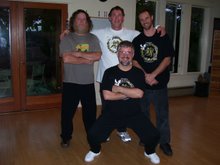
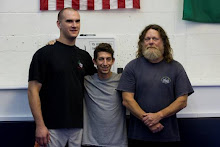
Goofing off after class

Here's a link to Michael Gilman's website, and "The Gilman Studio" in Port Townsend, Wa.
Tuesday, July 15, 2008
Tai Chi Chuan Fighting Form: A Work In Progress
Recent Practice
Previous Practice
This last weekend I went to train with my instructor Michael Gilman, the focus was on the 88-movement fighting form. Michael always goes into great detail and the form evolves in efficiant and dynamic ways. It was also a great three-hour workout. Later, back at the Dojo we made another video, this time with a different partner who is learning the form from us. This is the most difficult form I have ever tried to learn, and it is very difficult to teach. Each partner has 44 movements and you have to learn both sides - 88 movements.
In these videos, done over a year apart, I am doing the "B" side in both so I can compare more carefully. It's a different partner, and everybody moves differently and has a different body type and energy.
In the recent version, we are doing the form slightly faster. The faster you go the less deep, pendulum-type movement is possible. Things shorten up and are not as clean. When you do this at top speed, it is incredibly aerobic and you can get pretty winded after doing both sides back-to-back - (we just show one side in these versions).
Looking at both versions, I see we have quite a lot to work on. When the form is performed at this speed or even slower, we have to try harder to have deeper movement, in "Parting wild horses mane" for example. A little closer and more accurate contact. Each technique should be clearly apparent, where some of our moves here tend to blur together. I'm sure my instructor will have lots of criticizm, but to be fair, the partner in the recent version has only learned the form from us, not from our instructor.
All-in-all, I still feel pretty good about where we are at on this form, there is still much work to do, but we're on the right path.
-- On a side note; My instructor Michael Gilman learned this form years ago at a retreat camp on the Island where we live. The teacher was none other than Jou Tsung Hwa, a world-famous Taiji instructor. The years rolled by, and my friend and I started training with Michael, eventually learning this fighting form. Now the form has come full-circle, back to the island and is being kept alive here by our current practice.
That really makes me feel connected to a long lineage of great Tai Chi Chuan, and this form is truely an example of the "Art" in "Martial Art".
Subscribe to:
Posts (Atom)