Showing posts with label Olympic Sport Tae Kwon Do. Show all posts

Sunday, May 15, 2011

Alex Gillis; "A Killing Art"


I am sometimes late to the party, but when I get there I drink my share.
Which is why I am thrilled to review "A Killing Art", by Alex Gillis. This book, which was written in 2008 somehow escaped me until one of my Tae Kwon Do instructors from the past sent me a copy.
And boy did I drink my share; this book is not your typical background of Tae Kwon Do as a contemporary martial art. It is a historical account of The struggle of oppressed Korea, both North and South.
It is the story of the men who fought hand-to-hand in trench warfare against Communist soldiers and returned to refine the Shotokan Karate learned under Japanese rule to a uniquely Korean art that would aid the development of the emerging South Korean industrial tiger. The book is part history, part espionage, and the gradual emerging of western thought in a country that was steeped in stoic Confucian values of the past.
Author Gillis has poured over 4,000 pages of the U.S. Congressional investigation known as "Koreagate", conducted countless interviews and footnoted every reference in the book for further review. This book was researched in the best of journalistic methods and may be the most comprehensive book on the subject.
"A Killing Art" centers on the struggle between rivals to create Tae Kwon Do from the trench warfare era to present time. General Choi Hong-hi was instrumental in molding Korea's martial art from Japanese Shotokan, through the phase where nine separate schools (Tang Soo Do, Chung Do Kwan, Ji Do Kwan etc.), all of which had Japanese or Chinese influence became "Tae Kwon Do", or "foot-fist way".
General Choi, hardened by the war, favored a realistic fighting system and created the International Tae Kwon Do Association (ITF). Choi's art retained killing techniques, but began to be out shadowed by the emerging sport version favored by Korean Secret Service official Kim Un-yong. Here begins the internal war between the original battlefield martial art and Olympic sport Tae Kwon Do under the World Tae Kwon Do association (WTF).
Under treaties between the U.S. and South Korea, money for development flowed into South Korea in the 1960's, and Korea sent 300,000 trained soldiers to aid the U.S. and South Vietnamese in the Vietnam war. Likewise, thousands of U.S. servicemen were trained in using Tae Kwon Do in hand-to-hand combat. Tae Kwon Do became intrinsically linked to war and espionage, with thugs and gangsters enjoying it's use also.
Author Gillis describes how scandals developed involving the Korean CIA, shakedowns and kidnappings in Europe, The U.S. and elsewhere that led to misery and torture under the hands of Korean dictatorships. Gillis himself interviewed some of these agents in researching the book. Here-in-lies the dark side of the martial art known as Tae Kwon Do.
Alex Gillis pulls no punches in describing how Tae Kwon Do fell into decline with Olympic Tae Kwon Do and the shopping mall McDojo era. He describes the scandals revolving around the Olympics, and how the sport was corrupt and too boring for spectators to follow. The martial spirit was replaced with a careful game of tag that was often predetermined by corrupt judging and what is referred to as "branch trimming".
What sticks out most clearly, is that the same issues and criticism of Tae Kwon Do as a sport were played out by a bitter, aging General Choi (who appears to have been a North Korean agent) against his rival, the KCIA-embedded Kim Un-yong.
In "A Killing Art", Alex Gillis has compiled the best history of war-torn Korea and the subsequent dictatorships, the scandals involving espionage, U.S. Congressional members, and the pure athleticism of the men of Tae Kwon Do.
-It's one of my favorites, and has informed me towards future projects of my own.

Saturday, March 12, 2011

The Long and Short of Tae Kwon Do


My buddies Bob over at "Striking Thoughts" and Nathan at "TDA Training" have been splitting hairs over which style of Tae Kwon Do offers the most bang for your buck. Controversy centers on the WTF using chest protectors and heavy contact, but no punching to the head. The ITF does not allow heavy contact, but punching to the head is allowed and adds a sense of realism to the fight.
This is not a new discussion. In it's inception, the founders of Tae Kwon Do literally fought over these issues. Not surprisingly, rivalries focused on Korean National politics and power struggles that established hierarchy among Korean operatives and agents of the government working in foreign countries.
I'll have much more to say about this subject at a later time, but for now here is a repost of a 2006 piece I wrote about my journey in Tae Kwon Do, which I began in 1979:
The Long and Short of Tae Kwon Do - November 24 2006

Awww,... Look at the junior Rat.. He jumps, he spins; watch out he may bite!
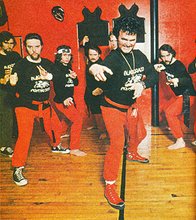
Yessiree folks, this is an actual vintage early '80's photo of the Rat Boy, complete with authentic Beer and pizza stains. Yes, it's part of my first Black Belt test, and this photo proves that it was perfectly acceptable for an assistant instructor to wear flannel shirts at Black Belt tests in Oregon in the old days.
--With that said, this post has been a long time coming and will surely piss some people off. Let me say it now: There are a lot of shortcomings in Tae Kwon Do as a martial art.
My training came at a time when the Koreans were desperately trying to organize TKD to become an Olympic sport. This was an exciting prospect, and I'm afraid it's one that has practically ruined TKD as a self defense art.
Pre-Olympic TKD was closely tied to Hapkido and Korean Judo. Our school practiced both. Our Master, Tae Hong Choi, once commented that TKD was structurally very close to Shotokan Karate, and at the time, it was true. There were powerful sparring sequences and a lot,lot of breaking boards and bricks. We gave demonstrations in front of thousands of people during festivals where Mr. Choi would disarm swordsmen and demonstrate the best of combat Hapkido. Choi had trained Special Forces in Vietnam. Those were heady times, When after events the Master would lead us, his entourage of Black Belts into seedy bars for after-hours celebrations. The training was solid, and the anarchic structure of the organization led to deep trust and friendships I'll always remember.
Then came the Olympics. The hands came down, short-range fighting became non-existent, and head-hunting became the rule.
Tae Kwon Do has always emphasised kicking techniques, but after the Olympics, TKD fighters had stopped using their hands altogether. While the flash kicking is way fun, and excellent gymnastic exercise, it sucks for self-defense. A good wrestler can easily move in on high kicks, and the groin is constantly exposed when you kick high. I know. I lost a tournament fight when I attempted a high hook kick and a Kenpo guy blasted me in the groin with a short counter-kick.
The most natural method of fighting is to hit with your hands. It's easy, quick and effective. The best thing for me is when I started training with my friend who was a boxer. Traditional boxing drills brought my hand speed up considerably, as well as hitting power. Not the brick-breaking type of power, but stick-and-move power, very mobile. Of course, modern TKD does not allow hitting to the head, so they are miserably outclassed by fighters that can hit fast and hard.
In this way, modern TKD has lost it's way. In the past, fighters from Korean systems, like Chuck Norris, who dominated the tournament scene in the '60's-'70's, were power to be reckoned with. Now the system has degraded into a pure sport, where the exercise is great but don't try this shit for self defense.
Tae Kwon Do would find a re-awakening by going back to it's true roots as a brawling Korean art with heavy Japanese and Chinese influence, yet retaining it's Kim-Chee-flavored national heritage.