Showing posts with label Master Tae Hong Choi. Show all posts

Thursday, March 17, 2011

Returning Korean Fighting to it's Roots

Taekkyeon

Recently on Dojo Rat I took another look at my experience in Tae Kwon Do, which began around 1979. "The Long and Short of Tae Kwon Do" detailed how I witnessed combat TKD degrade into a sport with a rule set that makes it only marginally useful in a serious fight.
I remember one of my instructors, who rescued a woman from being raped in downtown Portland say that without western boxing skills he could never have saved the woman from the two attackers.
There is a long, sordid history of the development of modern Tae Kwon Do, but here's the nickel tour: It originally started out as Shotokan Karate under the Japanese occupation of Korea. Many Koreans took Japanese names and were educated under the Japanese school system.
During the Korean war Korean fighters made their fame killing Chinese soldiers in hand-to-hand combat. These guys were tough, and soon caught the attention of the U.S. military. Decisions were made to categorize various schools of Korean fighters, and "Tang Soo Do" (way of the Chinese hand) became the most recognized system. By that time, the Koreans had distanced themselves from their Shotokan roots by adding spectacular high jumping kicks. These were performed at military and government demonstrations to awe the crowd, and were almost useless in actual combat.
None-the-less, lessons learned in hand-to-hand fighting were taught to Korean and U.S. military units as well as the secret service of both countries.
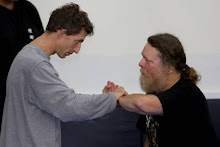
My instructor, the late Master Tae Hong Choi taught these techniques to Special Forces in Vietnam as well as the U.S. CIA.
Master Tae Hong Choi

Political rivalries that labored under the Korean dictatorship were mirrored in it's agents that were sent out around the world. Eventually, the disparate schools of Korean Martial arts became united under the name "Tae Kwon Do" (foot-fist way).
Originally, our TKD school practiced Korean Judo and Hapkido techniques that reflected the experience of soldiers in the Korean and Vietnam wars, as well as powerful kicks and strikes. One-step fighting patterns, called "Kibone" were practiced using chops, sweeps, elbows and knees.
But with the largely political push to get Tae Kwon Do into the Olympics, the fighting system was watered down to sport level, focusing on highly gymnastic jumping and spinning kicks. TKD fighters were vulnerable to systems that grappled or used fast repetitive hand strikes. The politics were insufferable.
---------
Now it seems that "Olympic" Tae Kwon Do has run it's course. The sport limitations have shown through, and it appears that Koreans are seeking to return to more effective fighting techniques. The video above is of "Taekkyeon", the name hearkening back to an ancient Korean fighting style. While largely ceremonial and dance-like, Taekkyeon competition resembles Capoeria in some ways. The players dance about, switching feet while attempting sweeps and head kicks.
However, as demonstrated in the video above, there is an effort to put serious fighting techniques back into Korean Martial Arts.
And this is a very good sign, as in this era of cross-training with MMA and other systems, the Koreans may once again find their true fighting roots.

Monday, January 10, 2011

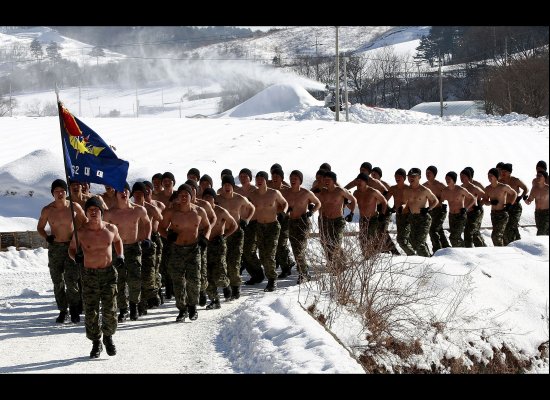
South Korean Soldiers: Winter Training


I came across this photo essay in "The Huffington Post", showing South Korean soldiers in winter training. It brought back lots of memories, as my first martial arts master was Tae Hong Choi in Portland Oregon. I have lots and lots of stories about training with, drinking with, and working for Mr. Choi to pay for tuition and Black Belt tests.
Back in the 1970's, Tae Kwon Do was a little newer and slightly more exotic than Japanese Karate and Judo. I had been a gymnast in high school and took well to the crazy spin-kicking as well as the Hapkido-type stuff. Mr. Choi had trained South Korean and South Vietnamese military along with American special forces in Vietnam. He later went on to train Secret Service and CIA agents in Washington DC.

Journalist P.J. O'Rourke called the Koreans "The Irish of Asia". He suggested they had drinking and fighting in their DNA. I think I can attest to that. We heard many stories about the R.O.K. Rangers and some kind of feared "Tiger Squad"
that operated with the U.S. military in Vietnam.
But one of the guys in our school was a Special Forces guy that went on missions on the DMZ, the border between North and South Korea. Stuff happened that he wasn't supposed to talk about. Guys got killed in firefights as they probed the border, and this was in "a time of peace".
But he saw a lot of South Korean soldiers training, and he said the American Special Forces guys were actually much better in hand-to-hand combat. The U.S. has a volunteer Army (for now), and the South Koreans have mandatory military service. They would rotate out of college, pull two years in the military and go back to college. The American guys were in it for the career. This could have simply been his bias, but he saw lots of demonstrations. He implied that the Korean army kind of "handed out Black Belts".
Before people get pissed at me, keep in mind this was told to me by a Ranger who served and was under fire on the Korean border.
This doesn't affect my early love for the Korean martial arts. They provided me with a strong foundation and a tremendous sense of camaraderie with Master Choi and my fellow students. Many people simply believe that the Olympics probably ruined aspects of Tae Kwon Do by turning it into a sport.

Looking at this picture it appears that the Korean military may have altered some of it's technique to resemble a boxing posture. This is a welcome sight, as Korean fighters play such a kicking game they keep their hands too low and risk getting punched in the face.
One of these days, I'll put together a good article about my experiences with Mr. Choi, a man of strength, humor and compassion that helped me keep my young life together.

Friday, November 13, 2009

Fear The Mongols!


Over at "The Ground Never Misses" my friend, Xingyi instructor and general Big-Bald-Badass Jake Burroughs is running This series on Mongolian wrestling. (Also Here).
This brings up a story that old Mr. Choi, my Korean Tae Kwon Do master told me about his childhood;
As I remember, he grew up in North Korea and his family fled to the South when war broke out. His family had a farm, and every day he would take a large potato to school with him. All the kids would put their potatoes on the woodstove to heat them for lunch. They had a pack of farm dogs that they would let loose once a week which probably killed every living bird, rabbit or rodent they could catch.
Once, when Mr. Choi was still quite young, his family took a trip to see a Mongol festival, much like the one depicted in the video above.
They arrived at a village or camp, tents and yurts everywhere. Mongol horsemen swung from their mounts at full gallop. That night, his family entered one of the largest of the tents. Mr. Choi's eyes lit up as he described the scene, which was etched on his memory;
The interior of the tent had cooking fires and torchlight. Huge Mongolian wrestlers were competing for the crowd. The spits on the cooking fires held entire animal bodies that were being turned and roasted. Compared to his Korean family, the Mongols were giants, and he remembers some of them in full-Mongol party-mode eating entire rams legs, the grease dripping and coating the rough garb they were wearing.
It was a spectacle that Mr. Choi never forgot, and some of the roughest and most powerful warriors he would ever meet.
Check out Jake's posts on Mongolian wrestling at the links highlighted above.

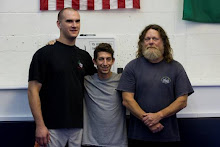
My friend and instructor, the late Tae Hong Choi

Thursday, March 12, 2009

Master Tae Hong Choi Has Passed Away


My Tae Kwon Do instructor, Master Tae Hong Choi has passed away. I spent years with this man, who provided me with the strong martial foundation I have tried to carry with me for life. There are many, many stories I have about training, working, and yes, even drinking with Mr. Choi. But now is the time to reflect on the strong organization Mr. Choi built and the comradery of his many, many students.
From Oregon Live:

Portland-area tae kwon do grandmaster pioneered sport in U.S. Tae Hong Choi, who established schools and taught thousands of students, dies at 73
Grandmaster - Tae Hong Choi, who ran schools in the Portland area, dies at 73
Wednesday, March 11, 2009
HELEN JUNG
The Oregonian Staff
For years, Gordon Graaff had been sparring with -- and losing to -- his internationally heralded tae kwon do instructor, Tae Hong Choi.
Finally, Graaff thought he was about to topple the master, he recalled, thinking back to the episode some 20 years ago. "I was feeling pretty cocky. . . . I'm 25 or something, I'm young and strong, and he's got to be like 45 and an old man."
Next thing he knew, Graaff was flat on his back.
"(Choi) pumped me on the chest with his fist, and he just goes 'heh heh heh heh,' " Graaff said. Choi had a good sense of humor, he said, but the master still earned respect.

Choi, a grandmaster in tae kwon do, winner of multiple martial arts titles and a teacher of thousands of students, died Sunday at Providence Portland Medical Center. He was 73.

The eventual Korean national champion was initially shooed away by the martial artists he watched as a young boy delivering newspapers in Korea, according to a 2004video by NW Documentary that featured Choi and other Northwest Koreans.
After seven days of his pestering, the men seemed to relent -- but put him to work instead. After 20 days, they rewarded his work ethic and started teaching him. He earned his black belt after two years. He soon started winning titles and eventually earned a ninth-degree black belt, the sport's highest designation.
While in the Korean army, he fought in the Vietnam War and taught hand-to-hand combat skills to Korean and U.S. special forces. That got him his next job of instructing hand-to-hand combat for top-level U.S. security agents, his family said, and he moved to Washington, D.C., in 1971. He brought his family over to Oregon where a distant cousin lived, said his second son, Sung Choi.
After rejoining his family in 1972, Choi started teaching tae kwon do at the YMCA and later opened a studio in Northeast Portland.
He also helped establish tae kwon do nationally, serving in the sport's governing body in the United States.
Choi so impressed one young student, Leon Preston, that he decided to study under Choi, even though it meant making frequent trips down to Portland from his Seattle home.
"He represented what a true martial artist is," said Preston, who now is a master instructor himself and was a tae kwon do referee in the 2008 Beijing Olympics. "His teachings included self-discipline, a broader worldview of how we fit into society, and . . . dedicating yourself to making a change for the betterment of the community."
Choi eventually opened two more schools for students in Beaverton and North Portland, his son said, and at times, let students slide on tuition.
Choi's honors included traveling to Seoul with one of his students who competed in the 1988 Olympic Games; recognition from the Korean Minister of Culture; and a 2007 lifetime achievement award from the United States Taekwondo Grandmasters Society.
"Mr. Choi was one of the pioneers for tae kwon do in this country," said Joon Pyo Choi, co-chairman of USA Taekwondo's martial arts commission. "When the word 'tae kwon do' didn't even exist in this country, he was already teaching."
Survivors include his wife, Man Soon Choi of Portland; daughters, Ilsun Kim and Minsun Min, both of Seattle; sons, Hung Choi of Beaverton and Sung Choi of New York City; and five grandchildren.
Services will be held 3 p.m. Thursday in the Korean Mission Church, 9100 S.W. Wilshire St., Portland. Burial will follow in Skyline Memorial Gardens, 4101 N.W. Skyline Blvd., Portland.
Helen Jung: 503-294-7621;helenjung@ news.oregonian.com