I just finished reading an article in the February 4th issue of "The New Yorker" magazine, detailing the Chinese Olympic boxing team. In it, Boxing star Zou Shiming (who trained in classical Wushu Kung Fu) comments on his successful and elusive style:
(Zou): "I think I've combined martial arts and boxing". "Martial arts have a soft and flexible side, and boxing is more direct. Putting them together is a specialty of Chinese boxing".
-- This is something I have been giving a lot of thought to lately, and it is surely not without controversy in orthodox circles.
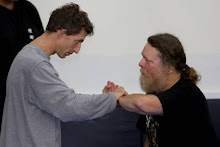
I no longer focus on the long-range fighting of my old Tae Kwon Do training, and my Kenpo has softened due to the influence of my passion for Tai Chi Chuan. Our hitting drills mostly stem from western boxing, with some open-hand variations. At the pre-clinch distance the sticking and coiling arm feeling comes from Chi Sao of Wing Chun and tactile softness of push hands. These naturally lead to some great joint locking action.
We have, in the course of learning these various systems, practiced them seperately and moved from one drill to another. Recently however, we have started doing something that is likely to horrify traditionalists; we are trying to combine it all into one unified practice.
Now, this blending of hard/soft is not a new idea. Think about Goju Ryu Karate. The problem is, That system is still way more "Go" (hard) than "Ju" (soft). Our persuit of Tai Chi Chuan has forced us to shift gears into a far more yielding approach to dealing with the incoming force of an opponent.
Using push hands as a foundation (both Yang style and Chen four-hands) we first added the occasional straight punch, which is neutralized and we return to the pattern. This works much better with the Chen pattern, which allows for a wider variety of movement. If we fall out of the pattern, chi sao sticky arms are maintained until we find the pattern again. This also allows for finger, wrist and elbow/shoulder locking, again returning to the pattern. For now, we have been alternating who does the technique back and forth -- push, hit, pattern, push, lock, pattern. Rollback is used to set up locks, with knees and elbows in the clinch. This is not necessarily done in a static motionless stance, we try to float around with a little natural movement, always returning to the pattern.
Critics may suggest that we are dabbling in drills that have distinctly different energies, and I suppose we may be distancing ourselves from the purity of any one art. A Tai Chi person might say "You're not doing Tai Chi" A Wing Chun guy might not like the softer push hands pattern, a striker might not recognize the value of sticking hands. A stand-up Small-Circle Jujitsu (or Chin Na) practitioner however, will see the value of this linking of systems.
We will be ready soon to put out a short video clip of what we are working on. In the mean time, I am curious what others think about this.
Am I "cheapening" an element of purity in my systemic drilling practice? Could it compromise the possibility of a truely deep understanding of any one art or system?
Or is this the natural evolution of years of training in seperate techniques and arts?
Isn't this how a broader understanding of dealing with an opponent is developed?