Tuesday, December 11, 2007
Snake Style #4 --Takedowns
This is one of my favorites; it's the late Dr. Xie Peiqi demonstrating Snake chin-na with some really cool takedowns. This clearly comes from a Bagua background. The Judo and Aikido guys out there will see the similarities and differences between the techniques of said arts. Also note he is striking pressure points on the side of the neck in one technique.


Monday, December 10, 2007
Snake Style #3 -- Coiling
This may look kinda' odd, but what a great drill! This exercize will be great for learning to aquire locks on the wrist, elbow, shoulder and neck. Wrapping and coiling around the opponent's limbs, much like the snake...
This is from the Tallahasse Shaolin school, maybe some of you Florida Dojo Rats know who they are, Thanks for the drill!
Sunday, December 9, 2007
Snake Style #2
In the second installment of our Snake Style series, we see this un-named practitioner in what is called a "Snake fist form, family style". I think it's not a bad form, but this poor guy just gets hammered by armchair pundits on YouTube. Everybody's an expert...
Aside from the obvious finger strikes, there is the coiling motion of the arms, useful in setting up traps and locks. Also, note the "whole arm" swinging in striking/blocking actions. I saw this also in Mike Martello's mantis techniques at the seminar in Seattle. I never realized how much unified body power this motion develops until Martello demonstrated it. The next posts will move beyond forms and will sample specific techniques...
Friday, December 7, 2007
Snake Style #1
Snake preparing to strike
Xiao Yang at Chinese Nationals
Today we begin a study of the movements of the snake as used in martial arts techniques. A powerful figure in mythology, the snake has been widely imitated in it's coiling and fast strikes. The legendary Chang Seng Feng is said to have witnessed a fight between a snake and a crane, and created Tai Chi Chuan from that experiance. There will be another teaser over the weekend, but the really cool stuff will start Monday..
Wednesday, December 5, 2007
Temple Guards

Warrior God

Dojo Rat Warrior God
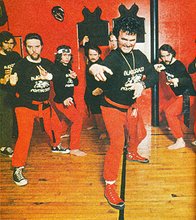
Our fierce Warrior Totem, (A.K.A. Punkin'head) guarding over Rat Land...
Tuesday, December 4, 2007

Sunday, December 2, 2007
Review: Cheng Hsin- The Principles Of Effortless Power
Peter Ralston of Cheng Hsin
Several months back, Dave from “Formosa Neijia” wrote about Peter Ralston, founder of the “Cheng Hsin” martial art system. Cheng Hsin refers to “The true nature of being”. The description was very interesting and I checked out Ralston’s website. Along with Ralston’s description of his martial philosophy, there were several clips of him performing various internal martial arts techniques. Ralston is no slouch, he has a varied background and has successfully competed internationally.
With that in mind, I ordered two of his books: “The Principles Of Effortless Power” and “Cheng Hsin T’ui Shou; The Art Of Effortless Power”.
“The Principles Of Effortless Power” is Ralston’s first book, so I started there. It begins with his martial history, and his journeys in spiritual awakening. These were steeped in the self-realization and encounter-group sessions of the 1970’s. These sessions branded Ralston’s first book with the stigma of new-age thought and explanation.
Ralston seems to be attempting to explain Internal Art principles without using any of the Chinese or Japanese terms and thought patterns. In some cases, he re-labels them. I am no stranger to alternative views and esoteric thinking, but in my opinion, Ralston is trying to re-invent the wheel. While westerners sometimes have difficulty with vague terms such as “Peng” in Tai Chi Chuan for example, there is no real need to eliminate the term or replace it.
I see where he is going with his philosophy, and understand much of it, but I have to say I find him explaining things in a circular fashion at times. For example, I book-marked this paragraph on page 90:
Ralston writes:
“ Since we already give BEING to the perception of what IS (in other words, we acknowledge it’s “beingness”), and to interpretation itself, it is necessary to move our cognition-attention and life force into a position of Being in which this can be recognized as already and actually the case. We can then give being to what is not at present occurring”.
--Whew!… this passage is not an isolated case, and I have to admit that twenty pages later I simply set the book down and moved on to his next one, which I’ve just started. That book, “Cheng Hsin T’iu Shou” shows a greater degree of maturity in his writing. While his sometimes-frustrating philosophy is present in the first part of the book, the second half is all applications that demonstrate what he has been prattling on about philosophically. While I have been on the search for concept books, Ralston’s first attempt is pretzel logic to me. I feel I will get much more out of his application book, which demonstrates many internal art principles. I came away from these books feeling that Ralston may be better as a Guru demonstrating direct transmission of knowledge to students in a Dojo format. His knowledge is deep and he is a skilled martial artist. I’ll be interested if anyone else has read his material, and any comments they have
Subscribe to:
Posts (Atom)