Sunday, April 12, 2009

Fungus Amongus


Japanese scratching their heads over fungus that is killing judo
Richard Lloyd Parry in Tokyo
They are among the most famous fighters in the world, renowned for their discipline, speed and toughness. Now Japan’s martial artists are being laid low by an epidemic that is inflicting them with itching, disfigurement and baldness.
Doctors and officials say the sport of judo is facing ruin because of an infectious skin fungus spreading through clubs across Japan. It is passed from one participant to another during the grappling that is at the heart of the sport.
Practitioners of Western-style wrestling and the ancient sport of sumo have also been afflicted by Trichophyton tonsurans, a skin-eating fungus similar to athlete’s foot. So concerned is the sport’s governing body, the All Japan Judo Federation, that it commissioned research to gauge the extent of the problem.
It revealed that almost one third of judo clubs and half of all high-school judo teams have been struck by the fungus, which is highly infectious and difficult to treat. Its symptoms include patches of redness on the neck, face and upper body, which are often itchy and swollen.
The fungus most often affects the scalp, sometimes causing patches of skin to flake off, but often displaying few obvious symptoms in the early stages. Left untreated the fungus can enter the hair follicles, causing loss of hair. Treatment consists of a three-month course of drugs.
The prospect of fungus-infested Olympians or sumo wrestlers deprived of their famous topknots has caused wide disquiet. “The federation has become worried about the situation,” said Seitaro Hiruma, a professor of dermatology at Juntendo University, Tokyo, who carried out the research.
“Now they are saying that if they leave this infection unchecked it will ruin Japanese judo.” In a letter to judo clubs across the country the federation pleaded with judoka, as judo practitioners are called, to take part in the survey. “If this infection spreads it may harm the image of judo and can’t but contribute to the decline of the sport,” the letter read. “So please cooperate with this research.” The contagion is a side-effect of the great success of judo and its growing internationalisation since it became an Olympic Sport in the 1964 Tokyo Games. Professor Hiruma said that Trichophyton tonsurans originated in Latin America. “The infection started in America in 1960s after the revolution in Cuba when lots of refugees moved into US,” he said. “Wrestlers brought it into Europe and the infection spread among the wrestling population.” In Japan the number of wrestlers is small – 50,000 – compared with 500,000 judoka. Japanese judo athletes got infected in Europe and brought it back to Japan.
Follicular faith
- Sumo wrestlers are expected to grow their hair long and fix it in a topknot similar to that worn by samurai during the Edo period. Yokozuna Tochigiyama, one of Japan’s most successful sumo wrestlers, retired in his prime in 1925 as he did not have enough hair
- Tottenham striker Jermain Defoe was asked by a journalist why he had cut all his hair off. The superstitious footballer replied: “I had to, I only ever seem to get injured when I have longer hair”
- In the 1998 World Cup the Romanian team emerged for their match against Tunisia with bleached hair. The decision had been made to reverse a curse placed on the team by the Romanian Orthodox Church
- In Ancient Greece Olympic wrestlers were among the only men, besides slaves, to keep their hair short to keep their opponents from grabbing it during a bout

(LINK)

Friday, April 10, 2009

Fantastic Sword Cuts, Seemingly Impossible


Wow!
First of all, these Japanese game show formats just crack me up. But holy crap, it doesn't seem that these stunts are faked. If true, this is the stuff that legends are made of... keep watching, it gets better -

Thursday, April 9, 2009

Dojo Rat Now In Urban Dictionary


A fellow Rat alerted me to the fact that nobody had defined the term "Dojo Rat" in the online version of "The Urban Dictionary". Here is how the current addition of the book is described on Amazon:
About the Author
"Founded in 1999 by Aaron Peckham as a parody of the dictionary, urbandictionary.com features definitions written by people from all over the world. Since then, Urban Dictionary has been cited in court, in graduation speeches, and by countless news media outlets, including CNN and Time magazine. Today Aaron is a software engineer in Silicon Valley and San Francisco".
--And here is how it is now defined (by me):
1. Dojo Rat
Dojo Rat:
(1). Intensely motivated Martial Arts practitioner. Always working out at the training hall (Dojo).
(2). An old Martial Arts hack that has been around forever and can still kick ass. See dojorat.blogspot.com
(3). All of the above
(use in sentence)
(1). Zac The Dojo Rat is always at the damned Dojo.
(2). Tom is an old Dojo Rat dude but he can still crush your face.
(3). I'm scared of those Dojo Rat guys.
tags:
karate-tai chi chuan-martial arts-dojo-asskicker
by Dojo Rat Apr 8, 2009 share this

--Anybody else want to chime in? Here's the link for "The Urban Dictionary"
-Available at Amazon here.

Wednesday, April 8, 2009

Kent Howard: Leg Trap And Counter To Leg Trap


Leg Trap
Once again, I've really been enjoying these video's produced by Bagua instructor Kent Howard. In this first one, he demonstrates leg traps using the T,L, and V steps from the Bagua palm changes. I used the inside trap during a freestyle push-hands match Monday, just to disrupt my partners balence followed with a push. I could have taken him off his feet completely if I chose to, and it reminded me how vital these traps are when you are in close quarters.

And here he demonstrates the counter to the leg trap with a nice little partner drill. Thanks Kent!

Monday, April 6, 2009

Springtime For Taiji In Port Townsend


Arriving by boat to Port Townsend Washington

What a difference a couple of weeks makes; last trip to see our Tai Chi Chuan instructor Michael Gilman the Ferry shut down due to high winds and snowstorms. This Weekend, it was sunny, 65 degrees and beautiful.
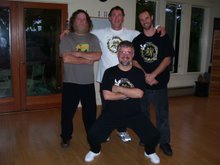
Myself and another Dojo Rat were joined by two other Rats from the Seattle club for a class with instructor Gilman that hosted around twenty students. Michael has been teaching seminars on the various "energies" in the practice of Tai Chi Chuan, and we have gone over Peng-Lu-Ji-An in great detail. The focus this time was more directed to Ji and An, and the Yang-style push-hands patterns.

Michael Gilman, assistant instructor Stephanie, and a pack of Dojo Rats

The seminar wrapped up with a lively session of push-hands with the warmer temperature really bringing the sweat on! That of course necessitated replacing our vital body fluids with the elixer of life; Beer. Now, Port Townsend has a brewery that produces one of the finest IPA's I have ever had. I usually start with that then move on to something a little lighter. No matter how I tried, nobody joined me in drinking the Beer that made Washington State famous: Olympia in the can. Oly is light enough to fuel the Rat all night long, which is pretty much what happened as we watched a great R&B/Funk band and closed down two bars.

Looking south towards the Olympic mountains. The paper mill you see is where Deborah Winger was rescued by Richard Geere in the movie "An Officer And A Gentleman", which was filmed in Port Townsend. (The movie had a couple of great fight scenes). I think half the brown-paper bags in the United States come out of this plant. Below the grass headlands on the right is a beach where in 1981 I lived in a small travel trailer (until the Cops kicked me out).

And finally, here's a pic of the great little Kala Soprano Ukulele I picked up in town, which really came in handy as some of us had a late night train wreck of a music jam up in the hotel room.
All-in-all, a very successful mission!
For more information on Tai Chi Chuan in Port Townsend, check out Michael Gilman's Website.

Friday, April 3, 2009

Kent Howard On Bagua Single Palm Change


Here are some drills for the Bagua single palm change by instructor Kent Howard. The first one I learned years ago in Aikido, and we have been doing it pretty much as Kent presents it. The second drill is nice because of the Fan Jang aspect of the change. All of this guy's videos are well produced and have good information. The style is after master Wang Shujin, the barrel chested dude in the first picture in the video. The style is different than from what I practice in that he (1.) holds his elbows somewhat away from his body and a little higher than I like. I believe that may be because master Wang was so huge he held his arms away from his belly. Naturally, all his students would replicate that position. Jake Burroughs recently commented to me that he saw the same thing in the students of an obese Xingyi master. (2.)In the palm change, but not shown in this video is the high leg raise after the wrap and change of direction. I see the utility in leg sweep applications but is a little to high for me.
All this guy's video's are very good however, and we may take a look at a few more later. Also, you might check out the website for Kent Howard's book on Wang Shujin Bagua at this link.
- I'm off to a Tai Chi Chuan workshop with my instructor Michael Gilman this weekend, more on that next week.

Wednesday, April 1, 2009

April- Cute Hippie Chick Of The Month: A Brief History Of Hippie Chicks


"Wandervogels Abschied" by Fidus, 1900

Ah-- yes fellow Dojo Rats, it's time again for our regular feature "Cute Hippie Chick Of The Month".
This time, we take a look at the origins of the "Hippie Movement", such as it is.
Let's begin with this really great article "Hippie Roots & The Perennial Subculture". This is a legenthy and somewhat inspirational historical perspective that takes us back to the Pagan ethos of the German Folk at the turn of the last century. Yes, you read that right. The Hippie Chick (and Dude) movement started in Germany. The article states:
"Thus the religiosity of the Indo-Germanic people, whenever their nature can unfold itself freely, emerges only in that form which religious science has described as "nature religion" or "earth religions". To remove the German soul from the natural landscape is to kill it. The Romans knew this so once Christianity had become the state religion of the Roman Empire their missionaries were eager to chop down the German forests and set their temples on fire.
Whenever the church encountered Pagan elements that it could not suppress, it gave them a Christian dimension and assimilated them. These ancestral traditions were reinterpreted and revised, but the church never succeeded in effacing the German Pagan heritage".

Celebrating The Sun, 1926
The Pagan spirit of the Germans became the "Wandervogel" movement of the 1920's, with youth roaming the countryside playing music, clad in wool, swimming nude and establishing "Nests" and "Anti-Homes". Popular literature from Goethe to Hesse was heavily influenced by the emerging movement. From the article:
"the "Wandervogel", was founded in 1895 by Hermann Hoffmann and Karl Fischer in Steglitz, a suburb of Berlin. They began to take some high school students on nature walks, then later on longer hikes. Soon a huge youth movement that was both anti-bourgeois and Teutonic Pagan in character, composed mostly of middle class German children, organized into autonomous bands".

In the 1950's and 60's, Germans who moved to the United States brought the Wandervogel spirit with them, and were called "Nature Boys". Many lived in warm climates where they could camp and forage food from the wild. Many abstained from alcohol and caffiene and ate only raw foods. This was the dawn of the natural health food movement of today. As far back as 1896, these were the goals of the original Wandervogel: Particularly:

1. vegetarianism
2. nudism
3. natural medicine
4. abstinence from alcohol
5. clothing reform
6. settlement movements
7. garden towns
8. soil reform
9. sexual reform
10. health food and economic reform
11. social reform
12. liberation for women, children and animals
13. communitarianism
14. cultural and religious reform: i.e. a religion or view of the world that gives weight to the feminine, maternal and natural traits of existence
(D.R.) Pretty foward thinking, Eh?
And finally, the so called "Hippie" movement saw fruition in the fertile 1960's:

Hippie Chick and Surfer Dude on the island of Kauai, 1971
So, we conclude our salute to the "Brief History Of The Hippie Chick" with another historical photo:

Germany, 1916

For more information, go to the article at this link.