Sunday, January 11, 2009
Yin-Style Bagua With Mike Martello
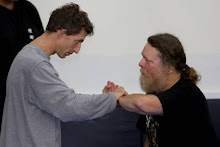
One more video of Mike Martello at his last Seattle seminar, this one is of the Yin-style Bagua portion which I attended. Notice how Mike explains concepts of movement with individual drills. Next, he introduces and combines those drills in a linear short form - Xaio Kai Men (Small Opening Gate). And lastly, he demonstrates how the movements in the form translate into self-defense applications in the partner circle-walking drill.
Although Xaio Kai Men is a linear form, it's easy to put it into walking the circle and use it like any of the other Bagua palm changes.
These and other seminars have been generously hosted by Jake Burroughs of Seattle's "Three Harmonies Chinese Martial Arts Center", website available at THIS LINK.
Jake will also be hosting a seminar with Tim Cartmell Feb. 7-8, with sessions on grappling and Bagua applications. For more information, contact Jake Burroughs at the website linked above.


Friday, January 9, 2009
Neighborhood Watch, Somali-Style

Johann Hari: You are being lied to about pirates
Some are clearly just gangsters. But others are trying to stop illegal dumping and trawling
Who imagined that in 2009, the world's governments would be declaring a new War on Pirates? As you read this, the British Royal Navy – backed by the ships of more than two dozen nations, from the US to China – is sailing into Somalian waters to take on men we still picture as parrot-on-the-shoulder pantomime villains. They will soon be fighting Somalian ships and even chasing the pirates onto land, into one of the most broken countries on earth. But behind the arrr-me-hearties oddness of this tale, there is an untold scandal. The people our governments are labelling as "one of the great menaces of our times" have an extraordinary story to tell – and some justice on their side.
Pirates have never been quite who we think they are. In the "golden age of piracy" – from 1650 to 1730 – the idea of the pirate as the senseless, savage Bluebeard that lingers today was created by the British government in a great propaganda heave. Many ordinary people believed it was false: pirates were often saved from the gallows by supportive crowds. Why? What did they see that we can't? In his book Villains Of All Nations, the historian Marcus Rediker pores through the evidence.
If you became a merchant or navy sailor then – plucked from the docks of London's East End, young and hungry – you ended up in a floating wooden Hell. You worked all hours on a cramped, half-starved ship, and if you slacked off, the all-powerful captain would whip you with the Cat O' Nine Tails. If you slacked often, you could be thrown overboard. And at the end of months or years of this, you were often cheated of your wages.
Pirates were the first people to rebel against this world. They mutinied – and created a different way of working on the seas. Once they had a ship, the pirates elected their captains, and made all their decisions collectively, without torture. They shared their bounty out in what Rediker calls "one of the most egalitarian plans for the disposition of resources to be found anywhere in the eighteenth century".
They even took in escaped African slaves and lived with them as equals. The pirates showed "quite clearly – and subversively – that ships did not have to be run in the brutal and oppressive ways of the merchant service and the Royal Navy." This is why they were romantic heroes, despite being unproductive thieves.
The words of one pirate from that lost age, a young British man called William Scott, should echo into this new age of piracy. Just before he was hanged in Charleston, South Carolina, he said: "What I did was to keep me from perishing. I was forced to go a-pirateing to live." In 1991, the government of Somalia collapsed. Its nine million people have been teetering on starvation ever since – and the ugliest forces in the Western world have seen this as a great opportunity to steal the country's food supply and dump our nuclear waste in their seas.
Yes: nuclear waste. As soon as the government was gone, mysterious European ships started appearing off the coast of Somalia, dumping vast barrels into the ocean. The coastal population began to sicken. At first they suffered strange rashes, nausea and malformed babies. Then, after the 2005 tsunami, hundreds of the dumped and leaking barrels washed up on shore. People began to suffer from radiation sickness, and more than 300 died.
Ahmedou Ould-Abdallah, the UN envoy to Somalia, tells me: "Somebody is dumping nuclear material here. There is also lead, and heavy metals such as cadmium and mercury – you name it." Much of it can be traced back to European hospitals and factories, who seem to be passing it on to the Italian mafia to "dispose" of cheaply. When I asked Mr Ould-Abdallah what European governments were doing about it, he said with a sigh: "Nothing. There has been no clean-up, no compensation, and no prevention."
At the same time, other European ships have been looting Somalia's seas of their greatest resource: seafood. We have destroyed our own fish stocks by overexploitation – and now we have moved on to theirs. More than $300m-worth of tuna, shrimp, and lobster are being stolen every year by illegal trawlers. The local fishermen are now starving. Mohammed Hussein, a fisherman in the town of Marka 100km south of Mogadishu, told Reuters: "If nothing is done, there soon won't be much fish left in our coastal waters."
This is the context in which the "pirates" have emerged. Somalian fishermen took speedboats to try to dissuade the dumpers and trawlers, or at least levy a "tax" on them. They call themselves the Volunteer Coastguard of Somalia – and ordinary Somalis agree. The independent Somalian news site WardheerNews found 70 per cent "strongly supported the piracy as a form of national defence".
No, this doesn't make hostage-taking justifiable, and yes, some are clearly just gangsters – especially those who have held up World Food Programme supplies. But in a telephone interview, one of the pirate leaders, Sugule Ali: "We don't consider ourselves sea bandits. We consider sea bandits [to be] those who illegally fish and dump in our seas." William Scott would understand.
Did we expect starving Somalians to stand passively on their beaches, paddling in our toxic waste, and watch us snatch their fish to eat in restaurants in London and Paris and Rome? We won't act on those crimes – the only sane solution to this problem – but when some of the fishermen responded by disrupting the transit-corridor for 20 per cent of the world's oil supply, we swiftly send in the gunboats.
The story of the 2009 war on piracy was best summarised by another pirate, who lived and died in the fourth century BC. He was captured and brought to Alexander the Great, who demanded to know "what he meant by keeping possession of the sea." The pirate smiled, and responded: "What you mean by seizing the whole earth; but because I do it with a petty ship, I am called a robber, while you, who do it with a great fleet, are called emperor." Once again, our great imperial fleets sail – but who is the robber?
j.hari@independent.co.uk http://www.independent.co.uk/opinion/commentators/johann-hari/johann-hari-you-are-being-lied-to-about-pirates-1225817.html
Thursday, January 8, 2009
Mike Martello: Throwing Part Two
Ya gotta' love this.
Remember, Mike Martello is just a little over five-feet tall. You can see the amount of power he is able to generate with that compact, wirey frame.
Wednesday, January 7, 2009
Mike Martello Seattle Seminar
Here's part one of a seminar with Mike Martello at Jake Burroughs school in Seattle.
Mike is one of the best instructors I have had the pleasure to meet and train with. He's got just the right amount of "class clown" to make everything you learn outright fun, but as you can see he is skilled and serious about his teaching.
I wonder if the Judo guys out there have any observations about the differences in the Chinese-style throwing, including the set-ups.
Sunday, January 4, 2009
John Bracy's Forty-Years Of Martial Arts
I had a very nice E-mail from John Bracy the other day, asking me to check out his website "Chiarts.com", at THIS LINK.
As you can see in the video above, Bracy is a skilled practitioner and instructor. He also has a new DVD on Internal Power available, and I hope to review it soon.
My first introduction to Bracy was through his book "Bagua- Hidden Knowledge In The Taoist Internal Martial Art". I really found this book to be helpful in both historical aspects as well as a good overview of Chinese Internal Arts.
From February 2007, here is my review of "Bagua" by John Bracy and Liu Xing-Han:

Taoism And The Martial Arts
I'd like to suggest anyone interested in the history of martial arts to get a hold of a copy of John Bracy and Liu Xing-Han's book, "Bagua: Hidden Knowledge In The Taoist Internal Martial Art".
Books that show technique are great, but the innovation of video has surpassed the book in that area. Books that describe the philosophy, motivation, conflicts, successes and goals of the ancient masters is where we learn the universal truths about our art. This unique book includes both.
Bracy describes in this book how the Taoists, mountain recluses with a history dating back to 500 B.C. influenced the Chinese intellectuals in 1800's China, and a new form of art was born.
In ancient times, warriors were often unkempt and crude, and looked upon with disdain by the upper class. In early studies, the Taoists were, like other alchemists, in search of the elixer of life. That external search became modified into a view that the human body was a microcosm of the universe, and internal yogic alchemy, or "Nei Tan" was practiced. The elixer of life, and rightly so, was believed to be achieved within ones own body. For many centuries in remote areas Taoists practiced this goal, and began to weave the martial skills necessary for survival in with their yogic health traditions, alchemy and mysticism.
It was in the chaotic times approaching 1900 that the intellectuals, generally Confucianist bureaucrats, realized that the "State" could no longer protect them and began to form secret societies and practice the martial arts. The deep analytical systemic thought of the Confucianists blended with the Taoist Yogic martial arts, (after all, why practice a mundane soldiers battlefield art?) and the clans of the upper class began a new level of martial study. It was at this time that the first publications about the internal arts began to emerge.
Communism cast a sooty grey pall over the continent for several generations, and in the late 1970's China was again "open for business". Martial arts had been supressed by the authoritarian government, many masters had been killed through the various conflicts, and many of the ancient skills were nearly lost. Bracy suggests in his book that "Although there are some exceptions, a comprehensively trained, true senior master living in mainland China today must have achieved base proficenicy before 1937".
In some ways, I believe it may at times be necessary to "re-invent the wheel". In our world today, we have more information available than at any other time in history. Our culture is not restrained any longer by narrow fundementalist thought and people are open to paths of enlightenment and deep introspective research.
With these tools in hand, I trust we will keep the old traditions alive and integrate them with new ideas, and our new "wheel" will be better than it ever was.
Bracy's book is widely published and available on Amazon.
Books and videos by John Bracy can be found at THIS LINK.
Friday, January 2, 2009
Man Disarms Attacker With .45

Man got more than he bargained for
The Associated Press
(12/31/08 02:19:28)
FAIRBANKS — A Fairbanks man who allegedly pulled a gun on a man skilled in the martial arts got more than he bargained for.
Jeffrey Walker, 44, said he was minding his own business last week at his apartment building when the neighbor below him called to complain his 2 year old was making too much noise.
"He just starts berating me, saying that if I can't shut the kid up, he'll shut him up," Walker said.
Walker, a former firefighter who has lived in Fairbanks for only about a year, thought his neighbor would call the police or the apartment manager to complain.
Instead, Walker said he showed up at his front door with a .45-caliber handgun. Walker leapt into action when he saw the man pull the gun out of his hoodie.
Walker grabbed the barrel of the gun and lifted it up with his left hand while simultaneously using his right hand to push the assailant's wrist and arm into his own head, effectively using the butt of the gun like a hammer.
"It only took about five seconds," Walker said.
While his girlfriend called police, he continued to hit the man until he stopped resisting.
Walker began studying bojuko, a form of self defense, when he was 25. Its creator says it teaches people who to eliminate threats with a variety of blocks, grapples and strikes.
Walker was able to reach level 3, which is the grade just below becoming an instructor.
Eric E. Backlund, 38, of Fairbanks was charged with third-degree assault, a felony.
When police arrived on the scene, they found him sitting in a pool of his own blood with Walker standing over him. He was treated for facial lacerations at Fairbanks Memorial Hospital before being arrested.
(D.R.)-- This guy is lucky he wasn't shot, but I guess you just react in these cases.
I've only had one gun pulled on me (so far) and I knew he wasn't going to use it when he stuffed it back under the seat of his car. He was scared of me, so I was able to walk over to his car, take the gun out from under the seat and throw it into a big patch of blackberry-bramble bushes.
-- The self-defense system the Fairbanks guy practiced was actually called "Bojuka".
It appears to be a reality-based system like Krav Maga. The website for "Bojuka" is HERE.
Thursday, January 1, 2009
January: New Years Cute Hippie Chick Of The Month
Woah!
Hippie New Year to all the fellow Dojo Rats out there!
Subscribe to:
Posts (Atom)