Showing posts with label Shuai Jiao. Show all posts
Showing posts with label Shuai Jiao. Show all posts
Sunday, February 27, 2011
Black Horse Tai Chi Chuan
Tip of the hat to the guys over at "The Rum-Soaked Fist", where I found this guy.
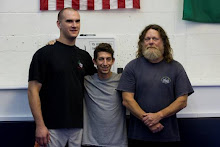
His name is Casey Payne and he runs "Black Horse Tai Chi". From his website, it looks like he trained in Taiwan, and he's a damned good athlete. It looks like he specializes in push hands, and as you can see it serves him well in his first Chinese "Shuai Jiao" Chinese wrestling competition.
One of his posts says he is attempting to bring all the Tai Chi schools in Milwaukee Wisconsin together in a unified spirit of fellowship and competition. I think he'd be a great guy to train with if you are in his area.
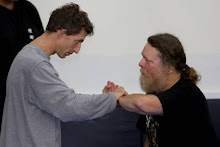
Here he is in a nice arm bar submission:
I'm going to watch his website for a while and it might end up on my links list.
Here's the link to his site: Black Horse Tai Chi


Thursday, February 10, 2011
Chang Tung Sheng: Yang Style Tai Chi Chuan
I ran across this video again and looked at it in a new light; this is how a true fighter interprets Yang-style Tai Chi Chuan.
Chang Tung Sheng is one of the most famous of Chinese Shuai Jiao wrestlers. It is said he was never defeated in challenge matches.
No silk pajamas.
No fancy stylistic flair.
Pure efficient movement.
Here's from Chang's Wiki bio:
"Nicknamed the "Iron Butterfly," Chang would go on to win numerous challenge matches before entering China's armed services - traveling across the Kuomintang controlled areas of China to seek out other shuai jiao practitioners in order to test his skills. He may also have first started learning xingyi in this period.
He taught as the youngest faculty member in the Nanjing Central Kuoshu Institute (中央國術館) and exchanged knowledge with other martial arts experts. He created his own variation of Tai Chi and xingyi, Chang Tai Chi, based on Yang style tai chi chuan, xingyi and his shuai jiao knowledge.
Throughout the Second Sino-Japanese War and World War II, of which China became a part, Chang instructed large numbers of Chinese Nationalist troops in Shuai Chiao (including the elite Red Wall paratroopers), while continuing to fend of numerous challenges. When not otherwise occupied, Chang visited several POW camps to test his Shuai Chiao against Japanese practitioners of judo, jujutsu and karate."
A couple of observations:
He moves through the form at about twice the speed that other masters do. That may be for the filming time length, or he may normally do it at this speed. This dispels the myth that Yang-style Tai Chi Chuan must be practiced at excruciatingly slow speed.
In the end, he demonstrates "Snake creeps down" in a relatively high posture with a bend in his lead knee. I read somewhere that he saw dangerous flaws in the traditional low ground sweeping method with the knee locked straight.
As far as martial tradition, Chang's method is similar to my studies: a wrestler who went on to train in Yang Tai Chi Chuan and Xingyi, a pretty formidable mix of traditional Chinese Martial Arts.
Thursday, May 13, 2010
Shuai Jiao: Chinese Wrestling
Here is a dramatically overproduced video showing an example of Shuai Jiao, or Chinese Wrestling.
Note the conditioning methods, they produce very strong fighters.
And here is Yang Jwing Ming demonstrating Shuai Jiao as it is practiced in Tai Chi Chuan. This will give the viewer an example of the varied self-defense aspects of Chinese wrestling:
Wednesday, May 12, 2010
Review: The Method Of Chinese Wrestling

In primitive times, unarmed combat was survived in two ways: running or wrestling. Wrestling is the natural way of dealing with an aggressor, perhaps more so than striking which is very specialized.
As legend has it, nearly all Asian martial arts came from India and spread throughout China to neighboring areas. There is much historical information to suggest that Chinese Wrestling is the basis for Japanese Jujitsu, Sumo, Hapkido and related arts-- From Tong Zhongyi:
"Wrestling arts were most popular among the Manchurians and Mongolians. Most of the northern martial artists are skilled at these wrestling arts. During the Ming Dynasty, the Japanese obtained a copy of a book on our comprehensive martial arts. This is the origin of Ju jutsu in Japan"
So begins "The Method of Chinese Wrestling" by Tong Zhongyi, translated by expert grappler and martial artist Tim Cartmell.

Culturally, in Northern China the climate is colder and heavier clothing is worn. This favored the grappling methods and the physically larger body types associated with the Mongols. My Korean Tae Kwon Do Master, the late Tae Hong Choi told me a story of his family traveling to a festival held by the Mongols when he was a very young boy. At night, they entered a large tent to witness this scene: Mongol warriors were wrestling everywhere. There were whole animals being roasted on spits over open fires. One huge Mongol approached young Choi; he was eating an entire leg of a sheep, grease dripping down the front of his chest and clothing...
This is the historical background for the type of wrestling favored by the Chinese, commonly called Shuai Jiao.
"The Method Of Chinese Wrestling" provides us with a fairly comprehensive view of the history, training methods, conditioning and techniques of this art.
For a reproduction of such an old book, the pictures are remarkably clear and the text is simple and readable. Tim Cartmell has done a very good translation, and the forwards by other masters provide context.
One thing that students of other grappling arts may find unique about Chinese Wrestling: they have solo forms, intended to be practiced by the individual. I have not seen other grappling arts use such form work. Additionally, conditioning methods use simple sticks, posts, weighted baskets and large barrels. Modern fitness buffs will be amused yet appreciate the simplicity of such training.
This book may also give Judo players another view of grappling, with variations of techniques such as entangling legs and knock-downs as well as common high throws.
Typically, Chinese Wrestling does not include ground fighting, so consider this strictly a book on takedowns.
From the historical aspect, elements of conditioning and use of techniques, this book will compliment the library of any grappling enthusiast, I enjoyed it quite a bit.
You can find "The Method Of Chinese Wrestling" and hundreds of other martial arts titles at the website for Blue Snake Books.
Thursday, April 23, 2009
Case Study: Grappling Defeats the Kicker
Years ago, when the young Ratlet was in High School, I was a wrestler. Every fight ended up with someone on the ground getting pounded. Then came Karate and Tae Kwon Do. Check out those cool chuck Norris-style kicks! Kicking was the rage as I fought for years in TKD tournaments, and I was often outmatched by lanky kickers with longer legs. Then came Kenpo and Boxing drills, which finally brought my hands up to speed.
Now, as I approach 50, I once again realize the importance of grappling skills and things are coming full-circle.
In this video fight, Black is said to be a Bagua stylist, Yellow a Shuai Jiao wrestler. Now, Black is no slouch. He has a good sense of timing and has pretty good game. But the grappler just waits patiently until Black offers him a leg, and... Slam!
Now, imagine if Tae Kwon Do tournaments were conducted like this.
**** Side note: I still am not sold on prolonged ground wrestling in a street fight, it's too risky. But, these type throws with a good stomping, I can go for that...
Subscribe to:
Posts (Atom)