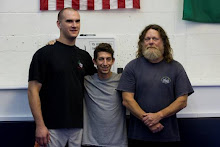
Today we conclude Robert Wyrod's sociology thesis "Warriors of the South Side: Race and the Body in the Martial Arts of Black Chicago"
This thesis was first published in the "
Berkeley Journal of Sociology".
All comments and conclusions drawn are those of author and film producer Robert Wyrod.
See part 1 hereSee part 2 herePlease see Robert Wyrod's video documentary "South Side Warriors" hereSee my review of Robert Wyrod's documentary, Gregory Jaco and the South Side Warriors" here----------------------------------------------------------------------------------
Martial Arts as Personal Empowerment and the Dojo as Community
Having addressed why the body is central to martial arts training in the black community, it is important to specify what meanings these bodily practices take on in each dojo. Although both James and Nate see their work as a form of community activism, the martial arts acquire very different meanings at each school. Nate has focused the training at the Mt. Olive School on young people, using the martial arts to build self-confidence in students on an individual basis. Nate sees the dojo as a place where each member can learn to maximize his or her own potential. By contrast, the Typhoon School is focused on building a sense of collective identity within the dojo. Unlike Nate, James does not encourage his students to compete in tournaments, but instead focuses on creating unique rituals within the dojo – rituals that bind the members of the Typhoon School together and produce a collective, communal identity.
For Nate, the martial arts empowers young people, giving them the self-esteem to overcome the obstacles they are confronted with on a daily basis. "The martial arts in my concept in relation to the political arena," he told me, "I see it as a vehicle to educate, to organize the youth of today as counter to the ill fates of what is happening in the black
140
community, such as the drugs and gangs and things of that nature." This emphasis on individual empowerment is echoed by both the students and parents alike.
Kelly is a parent who is particularly interested in Nate's classes, bringing not only her two children, but several other children from the projects to the dojo twice a week. During class she sits attentively on the sidelines, making sure her children are following the teacher's instructions to the letter. When asked why she is so interested in the program, she said, "I thought that it was a great idea for my son especially, with all the drugs and gang violence. Something to teach him discipline and self-determination, and teach him to go after something he really wants...And my daughter, I brought her to karate because it's like she's not more open, and things she wants to do but she won't go after them, and I think the karate class will help her achieve that." According to Kelly, the classes have had a positive impact on her kids, making her son more tolerant of losing and her daughter more assertive.
The students I interviewed at the Mt. Olive School echoed Nate’s emphasis on individual achievement. Although most of Nate's students are under fifteen, there are a few older students who train consistently at the dojo. Leonard is a young man in his early twenties, with a good job as a surgical assistant. Given his success it was somewhat surprising to hear him discuss how the training has affected his self-esteem, "I feel a lot more confident in myself, going from white belt to yellow belt. Being able to break bricks, and boards, remembering the different katas and forms, and also even placing in the tournaments. So it makes a really big difference in my confidence."
The emphasis on individual achievement is also evident in the activities at dojo on any given night. Students are often singled out to demonstrate their prowess in a particular area, such as board breaking. These are usually solo performances in front of the entire group with Nate evaluating the student along the way. If the student performs well, he or she receives praise from everyone at the dojo. In addition, every class at Mt. Olive ends with a thirty minute sparring session where two students fight in front of the entire group. These small matches last for five minutes and each one ends with a clear winner. Nate makes a concerted effort to give every student a chance to fight each night, which provides every student a concrete assessment of their individual progress as a martial artist.
For Nate, his work as a sensei is a natural extension of his many years of community activism. In the late 60's, Nate was very active in the Illinois Chapter of the Black Panther Party for Self Defense. Not only did he work closely with Fred Hampton, the chapter's president, he was also Huey P. Newton's personal bodyguard. Today he is only infrequently involved with any direct political actions, but Nate's
141
connection to the Party's ideology is still strong. On occasion, Nate has used the martial arts to educate his students about the Party's involvement with radical politics. In 1996, he hosted a tournament in honor of Fred Hampton, even though both the FBI and the Chicago Police made a concerted effort to cancel the event. But the weekly classes at Mt. Olive seem devoid of any conscious attempts to build community, or collective action, through martial arts training. Although Nate sees the training as addressing problems specific to black communities, in practice the emphasis on self-esteem, self-confidence, and self-control is little different than any other dojo. Karate schools in all white neighborhoods on Chicago's North Side claim to offer the same benefits to their mostly white, professional clientele. Martial arts training is marketed to white women in particular as a way to build self-esteem and confidence as well as a form of bodily protection.
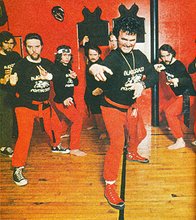
In stark contrast to Nate, James sees building black community as the central mission of his dojo. For James, the martial arts have been a way for blacks to create solidarity, and his school is continuing this tradition:
For those who didn't want to go into the gang mentality and went into the martial arts they found that it provided military strength. It gave us a relationship of being in the tribe, of being warriors. But even more it gave us family. As a school itself we live as a family. It's a family of ancient history living in the modern times with our own rules and regulations of governing things.
In James' mind, the Typhoon School has carved out a small, autonomous niche in an otherwise oppressive society. With the martial arts as a form of cultural cover, or camouflage, the dojo has become a refuge beyond the reach of a threatening, racist world:
So called free liberal society is destructive of anything other than itself. So if we find a discipline in someone else's martial arts that covers up our desire to be a tribe, and allows us to exist in the same way as we are as a tribe, but comes from something they have accepted, then we exist happily. And we go on to try and achieve the highest levels [in the martial arts] because it won't matter what they think because we will have found the energies to repress any type of genocide or aggression put against us by the government of any group of people who object to our being.
So for James, the martial arts are not only resources for confronting and challenging racial oppression, but a way to build a separate community based on a mythical tribal past.
Although James is the only member of the dojo who explicitly connects the training to a quest to regain a lost tribal order, other teachers have emphasized the strong sense of family they feel at the
142
dojo. When asked what makes the Typhoon School unique, Dean, a teacher in his early twenties, replies, "Basically everyone is more of a family. Everyone finds someone to cling on to more as a good friend, as opposed to just a training partner. Fred, another teacher in his twenties, expressed similar feelings about the school:
The uniqueness of our teachings you can see it amongst our students, you can see it within our school. Not only do we run a school we also have a family atmosphere. We continue to socialize with each other. Of course people are going to have little problems. But you can feel the spirit of the school.
Fred recently returned to the United States after serving overseas in the marines for several years. Immediately upon his arrival in the United States, he began regular training at the Typhoon School, and from an outsider's perspective it appears that he never left the dojo.
A fourth perspective on the community of the Typhoon School comes from James' brother Larry, who is also a teacher. Unlike his brother, Larry is a very shy, soft-spoken man, who was rather reluctant to talk about the school. He says he prefers to let his body speak on the mat, which is understandable, because he is an extremely graceful and agile martial artist. Of all the teachers at the school, he is the most interesting to watch. But from interviews and casual conversations, it is clear that Larry has much to say about the mission of the school:
This school here, in our martial arts adventures, we search out and bring our culture into our environment of the martial arts. You know our pain, our suffering as a people is all in here. That's why we try to, like the Army says, be the best you can be. We try to be the best martial artists that we can be. Not what society says for us to be but what we feel is the best for us to be. Because society has never depicted us in the right ways. It was always in the negative way, what they want us to be.
Although Larry does not describe the dojo as an ancient tribal order, he clearly shares James' vision of the school as a space separate, and independent, from society. The dojo is the refuge from the oppressive world where Larry can work through what he sees as society's racist constructions of black men.
As these stories and statements attest, the Typhoon School has done something unusual, and surprising, with the martial arts. The training is more than simply a resource for building self-esteem and self-confidence, but also a means of creating and sustaining the social ties that bind members to the community of the dojo. Unlike Nate's emphasis on individual development, the work of the Typhoon School is a collective project, concerned not only with individual transformation but
143
creating community.
The differences between these dojos lead to the question of how bodily practices foster collective action. Bodily practices should not be thought of in any essentialist sense, in which the practices themselves have some natural essence that produces certain social relationships. Bodily practices only take on meaning in a social context, and as that social context changes, the meaning of bodily practices shifts as well. In addition, these material, physical practices are not only shaped by their social context, but also play a role in constructing that social context. Social relations give meaning to how people understand their bodies, and the collective, physical action of individuals in turn shapes those social relations.
Returning to the activities inside the dojos, the different meanings that emerge from similar bodily practices can be attributed to the social context in which these practices are performed. Although both dojos draw on a similar set of martial arts practices, the subtle, and not so subtle, differences in the way these practices are conducted infuse them with very different meanings. These practices have been shaped over time, and now have a life of their own, actively shaping social interactions at the schools. And it is through these practices themselves that Mt. Olive becomes a space centered on individual empowerment, focused on rebuilding relationships between individuals and the world beyond the dojo, while the Typhoon School becomes a collective project of building community within the dojo.
Because of the intense hierarchy of any dojo, Nate and James play a major role in shaping the social context of the school. Initially, then, it would seem that their personalities alone would determine what meanings emerge from the bodily practices. If James says the training is supposed to build community, then that is the meaning it takes on at his school. But on closer analysis, it becomes clear that their personalities alone are not determining the meaning the training has for teachers and students. It is in the practices themselves, and more importantly, how they are practiced, that make the meanings created at the dojos so different.
To appreciate how the practices differ at the two sites, it is useful to closely compare the training at the schools. Both dojos place a good deal of emphasis on the proper protocol for entering the training area. At the Mt. Olive School the students are expected to bow once to the teacher and once to the dojo before entering. If they forget to do this they are denied entry until they figure out what they did wrong. The Typhoon School takes this protocol a few steps further. Students stand at the edge of the training mat and wait for a teacher's permission to enter the mat. They then bow, do a somersault on to the mat, and then enter the class by walking behind any other students already on the mat. No matter who is
144
in charge of the class, these rules are all followed closely.
Warm-up exercises are a large part of the training at Mt. Olive. The first half of every class is devoted to very mundane warm-up exercises. There is a lot of toe touching, squatting and bending, along with a few martial arts stances. The children follow along fairly well, but often drift off after a short while. There is also a lot of moaning on the part of the children. When an exercise gets too demanding the whole class will start to whine and complain.
At the Typhoon School, warm-up exercises are usually fairly brief. Class often begins with some stretches, but even these mundane exercises seem to be taken seriously by everyone. Some of the stretches can be rather strenuous, but the students try not to show any pain, and no one whines or moans. Occasionally, the warm-up routine involves more cardiovascular exercise, with the students running and jumping in place. Everyone counts out loud together, and yells "ki-ah" at the end of every jump to stay in synch. There appears to be an unspoken, or rarely spoken, rule that everyone should work together, in unison, through the exercises.
At Mt. Olive the warm-up exercises slowly transition into more martial arts training. The students practice punching and kicking, but there is surprisingly little technique training. Rarely will Jimmy (Nate's assistant) make the students go through a series of moves, such as a combination of punches, blocks and kicks. Usually he stresses a single move, and then goes back to more stretching. The older students, however, are usually working with Nate in a separate group practicing punches, blocks, and kicks. These students are all very focused on their activities, and they occasionally get supervision from Nate. They seem pretty detached from what is going on in the rest of the dojo, concentrating instead on their own small group.
The last forty five minutes of every class is reserved for sparring. The entire class forms a circle, and students enter the ring two at a time to spar. Nate judges the matches just like they are judged in a tournament. Each match lasts about five minutes, so nearly everyone gets a chance to spar. The night usually draws to a close after Nate and the other high ranking students have had a chance to spar.
By contrast, much of the training at the Typhoon School is devoted to refining specific techniques. Most teachers start by focusing on one or two specific moves, such as a front kick or a side kick. These moves are practiced again and again before the class proceeds to something else. So much of the training involves repeated exposure to the same movement, with everyone doing the same thing at the same time. The training often involves little or no verbal instruction, and the group just moves in a kind of perpetual motion, accenting certain moves with a "ki-ah."
145
But the training can vary considerably from one teacher to the next, and from one night to the next. One teacher, for example, places a lot of emphasis on strength training, while another is more interested in teaching basic martial arts stances. From participating in and observing the training, one gets the sense that a lot of the training is completely improvised. The teachers are drawing on a wide range of techniques, some traditional and others most likely their own creation, and stringing these techniques together in their own enigmatic ways. The students never question the authority of the teacher, however, and the techniques are still performed in unison by the group.
One of the more interesting aspects of these classes is that for the first half all the students, regardless of skill level, train together. Many of the exercises seem like they would be boring to a black belt, but even the most advanced students are very serious about participating. They seem to find this more basic training as fulfilling as the more advanced training they undergo later in the evening.
Although both dojos emphasize protocol, and rely on repetitive bodily practices in their instruction, there is a special form of ritualized bodily practice that emerges at the Typhoon School. Both dojos are ritualized spaces, but the Typhoon School has placed their own stamp on the martial arts, creating ritualized bodily practices that are unique to their school. Unlike Nate, who has based the training at his dojo on the more generic model of tournament competition, James has created a space where individuals can come together to both create, and participate in, unique ritual practices. These rituals are created, performed, and learned on the mat, through the bodily practices unique to the Typhoon School.
For James, the community of the dojo has emerged out of the specific forms of racial oppression endured by blacks living in the poor communities of Chicago's South Side. The discipline of the school is a counter to the perils of the ghetto, and the dojo is a community defined in opposition to mainstream society. But this type of opposition takes on a very specific form. Although the dojo is a space for building a collective identity, it is a collective whose attention is focused inward. For James, the mission of the dojo is not to directly challenge and change the forces which impinge on blacks, but to forge an autonomous space within a hostile society. For James, the martial arts provide a way of creating what he has called "a social structure within a structure," one that does not directly resist the forces of domination, but seeks to exist beyond their reach.
Gender also plays a role in the way the imagined community of the dojo is defined. For James, a return to an ancient tribal order is a return to a world with very rigid gender roles. Men are required to be the traditional warriors, providing for, and protecting their families. These
146
sentiments are echoed in some of Larry's more personal comments about the school, “I feel I have here my freedom, my sense of manliness and manhood and I won't let anyone come up on me to try and take that away because I know who I am.” It is easy to see how the masculinized aspects of martial arts training would provide a way to address such gender anxieties. Becoming a warrior is a familiar martial arts trope, and meshes well with the way racist representations of black males have threatened their masculinity.
But practicing side by side with the men at these dojos are women. Although the school is clearly male dominated, woman have been encouraged to participate, take leadership roles, and become an integral part of the community of this dojo. Both the men and women seem drawn to the training as a means of improving oneself within the community of the dojo. What this would suggest is that despite the patriarchal overtones of the “tribal order” there may be some continuity in the way women and men participate in, and experience, this space. However, without more ethnographic data that explicitly addresses the experience of women at the dojo, such claims are tentative at best.
Conclusion
What these sites suggest is that physical, bodily activity is an important aspect of agency on both an individual and collective level. It is not only the forces of domination that determine how people understand their bodies and what people chose to do with their bodies. Embodied subjects themselves are also instrumental in shaping their relationships to each other and to the social world. In addition, the Typhoon School illustrates that bodily practices can contribute to the construction of a collective identity that provides some refuge from the oppression experienced in everyday life.
This ethnographic data helps us to move away from notions of the body as a passive, biological entity only animated through discursive representations to an emphasis on an embodied subject whose interaction with the world is mediated through an active, material body. It is here that a sense of embodied agency becomes evident; an agency that has been shown here to take on both individual and collective forms. The Mt. Olive School is a space for individuals to build stronger selves, while the unique rituals of the Typhoon School have forged a collective identity that strives to maintain some degree of autonomy from mainstream society.
In The Elementary Forms of Religious Life, Emile Durkheim provided a framework for understanding the importance of ritual in building collective identity. Although not explicitly about the body,
147
Durkheim’s emphasis on ritual is an implicit recognition of the importance of bodily practices to collective identity. For Durkheim, these rituals bring people together, reaffirm their common bonds, and reinforce a sense of social solidarity. In religious ceremonies, the heritage of the social group is maintained and continually revitalized, counteracting those forces which could threaten and undermine social cohesiveness.
When applied to complex societies, Durkheim’s framework could also be used to understand the connection between ritual and resistance. The ritualized bodily practices of the Typhoon School could be understood as reinforcing a sense of social solidarity among members of the dojo. Drawn together by a shared experience of racial oppression, the students and teachers participate in bodily rituals that reaffirm their common bonds, and foster a sense of community. Through these bodily rituals, the martial artists are able to produce their community within the dojo and revitalize the social ties that allow it to withstand the forms of racial oppression that threaten its existence. So it is through the ritualized bodily practices that the Typhoon School is able to establish and maintain an oppositional community within a hostile host society.
Similar practices have also allowed Nate's students to strengthen their self-esteem and recoup a self-image that runs counter to racist constructions of the black body. The detachment and withdrawal of the imagined community of the Typhoon School, and the emphasis on individual empowerment at the Mt. Olive School, make labeling these practices a form of resistance problematic, but they allow us to envision the potential for something truly oppositional. In an era when racist discourse converges on the body, and when black bodies are faced with daily threats to their survival, bodily practices emerge as an important way to create and sustain resistant collective action. When a group of individuals begin to see their embodied selves as objects of similar forms of oppression, and when the corporeal aspects of the oppression become evident, bodily practices can emerge as a means of building solidarity and possibly complementing more overtly politicized forms of organizing.
References
Abu-Lughod, Lila. 1990. "The Romance of Resistance: Tracing
Transformations of Power through Bedouin Women." American Ethnologist :41-53.
Arnold, David. 1993. Colonizing the Body: State Medicine and Epidemic
148
Disease in Nineteenth-Century India. Berkeley, CA: University of California Press.
Blauner, Robert. 1972. Racial Oppression in America. New York, NY:
Harper & Row.
Burawoy, Michael. 1974. “Race, Class, and Colonialism.” Social and Economic Studies vol.24, no.4.
______. 1991. “Introduction.” Pp. 1-7 in Ethnography Unbound: Power
and Resistance in the Modern Metropolis, edited by Michael Burawoy et al. London, England: University of California Press.
Chicago Fact Book Consortium. 1990. Local Community Fact Book
Chicago Metropolitan Area 1990. Chicago, IL: University of Illinois Press.
Comaroff, John and Jean. 1992. Ethnography and the Historical
Imagination. Boulder, CO: Westview Press.
Durkheim, Emile. 1995. The Elementary Forms of Religious Life. New
York, NY: The Free Press.
Fanon, Frantz. 1967. Black Skin, White Masks. New York, NY: Grove
Press.
______. 1990. "The Fact of Blackness." Pp. 108-126 in The Anatomy of
Racism, edited by David Theo Goldberg. Minneapolis, MN: University of Minnesota Press.
Gilroy, Paul. 1987. "There Ain't No Black in the Union Jack": The
Cultural Politics of Race and Nation. Chicago, IL: University of Chicago Press.
______. 1990. "One Nation Under a Groove: Cultural Politics of Race
and Racism in Britain." Pp. 263-282 in The Anatomy of Racism, edited by David Theo Goldberg. Minneapolis, MN: University of Minnesota Press.
hooks, bell. 1990. Yearning: race, gender, and cultural politics. Boston,
MA: South End Press.
Jordan, Winthrop. 1974. The White Man's Burden: Historical Origins of
Racism in the United States. New York, NY: Oxford University Press.
Massey, Douglas S. and Nancy A. Denton. 1993. American Apartheid:
Segregation and the Making of the Underclass. Cambridge, MA: Harvard University Press.
Miles, Robert. 1989. Racism. London, England: Routledge.
Mohanram, Radhika. 1999. Black Body: Women, Colonialism, and
Space. Minneapolis, MN: University of Minnesota Press.
Omi, Michael and Howard Winant. 1986. Racial Formation in the
United States: From the 1960's to the 1980's. New York, NY: Routledge.
Roediger, David. 1991. The Wages of Whiteness. London, England:
Verso.