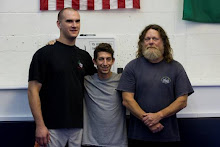
This week we will try something we have never done on The Dojo Rat Blog; we will review Robert Wyrod's sociological thesis on the empowerment of Martial Arts training in the black community of Chicago's South Side.
All comments and conclusions drawn are those of author and film producer Robert Wyrod, and this thesis appeared in The Berkeley Journal of Sociology.
The thesis will be divided into three parts over the rest of this week.
Please view Robert Wyrod's video documentary "South Side Warriors" at this link.
Also see my review of the video "Gregory Jaco and the South Side Warriors" at this link
-------------------------------------------------------------------------------------
126
As published in the Berkeley Journal of Sociology
Volume 44 1999-2000: 126-148
Warriors of the South Side:
Race and the Body in the Martial Arts of Black Chicago
Robert Wyrod
Abstract:
For four decades, the Asian martial arts have been a part of life on Chicago’s South Side. In the two South Side schools, or dojos, that are the focus of this ethnography, the rituals of the Asian martial arts have been given new meanings- meanings that resonate with people living in poor, black communities. Through the highly ritualized physical training that is unique to the martial arts, members of these dojos have forged an expressive cultural form that aims to counter the oppression experienced in everyday life. The training in these dojos is a means of recouping a sense of agency over a body that is burdened by racist depictions of being unruly and out of control.
These sites suggest that physical, bodily activity can be an important aspect of agency on both an individual and collective level. Bodily practices can empower individuals as well as contribute to the construction of a collective identity that intends to oppose oppression. There is a transformative aspect of bodily practices that links the body to resistance, suggesting that the coordinated, collective, physical action of individuals can shape their relationship to each other and to the larger social world.
Introduction
A giant black fist clutching a lightening bolt dominates the storefront window of the Scorpion School of the Martial Arts. Located on the southwest side of Chicago's loop, this now defunct black martial arts school held classes in karate and kendo for nearly twenty years. A few miles due south, in one of Chicago's poorest neighborhoods, the dilapidated home of the Black Dragon Slayers is still standing. The drawings of young black men, replete with generous afros and karate uniforms, breaking boards and flying through the air, only hint at what must have gone on when the Black Dragon Slayers were in their prime.
127
But the history of the martial arts on Chicago's South Side is one that stretches into the present. Today, there are at least a dozen schools, or dojos, on the South Side offering classes several times a week. Students can be found training in storefronts, churches, mosques, schools, community centers, and even the YMCA.
So what accounts for the popularity of the martial arts in the South Side of Chicago, and many other black communities? Why have the Asian martial arts been so enthusiastically adopted and adapted by some blacks?
Part of the answer lies in what has made the martial arts popular all across America irrespective of race, namely, the appeal of pop culture heroes from Bruce Lee to Jackie Chan. But in the South Side dojos that are the focus of this paper, the rituals of the Asian martial arts have been given new meanings- meanings that resonate strongly with people living in poor, black communities. For the teachers, or senseis, who founded the two dojos in this study, martial arts instruction is not just about developing athletic prowess in their students. These senseis see their work as a way to rebuild selves destroyed by racism and life in the ghetto. Through the highly ritualized physical training that is unique to the martial arts, members of these dojos have forged an expressive cultural form that aims to counter the oppression experienced in everyday life.
What links the martial arts training, as it is practiced at these sites, and the forms of oppression it is designed to address is the body. Both dojos are spaces where bodily activity takes center stage, and the work that is being done to instill self-esteem and discipline is primarily work on the body. The body is also central to racist discourse about blacks. Black men are represented as unruly and black women as promiscuous; bodies out of control. Such othering is material as well as representational, with the physical segregation and economic marginalization of blacks living in the South Side of Chicago a stark testament to attempts at isolating and containing black bodies.
My ethnographic evidence indicates that the physical, bodily activity of martial arts training provides a powerful means of contesting such forms of oppression. The students and teachers at these dojos have made the martial arts their own, tailoring them to address the issues of life in poor, black communities. But as this paper will make clear, the two dojos have slightly different missions. One is focused on individual empowerment, attempting to give young people the skills they need to survive in their dangerous environments. While the other school, the Typhoon School, has a more inward focus, using the martial arts to build a community within the dojo.1 What the Typhoon school illustrates is
1 All the of the names have been changed to protect the identity of the subjects of this ethnography.
128
that bodily practices, when performed collectively, open the door to the creation of a collective identity, one that intends to oppose domination from above. As this ethnography will demonstrate, there is a transformative aspect of bodily practices that links the body to resistance, suggesting that the coordinated, collective, physical action of individuals can shape their relationship to each other and to the larger social world. Even at society’s margins, where the effects of domination would seem most determined, the body emerges as a source of both individual and collective agency.
The fieldwork for this ethnography was conducted over a twelve month period. Twice a week I attended classes at two dojos on Chicago’s South Side, observing at one school and participating on the mats at the other. Such participant observation was a necessity to gain insight into the everyday life of the dojo and negotiate my status as an outsider. This approach was also crucial for analyzing bodily practices – practices that are significantly non-verbal and best studied as part of the life of the dojo. Through this fieldwork I was able to establish some lasting relationships and create what Burawoy refers to as a “dialogue” that allows us to “change our biases through interaction with others” (Burawoy 1991:4).
Race and the Body
As this ethnography will reveal, it is the work on the body that is most important to the members of these dojos. But a key question is why the body carries such meaning in the African-American community. Following Abu-Lughod (1990), we can use resistance as a diagnostic of domination to see how the activities in these dojo illuminate both the way power operates and how people respond to power. Resistance here is understood as a response to power dynamics, and it can be individual or collective, conscious or not. Labeling the activity in the dojos political resistance, however, is somewhat problematic. What is occurring at the dojos does not directly confront macro-structural forces that are bearing down on black communities. Members are not engaged in an active political struggle to redefine the social forces that define the communities in which they live.
But to dismiss the work at these schools as apolitical would be as problematic as interpreting it as a conscious, organized form of direct political resistance. Although not often stated in explicitly political terms, there are elements of resistance in these dojos. And as their own statements attest, the head teachers at both schools see their work as a way to address, and in some ways resist, the oppressive living conditions
129
endured by blacks on the South Side. Clearly, then, the activities at these dojos are connected to issues of resistance, and provide a way of exploring the structures of power and domination.
If racism is understood as an ideological code in which biological attributes are invested with social value and meaning (Miles 1989) then the body is central to the way racism functions.2 Facial features, skin color, and the texture of one’s hair have become imbued with meaning through racist discourse and used to justify racist sentiments. Thus the body is a focus of resistance in some black communities because racist discourse converges on the black body. The black, male body is represented as violent, unpredictable, hyper-sexual and in need of control; the black, female body as dangerous, sexual and unruly. However, racism is not simply a discursive practice; there are very material aspects to power as well. In the United States, institutionalized racist policies have concentrated many poor blacks in underclass ghettos. This physical isolation is coupled with the very real threat of police violence designed to contain and control black bodies. These material and representational effects of power are mutually reinforcing and together give the body its heightened significance in the dojos of Chicago’s South Side.
Although the connection between racism and the body may appear self-evident, there is little theorizing explicitly linking the body and race in the contemporary United States. One area where connections have been made between race and the body is the writing on colonialism.
Winthrop Jordan stresses how certain predispositions in the English problematized their first encounters with Black Africans. Jordan (1974) argues that certain biological characteristics had been given cultural values that led the English to racialize their contact with Africans. Although Jordan often discusses values as immutable and trans-historical, his analysis highlights how representations of the black body as impure and soiled played an important role in the origins of racism.
This theme of the black body as foreign and unhealthy is also central to the Comaroffs’ (1992) work on colonial South Africa. They connect the development of British colonialism in Africa to the
2 Miles’ insistence on racism as an ideological phenomenon is not without its problems. By banishing racism to the realm of ideology, Miles reduces the causal significance of race, making it secondary to more basic class and economic relationships. Although he does stress the need to contextualize the impact of racism within class relations, Miles remains reluctant to accord much power to race. I am more sympathetic to Paul Gilroy’s (1987) notion of racial identity, that sees race as part of an on-going process of social formation. Like Omi and Winant (1986), Gilroy argues for an understanding of race as a process that cannot be reduced to economic relations. However, when attempting to find connections to race and the body, Miles’ formulation is helpful.
130
development of Western medicine, drawing out the biological component of the civilizing mission. What is important here is their recognition that these “probes into the ailing heart of Africa” were premised on representations of the black body as “the very embodiment of dirt and disorder, his moral affliction all of a piece with his physical degeneracy” (Comaroff and Comaroff 1992:216). David Arnold (1993) draws similar connections in his work on nineteenth-century India, showing how Western science was used to justify racist otherings that depicted natives as diseased and morally degraded.
This work on colonial othering is important to contemporary theorizing on racism because it draws out the connection between race and the body. As Radhika Mohanram (1999) argues, different meanings of the black body at different times are metonymically linked. Eighteenth and nineteenth-century colonial categories of race were used to justify the massive social upheaval produced by the colonialists, while contemporary Western nations are the product of perceiving some citizens as “being out of the place to which they “naturally” belong” (Mohanram 1999:xiii). In both cases biological traits are used to rationalize a racist world view that places certain bodies in certain spaces, giving some bodies power while making other bodies subject to domination.
Roediger’s work on the white working class in nineteenth-century America indicates that the dynamics of racial othering in the colonies operated similarly in the metropole. Whiteness is shown to be a fragile consensus held together in part by “the idea that blackness could be made permanently to embody the pre-industrial past that they scorned and missed” (Roediger 1991:97). Roediger’s work highlights the dialectical nature of such otherings, with a disembodied whiteness created through an embodied blackness.
The anger elicited by such racist othering is illustrated in Fanon’s Black Skin, White Masks (1967). His writing on racist objectification centers on how racism problematizes the relationship between black bodies and the social world. For Fanon, racism works by destabilizing the connections between blacks and their bodies, replacing a bodily schema with a “racial epidermal schema,” thereby turning subjects of history into objects of history (Fanon 1990:110). For Fanon racist representations of the black body sever his connection to his own corporeal body. So in an odd way, the close connection between race and the body precludes any connection between the two for Fanon. The physical body exists for Fanon, but his own connection to it is shattered by racist representations of the black body.
What connects all these writers is an emphasis on linking race, and racism, to the body. Whether it is in the colony or metropole, the eighteenth-century or the twentieth-century, racism is a process by which
131
certain biological traits are endowed with meaning in order to create the other. It is through this process that blacks become embodied and whites disembodied. This is not to say that racial categories do not have any positive valuation, but it indicates how central the body is in racist discourse.
Representations of blacks are integral to understanding the connection between racial oppression, resistance and the body. But it is important to recognize that these discursive factors are symbiotically linked to the very real, material conditions that impinge on poor, black bodies on Chicago’s South Side. As Massey and Denton argue in American Apartheid (1993), blacks in Chicago are physically segregated to a such a degree they are most accurately labeled hypersegregated. Through massive public housing projects, the city has been complicit in creating immense, homogenous, poor, black communities, and fueling racist notions that unruly black bodies need to be contained and controlled. One school in this study, the Mt. Olive School, is located across from some of the city’s most depressed projects. According to the Local Community Handbook (1990) some census tracts have a 99% black population and a median family income of only $4,999. The area immediately surrounding the second school, the Typhoon School, had a higher median family income in 1990 ($21,845) but was 100% black. Although these statistics seem to indicate some socioeconomic differences in these neighborhoods, I do not think these differences are reflected in the memberships of the two dojos. From my experiences in the field, I believe that the majority of members of both dojos come from some of the lowest socioeconomic brackets in Chicago.
Police brutality is another facet of the very real, bodily threats poor blacks experience everyday. In the summer of 1999, Chicago made national headlines with the police murder of two unarmed blacks in two consecutive days. Similar incidents throughout the country have increased awareness of the epidemic of police violence in America, prompting Amnesty International to begin a human rights campaign against police brutality in the United States. This ever-present threat of deadly force is perhaps the most graphic illustration of the convergence of racism and the black body.
The physical segregation of the black ghetto is also connected to economic isolation. Like most Midwestern cities, Chicago experienced massive de-industrialization in the 1970's and 80's. National economic shifts from a Fordist economy based on full employment, to a post-Fordist economy with institutionalized unemployment, radically changed the economic conditions in Chicago's South Side communities. Erosion of the labor market was felt severely in poor black neighborhoods, and struck black males especially hard. Chronic unemployment became more of a threat for black men, and these threats were naturalized by racist
132
discourses undermining the ability of black men to be competent employees and responsible fathers. Such an alleged crisis of black masculinity utilizes racist tropes about the black male body to rationalize the economic despair found in poor, black communities.
The combination of physical segregation and economic marginalization has some lead theorists and activists to claim that blacks in the South Side of Chicago have experienced a form of internal colonialism. Similar analyses emerged in Chicano, Native American and Puerto Rican communities in the 70's (Blauner 1972). Although such perspectives have been the subject of criticism (Burawoy 1974), their strength lies in their recognition of how socio-economic forces combine with forms of cultural domination to produce and reproduce marginalized and alienated communities. The material conditions in these communities are linked to forms of representation that exoticize and marginalize the other. Internal colonialism, then, remains an important way of conceptualizing connections between race and the body because it shows how both discursive and material forces impinge on the black body.
The black nationalist movement of the 60’s and 70’s drew heavily on theories of internal colonialism, and some activists in Chicago’s black community remain committed to this perspective. I would argue that the continuing pertinence of the internal colonialism thesis springs from its ability to capture the way racism and the body are intertwined, a point of some relevance in poor, black communities. It is also valuable on a more theoretical level because of the way it neatly connects both the representational and material effects of racism to the body.
The body, then, is what links the forms of oppression impinging on black communities to the type of martial arts training practiced at the Typhoon School and the Mt. Olive school. For teachers and students at both dojos, the martial arts is a response to the forms of domination that converge on the black body. Embracing the rigorous physical training and intense discipline of the martial arts challenges representations of the unruly black body and provides some mechanism to cope with the material conditions of the ghetto.
Part 2 tomorrow
Wednesday, September 15, 2010


Monday, September 13, 2010
Gregory Jaco And The Southside Warriors
Photo courtesy of Floyd Webb

South Side Warriors, a video by Robert Wyrod
Video can be viewed in a better format Here
Martial Arts can mean a lot of things to different people. Millions of people have experienced them, quit and moved on. Some try Karate in college, or as a sport instead of football. Some are interested in Asian philosophy and culture, and are drawn to the arts. Some practice Martial Arts for survival.
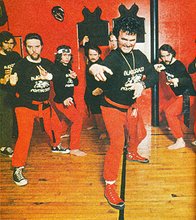
Like other kids who grew up in the '60's, I saw the early Kung Fu movies, was heavily influenced by Tom Laughlin's performance in "Billy Jack", and read with trepidation the adds in the back of comic books for "Count Dante", and his instructional manuals that included "The Dance of Death". Dante and his students appear in the photo at the top of my website.
As I began writing about Martial Arts and researching the Count Dante adds of my youth I discovered Floyd Webb, a film maker who had met Dante in his youth and is now making a movie - "The Search For Count Dante", which has grown into a much bolder project. You can see Floyd's website and a trailer for the movie at "Searching For count Dante".
In the course of reading about Dante and communicating with Floyd, I realized that it was more than a movie about one controversial Chicago Martial Artist. It was about community and social identity that brings eclectic players and men of character and strength together- sometimes in rivalry but usually for mutual support and camaraderie.
Floyd Webb's life was touched by Gregory Jaco, a former soldier on the Green Beret's Martial Arts Demonstration Team - turned community activist. In 2002, Robert Wyrod produced the video "South Side Warriors", detailing Jaco's "Tornado School Of Martial Arts", and it's influence in the community. In fact, Wyrod became one of the few white guys to join the school. Wyrod wrote to me:
"Back in the late 1990s I was living on the South Side of Chicago studying sociology in grad school. I had heard a little about the history of the martial arts on the South Side and wanted to know more. I believe I first came across Gregory Jaco's dojo The Tornado School in the phone book and decided to just stop by. I had no idea what a fascinating world I had stumbled into.
It took some persistence but I eventually convinced Sensei Jaco to let me train at the Tornado School. I would not say it was easy for a white guy with no martial arts training to fit in at the all black Tornado School. But after several months I started to feel more at home.
What I came to realize was the Tornado School was much more than a dojo and Sensei Jaco more than a karate teacher. Jaco had created a whole universe in that small dojo--one that provided refuge from the very tough South Side streets just outside.
It was a real privilege to be part of the dojo for a few months and this video was my attempt to capture the vibrant world Sensei Jaco orchestrated at the Tornado School."
Until I can fix the Embed, (it's working now) you can also view the video HERE
"South Side Warriors" gives us a glimpse of changing times. Jaco appears to know he is dying and intends to leave a legacy. Producer Wyrod follows students, friends and instructors as they describe the martial orbit anchored around the hub that is Gregory Jaco.
If you listen closely to Jaco's words, you hear not only strength, but subversion. Jaco speaks out in support of the outliers, standing up against both criminal elements as well as abusive police. Strength, unity and martial skills were necessary to survive against those odds. In fact, one of the instructors profiled is Stan Mckinney, a former Black Panther and current community activist.
Robert Wyrod masterfully captures the symbolism of Gregory Jaco, whose candle-flame will soon fade, turning over the "Tornado School of Martial Arts" to a young instructor. Wyrod blends the moment with the demolition of old housing projects in the area, leaving hope for renewal and rebuilding.
We leave Jaco, standing in front of his house. He has just dismissed a student and waits in thought, surrounded by the totems of his power; African shields, Chinese spears and halberds decorate his yard. Nobody ever messed with those weapons, or with Jaco.
For more information on Gregory Jaco, see Floyd Webbs "Searching For Count Dante"
For information on Robert Wyrod's documentary see "South Side Warriors"
If you have trouble viewing the video go to the site above
Thursday, September 9, 2010
The Eight Trigrams And Five Elements Of Jou Tsung Hwa

Lately at our little Dojo we've been reading and pondering the teachings of the late Master Jou Tsung Hwa.
Master Jou was a Chinese mathematician, and after an illness at 47 years of age, he turned his brilliant mind to the study of Tai Chi Chuan and found a return to health.
Jou's book "The Tao Of Tai Chi Chuan - Way To Rejuvenation" is a modern classic and is considered by many to be the premier book on Tai Chi.
-What caught our attention is Jou's interest in what he considered "the master key" to not only Tai Chi, but all martial arts.
Jou suggests a theory:
"Around 1970, Chi Chang Tao, an advanced student of the great modern master Cheng Man-Ch'ing, told me his teacher had said there were "eight trigrams in his hand". Chi did not understand this saying, and asked me about it because he thought my background in mathematics would enable me to explain the dynamics of hand movements in terms of the eight trigrams. I didn't understand then, but now, fifteen years later, I do."
"In the earliest classic on Tai Chi, Chang Sang-Feng says that Tai Chi is learned from the movement or orbit of the sun and the moon. Clearly, he watched their movements and related them to his own life."
-Jou did not understand until:
"-One night, as I practiced Tai Chi Chuan, I saw the crescent moon rise. Suddenly, I understood the connection Chang San-Feng made: the back of the hand is yang, the palm is yin. As the hand turns, a crescent of yang appears. We have two hands, so they must match one another like the relationship between the sun and the moon.
-- From this I was able to recognise that the pa kua, representing eight phases of cyclical change, is the key to the torso method in Tai Chi Chuan."
"The master key to the art of Pa Kua is the circular arrangement of the eight trigrams. Practitioners may imitate circular walking, but they must understand the eight trigrams for their art to truely be "Pa Kua". The master key to Hsing-I is the relation of the five elements in each movement. -
- The Tai Chi player must learn both the eight trigrams and the five elements. Lacking the master key, even after twenty years of study with the best teacher, you may have "Chuan", but it will not be Tai Chi Chuan.-
- Some practitioners of monkey fist, Pa Kua, Hsing-I and Tai Chi would exclaim loudly against this, saying it is too theoretical and useless for fighting. They would be right if the goal were form, but it is formlessness."
--------------
Now, that's a lot of meat to chew on.
In a simplistic explanation, one would reason that the spiraling, evasive palms of Pa Kua (Bagua) and the powerful angle-stepping and follow-step of Hsing-I (Xingyi) are the contributing factors to successful Tai Chi Chuan.
But Jou goes on, as a mathematician would, to link the movements to the I-Ching, the points of the compass and the orbit of the sun and moon. He details the trigrams and the relationship of the five elements to the ebb and flow of Tai Chi Chuan in a very readable and comprehensive way.
Master Jou was a brilliant man, with a huge following of students. As a middle-aged martial artist, I can relate to Jou beginning Tai Chi Chuan at age 47 and finding health and success.
Master Jou set the standard as "a thinking man's martial artist".
Tuesday, September 7, 2010
Combining Taiji, Xingyi and Bagua
Well, the guys over at "The Rum-Soaked Fist" sure have a good eye for picking out exceptional masters of the internal arts. This one is on a thread highlighted above.
The guy is a Japanese Master practicing Chinese Internal Arts, which is a curiosity.
A clip at the forum linked above shows his form movement, clearly exhibiting elements of Taiji, Xingyi and Bagua. This clip is of principles in application. Sure, it's a fairly static attack for this demo, but the Master is good at showing how some movement in the form is actually done in a different way in application.
For instance, in bagua we walk in a circle performing a posture or movement. Now, in application you do not attempt to walk around your attacker, it is not possible. Instead, you use the principle in the form that turns the opponent's body. Also note that when he uses the slapping strikes, he is hitting vital or pressure point areas. Downward into the bowels and bladder in front, and coming up into the occipital protuberance or gallbladder 20 on the back of the head. These strikes don't look like a power punch, but they would overload the attackers central nervous system and that last shot to the head would be a knockout.
People who practice Chinese Internal Arts will recognize Slant Flying, White Crane Spreads Wings, High Pat On Horse, The Bagua circling or Xingyi angle-stepping as in Pao Chuan.
Good stuff! The guys on the RSF forum suggest the Japanese call this "Taikiken".
Friday, September 3, 2010
It's Not Over Till The Fat Man Sings
Today's Friday Fun is dedicated to my buddy Bob over at "Striking Thoughts", who is single-handedly responsible for restoring honor to the Immense "Lord Of Pasta", Steven Seagal:
Oops; this is Bob-

And this is either Steven Seagal or a grown-up Eddie Munster:

Now, over here at Dojo Rat we have done our share to spread unsubstantiated rumors about the legendary skirmish between Seagal and "Judo" Gene LeBell in which Seagal allegedly got choked out and shit himself (See LeBell vs. Seagal), along with the variety of comments from Seagal supporters who were probably paid to write into Dojo Rat.
Or this, the sordid examination of Seagal's cob-webby references to working for the CIA, and his business partners that had clear Mafia connections (See Seagal Schmegal).
Or the lawsuit that was "dismissed",
"LOS ANGELES - Court records show a $1 million sexual harassment lawsuit filed by a former assistant against Steven Seagal has been dismissed in Los Angeles.
Kayden Nguyen had claimed Seagal forced her to stay in a Louisiana home and that the action star repeatedly fondled her. The allegations led to the suspension of filming on the reality series 'Steven Seagal Lawman.'
No reason was given for the dismissal granted Tuesday. Seagal's attorneys had been trying to resolve the case through private arbitration"
(snip)
"The lawsuit TMZ obtained alleged Nguyen interviewed with Seagal to become his executive assistant. Nguyen claimed she landed the job, but when she showed up for work, "Mr. Seagal had been keeping two young female Russian 'attendants' on staff who were available for his sexual needs 24 hours a day, 7 days a week." Nguyen also claimed Seagal treated her "as his sex toy."
Well, who could blame him,..eh?
So it was kind of surprising to see Seagal "training" Anderson Silva in the video below (Starts in Spanish, switches to English):
Interesting.
But of course, it's not over till the fat man sings (badly):
Note the highly advanced thumb-only picking method.
Anyway, Seagal is an easy target. He outweighs even me by a hundred pounds, has an inflated sense of self, to the point where he hurts other people. Stunt men, female assistants, you name it.
But what a character! Thanks To Bob over at Striking Thoughts for his constant updates on "The Lord Of Pasta"...
Thursday, September 2, 2010
The Barbarian Brothers, Part 2

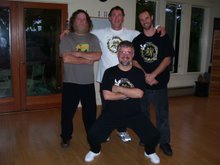
So lately we've had these two big guys, who I call "The Barbarian Brothers", come up to our island hideout to train with us on Wednesdays. (See part 1 Here)
These guys are 15 years younger than me and they are huge. They started doing Tai Chi Chuan with a friend of ours on the mainland, and that's how they found our moderately dysfunctional little training group. With that in mind, we have been mostly working on principles and applications so they can understand what the Yang-style long form is all about. That means, mostly rooting and yielding drills and push-hand patterns.
Last week however, we started doing some defense against hook punches, wild cowboy swings that are commonly thrown by drunks and unskilled fighters. These guys did fairly well, and despite being big, tense muscle guys they really tried to soften up and use evasive movement.
Halfway through last nights workout, I went into our junk closet and pulled out two pair of heavy marshmellow-padded boxing gloves and we had a round of light sparring with them.
None of us had mouth guards, and these guys are pretty ham-handed, so we kept the hitting to the body only. That's pretty hard to do- we all want to headhunt, even if only to open up other targets.
I have to say, the results were pretty good. Even being a 51 year-old half-assed fighter, I could hit these guys at will. They had no lateral movement, and I was able to use some sticking ability to tie up their arms a bit. My training partners can outbox me, and they worked these big guys over pretty good. Probably the most fun was seeing our youngest guy, at 21 and giving away 30 to 50 pounds dance around these guys, smiling and trading punches. That's the first time we threw him into the pressure-cooker and he did really well.
The Barbarian Brothers had a great time also, we worked them to exhaustion. I'm sure they will be back on a regular basis. The take-away from this was that all of the mundane drills and years of traveling to instructors has paid off. When faced with an unskilled fighter, even though they are younger, bigger and stronger, we can still kick their ass. Eventually we'll add light head contact, kicking and grappling.
Lots and lots of fun...
Wednesday, September 1, 2010
September: Cute Hippie Chick Of The Month
Yup, it's the first of the month and time for "Cute Hippie Chick Of The Month"!
This is the "Vault My Pole" edition, dedicated this month to fellow Dojo Rat Kostas in Greece, who has been complaining again about pictures of trees, apes and large boulders masquerading as Hippie Chicks...
Enjoy, Kostas!

*

*

*

*

This is the "Vault My Pole" edition, dedicated this month to fellow Dojo Rat Kostas in Greece, who has been complaining again about pictures of trees, apes and large boulders masquerading as Hippie Chicks...
Enjoy, Kostas!

*

*

*

*

Subscribe to:
Posts (Atom)