Saturday, March 29, 2008

MMA For Kids As Young As Six?


What is missing from this training?
Well it's finally happened. MMA has gone to the pre-teenbeat. It made national television yesterday, so it must be true. Kids are the new gladiators, and I wonder what is missing from this program.
How about:
-Learning about other cultures through tradition, formality and dress?
-Learning about the historical background of a chosen Martial Art
-Learning an "ART", something that you can practice alone for self satisfaction and self improvement
-Learning the structure of rank and dicipline
-Learning that it's not just about fighting...
Now, I know that this was inevitable, and this is going to train new generations of hellcat fighters, but there is something depressing and sad about it for those of us who have had the privilege to experiance the comraderie and structure of a traditional Martial "ART".
As I've said before; "Combat brings necessary pain, "Art" necessarily brings pleasure".
Here's the article:

Ultimate fighting expands to include children as young as 6; some fight with parents' blessing
By MARCUS KABEL , Associated Press
March 27, 2008
CARTHAGE, Mo. - Ultimate fighting was once the sole domain of burly men who beat each other bloody in anything-goes brawls on pay-per-view TV.
But the sport often derided as "human cockfighting" is branching out.
The bare-knuckle fights are now attracting competitors as young as 6 whose parents treat the sport as casually as wrestling, Little League or soccer.
The changes were evident on a recent evening in southwest Missouri, where a team of several young boys and one girl grappled on gym mats in a converted garage.
Two members of the group called the "Garage Boys Fight Crew" touched their thin martial-arts gloves in a flash of sportsmanship before beginning a relentless exchange of sucker punches, body blows and swift kicks.
No blood was shed. And both competitors wore protective gear. But the bout reflected the decidedly younger face of ultimate fighting. The trend alarms medical experts and sports officials who worry that young bodies can't withstand the pounding.
Tommy Bloomer, father of two of the "Garage Boys," doesn't understand the fuss.
"We're not training them for dog fighting," said Bloomer, a 34-year-old construction contractor. "As a parent, I'd much rather have my kids here learning how to defend themselves and getting positive reinforcement than out on the streets."
Bloomer said the sport has evolved since the no-holds-barred days by adding weight classes to better match opponents and banning moves such as strikes to the back of the neck and head, groin kicking and head butting.
Missouri appears to be the only state in the nation that explicitly allows the youth fights. In many states, it is a misdemeanor for children to participate. A few states have no regulations.
Supporters of the sport acknowledge that allowing fights between kids sounds brutal at first. But they insist the competitions have plenty of safety rules.
"It looks violent until you realize this teaches discipline. One of the first rules they learn is that this is not for aggressive behavior outside (the ring)," said Larry Swinehart, a Joplin police officer and father of two boys and the lone girl in the garage group.
The sport, which is also known as mixed martial arts or cage fighting, has already spread far beyond cable television. Last month, CBS became the first of the Big Four television networks to announce a deal to broadcast primetime fights. The fights have attracted such a wide audience, they are threatening to surpass boxing as the nation's most popular pugilistic sport.
Hand-to-hand combat is also popping up on the big screen. The film "Never Back Down," described as "The Karate Kid" for the YouTube generation, has taken in almost $17 million in two weeks at the box office. Another current mixed martial arts movie, "Flash Point," an import from Hong Kong, is in limited release.
Bloomer said the fights are no more dangerous or violent than youth wrestling. He watched as his sons, 11-year-old Skyler and 8-year-old Gage, locked arms and legs and wrestled to the ground with other kids in the garage in Carthage, about 135 miles south of Kansas City.
The 11 boys and one girl on the team range from 6 to 14 years old and are trained by Rudy Lindsey, a youth wrestling coach and a professional mixed martial arts heavyweight.
"The kids learn respect and how to defend themselves. It's no more dangerous than any other sport and probably less so than some," Lindsey said.
Lindsey said the children wear protective headgear, shin guards, groin protection and martial-arts gloves. They fight quick, two-minute bouts. Rules also prohibit any elbow blows and blows to the head when an opponent is on the ground.
"If they get in trouble or get bad grades, I'll hear about it and they can't come to training," he added.
In most states, mixed martial arts is overseen by boxing commissions. In Missouri, the Office of Athletics regulates the professional fights but not the amateur events, which include the youth bouts. For amateurs, the regulation is done by sanctioning bodies that have to register with the athletics office.
The rules are different in Oklahoma, where unauthorized fights are generally a misdemeanor offense. The penalty is a maximum 30 days in jail and a fine up to $1,000.Joe Miller, administrator of the Oklahoma Professional Boxing Commission, said youth fights are banned in his state, and he wants it to stay that way.
"There's too much potential for damage to growing joints," he said.
Miller said mixed martial arts uses a lot of arm and leg twisting to force opponents into submission. Those moves, he said, pressure joints in a way not found in sanctioned sports like youth boxing or wrestling.
But Nathan Orand, a martial arts trainer from Tulsa, Okla., said kids are capable of avoiding injuries, especially with watchful referees in the rings. He thinks the sport is bound to grow.
"I can see their point because when you say 'cage fighting,' that right there just sounds like kids shouldn't be doing it," Orand said.
"But you still have all the respect that regular martial arts teach you. And it's really the only true way for youth to be able to defend themselves."
Back in the Carthage garage, Bloomer said parents shouldn't worry about kids becoming aggressive from learning mixed martial arts. He said his older son was picked on by bullies at school repeatedly last year but never fought them, instead reporting the problem to his teachers.
And fighters including his 8-year-old son get along once a bout is over, Bloomer said.
"When they get out of the cage, they go back and play video games together. It doesn't matter who won and who lost. They're still little buddies."

(D.R.): "Some fight with parents blessing"?
***Also check out Pat's post over at Mokuren Dojo on Kids and armbars HERE

Wednesday, March 26, 2008

Is This What's happening In "No Touch Knockouts"?


"Look into my eyes"

Back to the controversial subject of "No touch knockouts", My original post is linked HERE. As I describe in that post, I have personally seen the "no touch knockout" work in some interesting ways, and I have seen it fail miserably. Nearly everyone has seen the videos of the technique failing against skeptics or hardened athletes.
There is however something going on, and I believe it is Hypnosis. Look at this example of Hypnosis used in a robbery:

Now, every time I have witnessed a "no touch knockout", there has been intense eye contact between the instructor and the subject. Here is the background of the above video:
'Look into my eyes': Supermarket robber who hypnotises checkout girls to get the cash is hunted by Italian police
Last updated at 11:19am on 21st March 2008
Italian police have issued video footage of a man who has been hypnotizing supermarket checkout staff and getting them to hand over the cash.
In every case, according to reports, the last thing staff remember is a man leaning over and saying 'Look into my eyes' before suddenly finding the till is empty. In the latest incident captured on video footage the man walked into a bank in Ancona in northern Italy.
He waited until he got to a female bank clerk and, according to the video footage, appears to hypnotise her into handing over more than £600.
He then calmly walked out.
The cashier who was shown the video footage reportedly has no memory of the incident. She only realised what had happened when she saw the money missing.
Checks of CCTV cameras in the bank showed her being hypnotised by the man.
Italian police are now looking for the suspect - who bears an uncanny resemblance to Saddam Hussein - who they believe is either of Indian or North African.
From dailymail:
http://www.dailymail.co.uk/pages/live/articles/news/worldnews.html?in_article_id=541234&in_page_id=1811
(D.R.)-- So there are legendary stories of warriors in combat, when one catches the other's gaze, causing him to falter and loose the battle. In a sense, capturing the opponent's "spirit". We are even tought in Karate sparring to avoid falling for eye fakes which throw your rythym off or confuse you. Even a loud Ki-ai can have an impact psychologically. I continue to believe that there is SOMETHING going on here. Take a look at my previous post ,and also HERE for more ideas...

Tuesday, March 25, 2008

Two Examples Of Sun-Style Bagua


Sifu Joshua Brown

Sun Style Bagua

Here's two examples of the Sun-style Bagua we have been learning. Lots of fun, much more dynamic than Tai Chi Chuan, and a surprisingly good workout. Having an instructor like Tim Cartmell show the applications to these complex forms is quite a trip. Contrast and compare...

Sunday, March 23, 2008

Back To School With Tim Cartmell


Sun Lu Tang

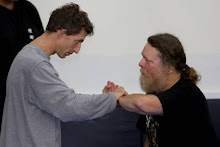
Tim Cartmell was in Seattle Saturday for his continuing series of seminars on Sun-style Bagua, as well as two other sessions on Xing Yi and a clinch clinic.
I had spent the last three days traveling to Oregon and back but was able to attend the afternoon session on Bagua before racing to catch the ferry back to the islands.
This time Tim focused on the Snake and Hawk forms, both unique and powerful in their applications. And when I say powerful, remember we are talking about Tim Cartmell, author of "Effortless Combat Throws" and other books on Chinese Internal Arts. Check out Tim's bio on Wikipedia Here. Tim has an incredible ability to take these obscure forms and pull out the joint locking, grappling and takedowns hidden within them, all from an internal martial arts perspective. After a review on the fan-jang hand techniques, with one he hadn't shown us last time (snake hands) we ran through the circle-walking before heading into a study of the Snake and Hawk forms. We practiced them in a linear way at first, just to understand them before moving into applications.
As you can imagine, the snake form tends to rely on tighter coiling movements, "snaking" around an opponents guard or torso. Applications included passing under the opponents arm into a hammer-lock with choke, with alternate San-kyo type lock. Another was from both opponents in an overhook-underhook wrestling posture. The technique was to keep the overhook very tight, snake the underhook arm across the opponents chest and down to the thigh on the side you have the overhook on. The palm turns against the opponents thigh as a fulcrum as you have stepped deeply into his dead angle to pivot him down for the takedown. There were several variations of this.
The Hawk form is more extended, with a piercing palm in one portion, turning with a chopping motion and a knee lift (similar to golden rooster stands on one leg in Tai Chi). The piercing palm application led into a over-the-shoulder arm bar, which could transition into a top wristlock. This is a grappling technique we practice at our Dojo, but bringing it out of the Hawk form application was fascinating. Here's what was really cool about the next part of the Hawk form: the knee lift after the turn is not a knee strike, because you are pulling the knee back and up, not foward as in a knee strike. Instead, you press against the opponents chest with one palm while pulling on his arm with the other, forcing him back on his heels. Then, you use YOUR lead foot to scoop his unweighted leg up, catch his heel and now you have his leg pulled up and extended where you can easily sweep the other leg or use any number of techniques for a powerful takedown. This is an application I had not seen or thought of before.
As always, the seminar was generously hosted by Jake Burroughs of "Three Harmonies Chinese Martial Arts Center". For further information, here's the link for Jake's website and contact info for upcoming events.-- Now I'm off to practice what we learned and nurse a few sore muscles...

Tuesday, March 18, 2008

It's Time We Had This Discussion


Do We Have Plans To Invade The Middle East?

Back in the "70's, When Donald Rumsfeld and Dick Cheney were still in Gerald Ford's White House, Robert Redford starred in "Three Days Of The Condor". This brilliant and thrilling movie foretold what we are living through today.
Think about it:
The U.S. economy is on the brink of destruction - The second Republican Great Depression. The blood and treasure of our great nation has been squandered in a grand chess game, played out by the puppet-masters and paid for with your children's
financial and physical legacy.
Self defense is more than kicking somebody's ass. It's knowing your rights when oppressed by authority. It's picking your fights wisely. It's feeding your family.
Self defense is considering the "worst case scenario".
We are in for hard times, possibly as bad as the crash of 1929. There are riots in third-world countries due to a decrease in rice production. Wheat production can not keep up with demand, and the bio-fuel scam is using up valuable cropland. Infrastructure in our country is literally collapsing. It is time to really, REALLY change the direction our country is going, and it's gonna' be hard work.
I know most people read this Blog for a lively discussion on martial arts, but protecting yourself also means not being willfully ignorant. With that being said, I am going to print this article in it's entirety.
Coming up in the next few months, I'd like to explore some ideas on how we will continue to protect our families, feed ourselves, and guard our financial resources.
Here's the article, from the Sacramento Bee:

Steven Mufson: A crude case for war?
By Steven Mufson -
Published 12:00 am PDT Tuesday, March 18, 2008
It's hard to miss the point of the "Blood for Oil" Web site. It features one poster of an American flag with "Blood for oil?" in white block letters where the stars should be and two dripping red handprints across the stripes. Another shows a photo of President Bush with a thin black line on his upper lip. "Got oil?" the headline asks wryly.
Five years after the United States invaded Iraq, plenty of people believe that the war was waged chiefly to secure U.S. petroleum supplies and to make Iraq safe -- and lucrative -- for the U.S. oil industry.
We may not know the real motivations behind the Iraq war for years, but it remains difficult to distill oil from all the possibilities.
That's because our society and economy have been nursed on cheap oil, and the idea that oil security is a right as well as a necessity has become part of our foreign policy DNA, handed down from Franklin D.
Roosevelt to Jimmy Carter to George H.W. Bush. And the war and its untidy aftermath have, in fact, swelled the coffers of the world's biggest oil companies.
But it hasn't happened in the way anyone might have imagined.
Instead of making Iraq an open economy fueled by a thriving oil sector, the war has failed to boost the flow of oil from Iraq's giant well-mapped reservoirs, which oil experts say could rival Saudi Arabia's and produce 6 million barrels a day, if not more. Thanks to insurgents' sabotage of pipelines and pumping stations, and foreign companies' fears about safety and contract risks in Iraq, the country is still struggling in vain to raise oil output to its prewar levels of about 2.5 million barrels a day.
As it turns out, that has kept oil off the international market at just the moment when the world desperately needs a cushion of supplies to keep prices down. Demand from China is booming, and political strife has limited oil production in Nigeria and Venezuela.
In the absence of Iraqi supplies, prices have soared three-and-a-half-fold since the U.S. invasion on March 20, 2003. (Last week, they shattered all previous records, even after adjusting for inflation.) The profits of the five biggest Western oil companies have jumped from $40 billion to $121 billion over the same period. While the United States has rid itself of Saddam Hussein and whatever threat he might have posed, oil revenues have filled the treasuries of petro-autocrats in Iran, Venezuela and Russia, emboldening those regimes and complicating U.S. diplomacy in new ways.
American consumers are paying for this turmoil at the pump. If the overthrow of Saddam was supposed to be a silver bullet for the American consumer, it turned out to be one that ricocheted and tore a hole through his wallet.
"If we went to war for oil, we did it as clumsily as anyone could do. And we spent more on the war than we could ever conceivably have gotten out of Iraq's oil fields even if we had particular control over them," says Anthony Cordesman, an expert on U.S. strategy at the Center for Strategic and International Studies who rejects the idea that the war was designed on behalf of oil companies.
But that doesn't mean that oil had nothing to do with the invasion.
In his recent memoir, former Federal Reserve chairman Alan Greenspan said: "I am saddened that it is politically inconvenient to acknowledge what everyone knows: The Iraq war is largely about oil." Says Cordesman: "To say that we would have taken the same steps against a dictator in Africa or Burma as we took in Iraq is to ignore the strategic realities that drove American behavior." There is no single conspiracy theory about why the Bush administration allegedly waged this "war for oil." Here are two.
Version one: Bush, former Texas oilman, and Vice President Dick Cheney, former chief executive of the contracting and oil-services firm Halliburton, wanted to help their friends in the oil world. They sought to install a pro-Western government that would invite the major oil companies back into Iraq. "Exxon was in the kitchen with Dick Cheney when the Iraq war was being cooked up," says the Web site of a group called Consumers for Peace.
Version two: As laid out in an April 2003 article in Le Monde Diplomatique, "The war against Saddam is about guaranteeing American hegemony rather than about increasing the profits of Exxon." Yahya Sadowski, an associate professor at the American University of Beirut, argues that "the neo-conservative cabal" had a "grand plan" to ramp up Iraqi production, "flood the world market with Iraqi oil" and drive the price down to $15 a barrel. That would stimulate the U.S. economy, "finally destroy" OPEC, wreck the economies of "rogue states" such as Iran and Venezuela, and "create more opportunities for 'regime change.' " There are historical roots for all this suspicion. After World War I, the Western powers carved up oil-producing interests in the Middle East. In Iraq, the French were given about a quarter of the national consortium, and the U.S. government pressured its allies to turn over an equal share to a handful of American companies.
Even now, the fate of Iraq's concessions is laden with politics.
Russia's Lukoil hopes to regain access to a giant field. China is seeking new fields. The big U.S. firms are angling to return to fields they ran before sanctions barred them during the 1990s. Smaller U.S., Turkish, European and Korean firms are gambling on new exploration deals with the autonomous Kurdish regional authority despite threats from Baghdad.
"One can imagine Iraq's oil fields as a pimple waiting to be pricked," says Antonia Juhasz, author of "The Bush Agenda: Invading the World, One Economy at a Time." She notes that the Bush administration put former oil executives on the reconstruction team, hired the Virginia consulting firm BearingPoint to write a framework for Iraq's oil industry, picked the Iraqis who took key oil ministry posts and has pressured Iraq to adopt a petroleum law favorable to international companies.
The petroleum law has become a rallying point for critics who say that the war was about oil. It would allow long-term production-sharing agreements, which Juhasz says are only used in 12 percent of the world "and only where the country needs to entice the companies to come." Defenders of the law, including exiled Iraqi oil experts, say that it provides for different types of contracts; how generous they are will depend on how well they are negotiated, but the law sets minimum conditions.
Greg Muttitt, another widely quoted war critic, who works for Platform London, a group of British environmentalists, human rights campaigners, artists and activists, says that an occupied country can't negotiate freely. What ended up in the proposed petroleum law, he says, was "pretty close" to what was in papers drafted by the State Department before the invasion. "Perhaps not surprising," he adds, given lobbying by U.S. officials and the role of former oil company executives in the reconstruction hierarchy.
That's the theory. The problem is: The petroleum law has not been adopted.
The idea that the Bush administration was in the tank for the oil industry glosses over a story of conflicting views before the U.S.
invasion and the bungled execution of plans afterwards. There were two rival interagency policy groups before the war, one led by the Pentagon and one by the State Department. Some key differences were never resolved. Some Pentagon planners wanted Iraq to maximize oil output, while State worried that a flood of Iraqi oil could threaten Saudi interests and market share.
The notion of an oil war also conjures up an image of a swashbuckling, string-pulling oil industry that no longer reflects a business that in many ways has become cautious and fearful of political turmoil. Western oil interests did encourage the overthrow of Iranian leader Mohammed Mossadegh in the early 1950s and the war in Suez in 1956. But generally oil companies are content to forge alliances of convenience with leaders as diverse as Saudi kings, Angolan communists and Indonesia's late, long-time autocrat Suharto as long as they're predictable. On those leaders' politics, human rights record, ethnicity or religion, oil giants are agnostic.
"Companies don't like and won't make investments where there's uncertainty, and war is the biggest uncertainty of all," said Rob McKee, the former number two executive at ConocoPhillips and a former top U.S. official overseeing Iraq's oil sector. "On the other hand, companies were hoping that Iraq would open up, and as long as Saddam was there, Iraq couldn't. ... From that point of view, maybe they were happy that there would be a change." Still, the big firms had trepidations. In a conversation with an adviser shortly before the invasion, the chief executive of one of the five major oil companies described what he would say if asked to invest billions of dollars in Iraq after the war: Tell me about the contract system, arbitration, physical security and social cohesion, then we'll decide.
Five years later, they still haven't decided, and physical security is so tenuous that the oil giants are still declining Iraqi invitations to send their employees to inspect existing fields.
This wasn't what Bush administration planners had expected.
Leading administration officials expected a postwar Iraq to reclaim its former position among oil exporters. "We are dealing with a country that can really finance its own reconstruction and relatively soon," then-Deputy Defense Secretary Paul Wolfowitz told Congress just after the invasion, predicting that oil would generate $50 billion to $100 billion in revenues within two to three years.
Ironically, Iraq might approach that figure this year because of high prices, not higher production.
Prewar planning settled who would oversee Iraq's oil sector. The Pentagon picked Phil Carroll, a well-respected former top executive at Royal Dutch Shell, who was succeeded by McKee. War critics point to such industry ties as evidence of nefarious influence, but former administration members say the choices were made on the basis of expertise. "If you wanted to get someone to help run an oil industry, who would you choose?" asked one person involved in selecting Carroll. "A broker on an exchange? An environmental expert? Or the head of an oil company?" The controversial details were all part of the larger strategic picture. "When we first decided on the war, I don't remember oil playing an important part," says Brent Scowcroft, national security adviser under the elder Bush and a critic of the current president's decision to invade.
But that's because concern about oil supplies is part of the architecture of U.S. foreign policy. Scowcroft notes that oil can't be disregarded because Iraq and its neighbors sit on two-thirds of the world's oil reserves. But oil needn't be mentioned either because it's self-evident. War critics might call that the perfect conspiracy.
In a sense, though, all Americans are part of that conspiracy. We have built a society that is profligate with its energy and relies on petroleum that happens to be pooled under some unstable or unfriendly regimes. We have frittered away energy resources with little regard for the strategic consequences. And now it's hard and expensive to change our ways.
Zaab Sethna, a business consultant and former official of the Iraqi National Congress, says that he attended many Pentagon and State Department meetings and never heard postwar oil policy discussed.
But, he says, "Let's not kid ourselves. Iraq is sitting on a very large portion of oil itself and is in a key region of the world. And that makes it important for U.S. security interests. ... The Iraqi opposition ... realized that Rwanda wouldn't be getting the attention of the superpower." Until Rwanda discovers oil.