Variation within the Song:
How Improvisation Unlocks True Understanding in Martial Arts Forms
By Corey Wiscomb
When I teach beginners ‘The Form’, the version I share is square, fluid, structured, and nearly the same every time. Physically it is a nice calisthenic that opens the joints of the body, especially invigorates the muscles of the lower body, improves balance, and relaxes the overall state of being. These health benefits alone make the practice of Tai Chi a worthwhile asset in many people’s lives, and hence why the art is practiced across the entire planet in today’s day and age. Yet, running the form in this way, the same every time, day in and out, while it shows great perseverance, will never yield any true understanding of the art within. Variation is the key that will unlock this gate.
I have been fortunate to study multiple styles of martial arts in depth in my continuing lifetime study of the fighting arts. I will not bore you with the list of black belts I have achieved over the past 26 years of practice. Instead I wish to make a comment on forms, since they are the major method of passing most martial styles on to future generations.
The First Level:
Forms, in most hard styles are straight-forward (or at least appear to be). A punch is a punch, a block a block. Physically the set is practiced nearly the same every time and the only variation you commonly see is a change in pacing of the movements and the dynamics of the speed and tension held during the motion. But the motion is the same. Go to any weekend martial arts tournament anywhere across the nation and you will see what I mean. This type of practice is good for physical strength and provides the foundation in stances and techniques for which the practitioner of that style will place on top all of their other martial skills.
The Second Step:
Not every school practices interpretation of form, often called bunkai. Those that choose not to leave their students with a complete disconnect for the purpose of the movements as to how they should be used in self-defense. And those that provide one interpretation to a form movement handicap their students by limiting the potential of a strong and capable movement to a single scenario that may never happen. Let me pose a question…
Have you ever watched someone practice a form before sparring only to see that the two seem like two separate arts? Their body moves in an entirely different way and the stylistic clarity of the form simply went right out the window. This is what happens when students have no interpretations to their forms. The moves are empty and the students think of them as a separate practice, so when the sparring begins a whole new set of skills emerges. Disconnect.
And on the other side of things are those who have single interpretations to their movements. They try desperately to be patient for the exact scenario for when to use that one movement only to have it pass in the blink of an eye. I can’t even begin to tell you the thousands of set techniques and applications that I have learned over the past two and half decades. And as a practitioner who is fond of sparring I can tell you that the perfect scenario happens next to never, or at absolute best one out of ten times… but let’s be honest, these are martial arts and we’re talking about fighting as preparation for self-defense, and having techniques that work only 10% of the time or less is not acceptable. As a competitor who won many national and international titles I learned one thing right away – I would have to adapt, I would have to improvise.
A little History to build understanding on the way to our Final step (for today):
My first awakening was in the study of the ‘9 Moving Forces’ as applied to Kata in the art of Shorei Goju Ryu. The practice, without going into detail, asks the practitioner to provide interpretation of striking, locking, choking, and lethal application all within one movement or form. Striking applications are usually obvious, but turning a down-block into a joint lock or lethal application was a very new and mind altering approach. And it’s true what they say, “A mind, once stretched, will never return to its former dimensions”. For more specific information on the ‘9 Moving Forces’ consult “The Pinnacle of Karate Do” as written by Robert Trias.
Once my mind began to see these movements in abstract ways a new understanding began to arise in my mind, perhaps it was possible to spar like the forms. My search led me to the (he’d like it that I call him this) infamous George Dillman, and for the first time I watched someone move the same in form as they would in fighting. George is best known for his understanding and application of Pressure Point Control Tactics, but it was his deep connection to form that drew me in as a student. I was completely enamored with the technical understanding and multitude of applications that he possessed for any movement given to him out of any kata, any style. I am still impressed to this day. Yet, the technical necessity of each movement brought me back to the dilemma I had hoped to resolve – too much information causes too much thinking, aka, the “paralysis of analysis” and in combat there is not even a split second for that.
I was passed around amongst many great teachers and after several years found myself in London, England training Small Circle Jujitsu with now Grand Master Leon Jay, son of Professor Wally Jay. While he didn’t really run forms per say, I was forever changed by the (painful) introduction to the art of ‘lock flow’: using your opponent’s energy against them no matter where they choose to move. This required a willingness and ability to adapt at a moments notice to the will of the opponent, and a technical proficiency in how to move in a balanced posture that was capable of mobility and stability at all times. It is all about flow, and it is never the same twice. Agh, variation, we are back to our theme.
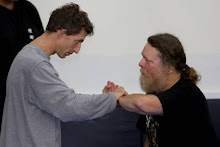
Now, those that know me know that Tai Chi Chuan is my martial base and I’m quite certain it will be for the remainder of my lifetime. It is the bottomless vessel that I poured all my other knowledge into when I emptied my cup. Sparring in Tai Chi Chuan is quite different than other martial arts. It begins with the practice of Push-Hands in which partners work to upset each other’s balance using the techniques of the form. When done appropriately it is fluid and contains same balance and postures as seen within the form, but rarely in the same order. It forces us to vary the movements in a way that often reveals to us the application of the movement itself only after we have done it. There is no thought. The body is in a constant state of adjustment to the present pressures and intents of your partner/opponent, there is no set pattern from which the mind can simply go to cruise control. It is a feeling and an experience that is absolutely necessary in order to understand the formwork, the very well from which to draw the water of substantial variation so as to practice the actual art of Tai Chi Chuan. Without it the dance is one of insubstantial motions that are quite often meaningless as to any application and serve no purpose in furthering the art other than a calisthenic exercising for the body. I have said that the vessel of Tai Chi Chuan is bottomless, and that is why it can hold all the elements of other arts within it. They simply become fuel for interpretation when added as extensions to the very abstract, yet completely functional, movements of Tai Chi Chuan.
In those times when I am not leading a group of beginning students the form becomes an improvisation of all that I have studied and experienced, I do not change the form, but I never run it the same twice. It is in these practices that my breath goes the deepest, my presence is brought to its absolute peak, my body opens to an immense rush of circulation, health, and my mind enters a deeper meditation than any other. This is the variation that brings form to life. It has taken me nearly three decades of practice to discover this and I can’t wait to experience it for the rest of my life.