Showing posts with label Chinese origin of Aikido?. Show all posts
Showing posts with label Chinese origin of Aikido?. Show all posts
Saturday, March 31, 2007
More On Aikido And Chinese Internal Arts
Mike Martello On Throwing And Locking
Mike sent me this video yesterday and I thought it was a very good representation of the similarities between Chinese Internal Arts and Aikido.
As discussed in the previous post (Is Aikido Of Chinese Origin?), Master Ueshiba traveled to China in 1936 and was impressed with the Chinese martial arts he saw. As quoted, Ueshiba could "see something once and observe exactly what they were doing".
Now, my point is not so much that Ueshiba borrowed spiraling and circular techniques from Chinese arts (which is generally believed), but Aikido is clearly different from the harsh and more liner Daitoryu Jujutsu. Additionally, Ueshiba was a spiritualist and follower of the Shinto Omoto Kyo ("Great Origin") cult, and certainly was familiar with Taoist teachings. It is of course the Taoist arts that replicate nature in the grand circular and spiraling movements.
Rather than split hairs on lineage and heritage, perhaps it is more important to accept paralell development and simply note the similarities and differences in the Japanese/Chinese arts. For instance, both Daitoryu and Aikido are based on the art of the sword. Many of the thrusts with the empty hand are not simply thrusts, they are "cuts". Footwork was also based on the art of the sword--but Ueshiba greatly expanded on it after his trips to China. Also, in Daitoryu and Aikido, the grappling aspect is the body of the art.
By comparison, Chinese arts replicate nature (wave hands like clouds, old man carries fish on back, etc.) rather than techniques based on sword work. Also, the grappling of Chin-na is a seperate study in Chinese arts, not the body of the art itself. The sub-categories in Chinese arts are; striking with the hands, kicking with the feet, wrestling and chin na (siezing or capturing a limb). Chin na is further broken down into: dividing the muscle/tendon, misplacing the bone, sealing the breath (cutting off air), Dim Mak (pressing or blocking a vein, artery), and Dian Xue (cavity press, or pressing a chi meridian channel.
In this respect, modern Aikido is much more cautious about not crippling the opponent, as was due to Ueshiba's latent spirituality. Daitoryu and Chin na have no such issue with completely disabling an opponent-- ("twist the neck to kill a chicken", etc.)
But on to the video:
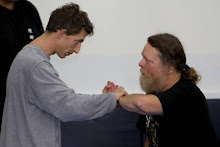
Here Mike Martello demonstrates techniques from the Chinese systems, and they are very, very close to Aikido techniques. The first throw is "Shio-nage", right out of Aikido. At 3:53 on the video clock Mike uses his first "San-kyo" control wristlock. At 5:13 Mike begins to loose his technique and transitions into "Kaiten Nage- or "rotary throw", by pushing the opponents head down and completing the throw. At 6:00 he uses an arm-bar throw that is not found in Aikido as far as I know. At 7:14 he begins transitions from "Nikkyo to Kote Gaeshi" wrist lock and throw. At 8:08, another Kaiten Nage- rotary throw. At 8:24 he begins some foot sweeps, which I don't believe is standard in Aikido. And finally, at 9:04 Mike sets up an arm trap which I only remember as the " #10 throw" from Aikido, and transitions back to "San-Kyo" for control.
I hope this attention to detail isn't boring people to death, but it is very exciting to me. When I first started studying Yang Tai Chi Chuan about eleven years ago, I had a lot of trouble seeing the practical application, even with my Karate background. Soon after, while studying Aikido with my instructor Chuck McCarty, I began seeing all those applications for the Yang form in our Aikido techniques.
I hope to post further thoughts on this angle of study in the future, and encourage people with similar intrests to feel free and submit their ideas...


Thursday, March 29, 2007
Is Aikido Of Chinese Origin?

There is an ongoing debate (What? debate in the Martial Arts community??) as to if Aikido Master Ueshiba was influenced by the circular Chinese arts such as Bagua or elements within the Tai Chi Chuan forms. They certainly share the spiraling and opening/closing, Yin/Yang feel of those arts. Furthermore, Chin-na joint locking may predate the Japanese systems. This is a small part of a very well researched article by Ellis Amdur at "Aikido Journal". The entire series of articles, some with lineage that is clearly over my head- ("Inside Aikido") can be found at http://www.aikidojournal.com/?author=8
Amdur writes:
However, Ueshiba did observe Chinese martial arts. Takeda Hiroshi studied Ruyi Tongbei ch'uan from He Zhenfang in the 1920's and 1930's. Takeda published the first book on Tongbei ch'uan in 1936. Tongbei is a martial system that uses a very flexible upper body and whipping techniques with the arms, as if there is an axle from one shoulder to the other. Although I do not know if this is true in Takeda’s line, some Tongbei ch’uan traditions have staff and/or spear training with fajin practice as part of their system. According to the following website,
www.tongbei.homestead.comHistoryQiShiStyles.html,
"Interestingly, although the content in certain portions of the book are very clear, other parts are very puzzling and strange. Many believe the reason is that Master He did not really want to teach Takeda, and so he diverted the teaching on purpose. There is speculation that this happened because of the political situation between China and Japan at that time." In any event, Takeda stated in an interview in a Japanese martial arts magazine in the late 1980’s, that his home became a center, not only for practitioners of Chinese martial arts, but also for visiting Japanese martial artists, and among them was Ueshiba Morihei, who visited him in 1936. According to Okumura Shigenobu, “Yes, he went to Peking too. He saw various Chinese martial arts. There are good martial arts in China. Ueshiba sensei was impressed by them.” Let me be very clear here. I am not saying that I believe that Ueshiba studied under Takeda Hiroshi - or anybody else in Beijing. But it is possible that, in his visit to Beijing, that he observed such training either by Takeda Hiroshi or by some of his other compadres, and saw something of value that he could "steal." Remember, Ueshiba was the man of whom Sugino Yoshio stated that he could observe something once and see exactly what they were doing. In sum, what I am saying here is that the type of force-building and expression that I am loosely referring to as “fajin,” may have been something that Ueshiba did observe in China and integrate in his own way into his art — either as something new or as a augmentation or variation to what he had already learned.
Subscribe to:
Posts (Atom)