Tuesday, June 30, 2009

The Circle And The Trance


Funny how things come "Full Circle"...
An article I read recently talked about medicinal opium poppy fields in Tasmania that were being raveged by stoned Wallabies, sheep and deer.

"We have a problem with wallabies entering poppy fields, getting as high as a kite and going around in circles. Then they crash. We see crop circles in the poppy industry from wallabies that are high," The Mercury newspaper quoted Ms Giddings as saying.
A manager for one of two Tasmanian companies licensed to take medicinal products from poppy straw said wildlife and livestock, including deer and sheep, that ate the poppies were known to "act weird".
"There have been many stories about sheep that have eaten some of the poppies after harvesting and they all walk around in circles," added Rick Rockliff, a field operations manager at Tasmanian Alkaloids".

Dong Hai Chuan, recognized as the founder of Baguazhang (Bagua, or eight-trigram palm) is said to have created the circle-walking fighting style. But walking the circle has a much more ancient origin - as Michael P. Garofalo writes:
"Tung Hai-Chuan (1813-1882) became a member of the Chuan Chen (Complete Truth) sect of Taoism. This sect was part of the Lung Men (Dragon Gate) school of Taoism which was originated by Chou Chang-Ch'uan. Interestingly enough, Chou also invented a method of meditation whereby the practitioner would walk in a circle and, wouldn't you know, this method was practiced by the Chuan Chen sect. Delving further into this Taoist connection, Professor K'ang Kuo Wu was able to find a section in the Taoist Canon which reads:
'A person's heart and mind are in chaos.
Concentration on one thing makes the mind pure.
If one aspires to reach the Tao, one should practice walking in a circle.'

Internal arts expert Bruce Frantzis explains here the trance-like aspect of Bagua circle walking:

Yet, circle walking was not just an Eastern practice; here's a picture of some Druids demonstrating a circle-walking ceremony at the Spring Equinox in London:

As well as the fantastic designs on the Plains of Nazca, often thought as of maps for space visitors, may have been huge walking labyrinths:

Classical labyrinth:

Circle walking also has uses in tool and engineering work, as in this hay press and the use of millstones:

Years ago, I read Fritz Capras "The Tao Of Physics". In one chapter, he shows a diagram of ancient Sufi dancing, which was composed of overlapping circles. next to it, he overlaid the patterns of the atomic structure, which was nearly identical:

In this way, modern physics is proving things that ancient shamanic practice realized at a very deep level embeded in the human psyche or the DNA itself, perhaps suggesting the existance of a "Unified Field Theory", or the interconnected-ness of all things...

Monday, June 29, 2009

Xingyi Seminar; And a New Camera!

*


Well, I did survive the Xingyi seminar down at Jake Burroughs' Three Harmony Martial Arts Center this weekend. Above is a picture of me in the Xingyi "San Ti" posture from a couple of years ago. Jake has corrected several posture issues that I now see in my stance. I use this pic because I haven't completely figured out how to extract small clips and still photo's from my new Samsung video camera, below:

My wife snagged this camera for my birthday, and I had to have a kid from the video generation help me figure it out. It was very reasonably priced at about $230, and of course came with a new software that I am stumbling through right now. When I learn it better, I should be able to have better video production and all the bells and whistles. If anybody else has this camera and has suggestions, let me know.
--But back to the seminar:
Jake taught us two forms; the Horse, and the Tuo (which is variously refered to as the Water-skimmer or Aligator).
The Horse is a bold, agressive form as many Xingyi forms are. Horses rear up and hit with their hooves. In this way, the applications have two fist variations; one is with conventional fists; the other uses the knuckles of the fingers to "rap", like knocking on a door. This is the version I prefer. The knuckle rap is not for heavy knock-out hits; it is for attacking the opponent's hand metacarpals (back of hand/fist), pressure-points on arms, or bony areas on the skull etc.
Used in this way, the horse form attacks sting and numb the opponent's guard or draw blood above the eyes. They can be used in angles that a boxing punch can not.
-- The Tuo (water skimmer/alligator) moves in a zig-zag pattern and unlike the other Xingyi forms I have learned it does not turn back, it moves foward and moves backward. One arm is held high in a conventional block level, the other is low, palm out for groin slaps.
The Xingyi that Jake teaches is heavily influenced by master instructor Tim Cartmell, author of "Effortless combat Throws" and other titles. As you can imagine, the gap with the opponent is closed using the form applications described above, and then many options open up for throwing and sweeping the opponent.
After the seminar, Zac and I stayed for another hour with Jake, which included correction on other forms but focused on infighting skills. This begins at San Ti crossed-hands range, closes with slaps and strikes and goes to the takedown set-up. Then the partners re-set and the game begins again. This is done at a 70% speed, is non-cooperative for a sense of reality, but not done so aggresively that it is beyond the capability of learning speed.
Lots of fun, I'll keep working on my new video software, and maybe pull a few stills or clips.

***** For information on Chinese Martial Arts In Seattle, contact Jake Burroughs at Three Harmonies Martial Arts Center

Saturday, June 27, 2009

Road Trip!


Hey!
We're off to the mean-streets of Seattle for a Xingyi seminar. Lots of knockdowns and throwing. I hope to survive.
Updates to follow.

Thursday, June 25, 2009

Direct Transmission Of Knowledge


Our Friend, The Late Mike Martello

"Direct transmission offers all possible wavelengths of experiance because it is holographic and infinate in nature. It can be recieved intellectually, kinesthetically, of trancendentaly, through the channels of the mind or the heart or the soul, as well as through the primal instincts of physical body awareness".
-Spiritualist Suyra Ma

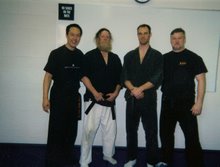
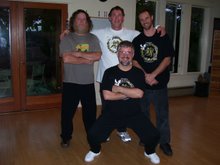
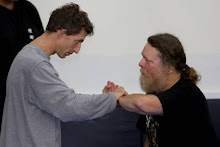
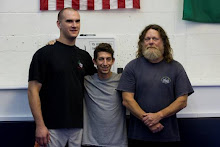
Jake and Dana at "Three Harmonies Martial Arts Center" in Seattle were kind enough to send me a few pics of our instructor and friend, the late Mike Martello. I thought the picture above represented what I view as "The Direct Transmission Of Knowledge".
At times, Mike loved to be the class clown and give everybody a good laugh, but when it came down to the nuts and bolts of understanding technique he was serious as hell.
I remember the exact moment this picture was taken; Mike was reminding me that a wristlock is not simply twisting a piece of meat, it is connecting to the center, to the entire body. He is demonstrating. He is making me understand intelectually. He is imprinting the moment in my mind, and he is making me feel the pain of a correct technique. This is direct transmission of knowledge, something no amount of reading or video surfing can accomplish.
Thank You, Mike.

Tuesday, June 23, 2009

More Bagua With Kent Howard


I just love this guys stuff. This video with Kent Howard is strictly Bagua applications, in others he talks about the techniques and methods. Kent is a great example of a teacher that really teaches. I know of some internal art Masters that say "just do it for 30 years, and you'll get it". That might have been the way in China 100 years ago, but not today. I know Tai Chi Chuan students, for example that have never pushed hands or learned a single applicaton.
What I am really beginning to understand is that the Chinese Internal Arts work by developing "Shapes". These shapes are postures that show how to express power and stability in it's given form. Rather than being techniques themselves, the "Shapes" are archtypes or blueprints for techniques. This video of Kent demonstrating the "Whirlwind Palm" from the Wang Shujin Bagua system is a great example of translating "Shapes" into techniques, and watching him move helps me really understand my Bagua forms.

Sunday, June 21, 2009

Epigenetics, Chi Cultivation, And Cellular Evolution


I might be over my head on this one.
Last week, I learned about the term "Epigenetics", and spent the last two days reading scientific journals, even contacting a scientist in an attempt to get to the bottom of this. Look, I know next-to-nothing about Microbiology. To me, a science experiment is brewing Beer. Let's start with a scientific definition of "Epigenetics":
“An epigenetic trait is a stably inherited phenotype resulting from changes in a chromosome without alterations in the DNA sequence.” Shilatifard and colleagues have also proposed three categories of signals that operate in the establishment of a stably heritable epigenetic state. The first is a signal from the environment, the second is a responding signal in the cell that specifies the affected chromosomal location, and the third is a sustaining signal that perpetuates the chromatin change in subsequent generations." (link embedded)
--So what the hell does this mean?
The study of Epigenetics refers to how environmental influences can alter cell structure and DNA information that can be genetically inherited. This is to say, something you do, or something that happens to you, can be inserted into your very DNA and passed on to future generations. You can see the huge implications of this, and many scientists consider "Soft Inheritance" to be a slippery slope in scientific study.
All of the research I saw refered to the study of Epigenetics regarding inherited disease factors, such as Lupus, Autism or Cancer.
But what if self-introspective practices such as meditation or internal energy cultivation also cause genetic changes, perhaps that can be passed on to offspring?
In the groundbreaking book "The Aquarian Conspiracy; Personal and Social Transformation in Our Time", Marilyn Ferguson describes How meditative mind-body practices re-wire our brain and body: (pp 168-169)
"Inward attention, in other words, generates a larger fluction in the brain. In altered states of consciousness, fluctuations may reach a critical level, large enough to provoke the shift into a higher level of organization... Larger fluctuations of energy cannot be contained in the old structure. They set off ripples throughout the system, creating sudden new connections.. (this theory) helps to account for the dramatic effects sometimes seen in meditation, hypnosis, or guided imagery".
-- Now, what Ferguson refers to is a mechanical change in brain and body. What Epigenetics may suggest is that we may not be only re-wiring our Brain, but actually facilitating changes in cell structure and "soft inheritence" in DNA.
Eric Richards, PhD professor of biology in Washington University, St. Louis states:
"To get to the issue of the more extreme variations of soft inheritance, it has to be determined whether the environment can induce an epigenetic change in an organism that can be inherited in subsequent generations. Certainly, nobody has shown that an epigenetically induced beneficial or adaptive change has been inherited. Mechanistically, there is no reason to discount epigenetic inheritance. The biochemical nuts and bolts are there to support it. The big questions to resolve are how many epigenetic changes are induced by the environment, what types of phenotypes result from these changes, and how many of these epigenetic changes are inherited."
(link embedded)
--For further clairification I wrote Trevor Covert, editor of "Epigenetic News", with my questions about whether any studies questioned if practices such as meditation or internal energy cultivation could create positive Epigenetic changes. Here's his response:

Hi John,
Thanks for writing in with your question. I have not seen any scientific
studies on any epigenetic changes that might occur with meditation, etc.
However, there have been studies showing that DNA methylation patterns
change over a person's lifetime, as well as changes in methylation due to
dietary choices (i.e. There are some foods that have been shown to influence
changes in DNA methylation).
Some DNA methylation patterns have been shown to be correlated to a person's
susceptibility to cancer. Other diseases are also thought to be possibly
linked to DNA methylation, although few have been linked conclusively. This
is a very new field that is being studied aggressively so I expect that more
about what kind of changes in health/disease risk are linked to behaviors
and lifestyle choices will be uncovered in the coming years.
Thanks again for the question.
Cheers,
Trevor Covert
Faculty Research Associate
Washington State University
School of Molecular Biosciences
Pullman, WA 99164-4234

--So, as it seems, the research in this field is clearly looking at environmental influences that cause disease in the human body, perhaps passed on to future generations.
But, what if the opposite is also true?
For instance, in a metaphysical sense, could this explain something like generational Karma? Or what about "The Demon Seed"?
Studies have shown how the stress of big-city life with all the stimulation, electric fields and noise cause ill-health in it's residents. Perhaps an inherited neurosis?
What about introspective energy cultivation? Can it cause positive cellular changes that can also be passed on genetically?
Is this the next step of human evolution?

"We are stardust,
we are golden
we are billion-year-old carbon
And we've got to get ourselves back to the garden"--
- Joni Mitchell, "Woodstock"

Thursday, June 18, 2009

Carradine; The Bowie Knife Fight


Here's one hell-of-a knife fight, with the late David Carradine staring as Cole Younger. The movie was a revamp of the Jesse James/Cole Younger gang and was titled "The Long Riders"
The movie actually had four sets of actor/brothers in the cast, from Wiki:

The Keaches: Jesse James (James) and Frank James (Stacy)
The Carradines: Cole Younger (David), Jim Younger (Keith) and Bob Younger (Robert)
The Quaids: Ed Miller (Dennis) and Clell Miller (Randy)
The Guests: Charley Ford (Christopher) and Robert Ford (Nicholas)
It also features an uncredited appearance by Ever Carradine, daughter of Robert Carradine and niece to David and Keith Carradine.
******
It was a pretty good shoot-'em-up, damned near everybody gets killed.
The Bowie knife fight was really good, with Carradine as Cole Younger facing off against Cherokee Sam Starr, and of course Belle Starr instigating the fight.
-- Years ago I read a lengthy article about David Carradine in Playboy. It talked about him and Bob Dylan going to the same Kung Fu instructor in Hollywood. Perhaps the most interesting story, sandwiched between drug binges, was that of Carradine and the "wolf pit". It seems he was in some "B" western (like the one above) and the plot called for him to fight a wolf. Well, he got a hold of Dan Haggerty, who played Grizzly Adams. Haggerty had a small pack of wolf-dogs, and loaned them to Carradine. Carradine starved the wolves for two days before the shoot. On the day of the filming, He smeared dog food all over his body, and jumped into a pit with Haggerty's wolves. He actually got hurt pretty bad in that one, and Haggerty was pissed that his wolves had been misused.