Friday, February 27, 2009

Homegrown Security


Urban Food Tower

Now that the "Masters Of The Universe" have blessed us with the Second Republican Great Depression, we have to come up with some innovative ideas of how to handle the care and feeding of Americans. This may involve a "Back to The Future" solution, so called "Victory Gardens" for a modern age.
In this excellent article by Chip Ward, He recommends we need more "Homegrown Security" and less Homeland Security:
"Cultural historian and visionary critic Mike Davis has already wondered why our approach to homeland security doesn't draw from the example of "victory gardens" during World War II. In 1943, just two years into the war, 20 million victory gardens were producing a staggering 30-40% of the nation's vegetables. Thousands of abandoned urban lots were being cleared and planted by tenement neighbors working together. The Office of Civilian Defense encouraged and empowered such projects, but the phenomenon was also self-organizing because citizens on the home front wanted to participate, and home gardening was, after all, a delicious way to be patriotic".
Ward goes on to say:
"Columbia University professor Dickson Despommier recently unveiled his vision of a "vertical farm," a 30-story tower right in the middle of an urban landscape, that could grow enough food to feed 50,000 people in the surrounding neighborhood".

Inside The Food Tower
"Rebecca Solnit, author of Hope in the Dark, reports that, within the de-industrialized ruins of Detroit, a landscape she describes as "not quite post-apocalyptic but ... post-American," people are homesteading abandoned lots, growing their own produce, raising farm animals, and planting orchards. In that depopulated city, some have been clawing (or perhaps hoeing) their way back to a semblance of food security. They have done so because they had to, and their reward has been harvests that would be the envy of any organic farmer. The catastrophe that is Detroit didn't happen with a Hurricane Katrina-style bang, but as a slow, grinding bust - and a possibly haunting preview of what many American municipalities may experience, post-crash".

Photos of other beautiful and unique food towers are embedded in the link to the article above

Thursday, February 26, 2009

Back To School; And Hat Tip To Pat At Mokuren Dojo


In an interesting turn of events, I have been asked by our local rural High School to help teach a physical education class. This will be a short series, four Friday classes on Tai Chi as part of a "Fit for life" program.
This is not the first time the school has asked for my contribution, I gave a talk to a civics class on "The Freedom of Information Act", and how to file requests for information with a Government agency.
Now here is where I find myself having to really re-think my teaching approach:
Several months ago I had a Blog discourse with Patrick Parker over at Mokuren Dojo. Pat's discussion about how to teach kids a calming meditation technique without calling it "meditation" was at issue. His point was that in the deep south of Mississippi parents would pull their kids out of his Dojo if he was to teach anything close to "meditation". This was obviously due to deeply held religious values and suspicion of eastern concepts. I was critical, in a polite way, and I chastised the ommision of "eastern thought".
Well, now I have to chew on a very small corner of my hat, and acknowledge that this is a difficult issue to approach with other people's kids in a public school.
I have not been cautioned against any form of presentation, but I am going to practice a form of self-censorship.
In my written and oral presentation, I will describe practicing the Tai Chi Chuan form as providing three benifits: Quiet introspection, a unique exercise, and a practice based on ancient Chinese martial arts that can improve ones ability in other sports.
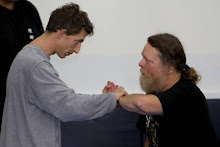
The two issues that I must tread lightly on in public school are meditation and martial art. That almost guts what my normal presentation is to other students who attend my Thursday evening TCC class. No concept of "Chi", Taoist philosophy, even fighting skills. Public High School is not the place to approach anything resembling fighting skills, so this is going to be an interesting series of classes for me to teach. I do however, think it will be possible to bring in another adult student at the end of the last class and do a demonstration that will include some push hands and self-defense applications, just for the students to view and to further inspire. There may be a few students that will want to research and pursue these other issues on their own, and hopefully have a more complete understanding of the art. I should also say there is a yoga instructor in another class at the school that is taking a similar approach.
-- So Patrick, I owe you a partial apology because, at least for this series of classes, I find myself in the same situation that you are dealing with.
I'm sure I'll have more to say on this later...

Here is the link to Patrick's original post

Monday, February 23, 2009

William Visits Tim Cartmell @ Shen Wu


Fellow Dojo Rat William made a trip from Canada to Tim Cartmell's Shen Wu school for some great training. I had met William at Jake Burroughs' seminars in Seattle, and he put together a nice video of the type of training at Tim's school.
After studying for years in Taiwan, writing and translating several books on Chinese martial arts, Tim found a weakness in traditional arts. They had no ground game at all. Tim went on to excell in Brazilian Jujitsu, winning the Copa numerous times and winning a silver medal at the '05 Mundials in Brazil.
As you can see, Tims "Shen Wu" combines the stand-up fighting of Xingyi, Bagua and Tai Chi Chuan with BJJ.

Saturday, February 21, 2009

For The Yang Tai Chi Chuan Guys


I usually don't post this guy's stuff because it's so, well, "Commercial".
But he does offer good instruction on this complex set of movements at the very end of the Yang Tai Chi Chuan long form. This is a series of postures that always give beginners a lot of trouble, and there seems to be no concensus on exactly how "Draw The Bow" is performed. Here, Master Gohring clearly shows detail that has escaped me in over a dozen-years of form practice. Specificly, details on draw the bow and the lotus sweep.
This is a reminder that there is so much information encoded within the Internal Martial Art forms. No one posture is an end in itself, rather a link in a continously moving chain, with techniques within techniques...

Friday, February 20, 2009

Crashing...


Ok; those of you who have read Dojo Rat for a while recognize that we discuss martial arts, political arts and the art of living simply. Today is the day for Political arts. I have been very hopeful since the Presidental election, and have not posted a political rant lately.
But frankly, I am f'in sick of Republican propaganda that currently fills the air. After nearly ten years of Republican rule (since they took the Senate in '98), they have succeded in crashing the system. We are f'ked. And they still blather on about corporate tax cuts etc.
From George Washington's Blog, Here is how bad things could get:
Thursday, February 19, 2009
Growing List of Officials and Experts Warn of Depression-Induced Violence

The number of high-level officials and experts warning that the economic crisis could lead to revolt and revolution world-wide - even in the U.S. - is growing every day:
The U.S. Army War College in November warned in a monograph [click on Policypointers’ pdf link to see the report] titled “Known Unknowns: Unconventional ‘Strategic Shocks’ in Defense Strategy Development” of crash-induced unrest:
The military must be prepared, the document warned, for a “violent, strategic dislocation inside the United States,” which could be provoked by “unforeseen economic collapse,” “purposeful domestic resistance,” “pervasive public health emergencies” or “loss of functioning political and legal order.” The “widespread civil violence,” the document said, “would force the defense establishment to reorient priorities in extremis to defend basic domestic order and human security.”
“An American government and defense establishment lulled into complacency by a long-secure domestic order would be forced to rapidly divest some or most external security commitments in order to address rapidly expanding human insecurity at home,” it went on.
“Under the most extreme circumstances, this might include use of military force against hostile groups inside the United States. Further, DoD [the Department of Defense] would be, by necessity, an essential enabling hub for the continuity of political authority in a multi-state or nationwide civil conflict or disturbance,” the document read.
Director of National Intelligence Dennis C. Blair said:
"The global economic crisis ... already looms as the most serious one in decades, if not in centuries ... Economic crises increase the risk of regime-threatening instability if they are prolonged for a one- or two-year period," said Blair. "And instability can loosen the fragile hold that many developing countries have on law and order, which can spill out in dangerous ways into the international community."***
"Statistical modeling shows that economic crises increase the risk of regime-threatening instability if they persist over a one-to-two-year period."***
“The crisis has been ongoing for over a year, and economists are divided over whether and when we could hit bottom. Some even fear that the recession could further deepen and reach the level of the Great Depression. Of course, all of us recall the dramatic political consequences wrought by the economic turmoil of the 1920s and 1930s in Europe, the instability, and high levels of violent extremism.”
Blair made it clear that - while unrest was currently only happening in Europe - he was worried this could happen within the United States.
[See also this].
Former national security director Zbigniew Brzezinski warned "there’s going to be growing conflict between the classes and if people are unemployed and really hurting, hell, there could be even riots."
The chairman of the Joint Chiefs of Staff warned the the financial crisis is the highest national security concern for the U.S., and warned that the fallout from the crisis could lead to of "greater instability".
Others warning of crash-induced unrest include:
The head of the World Trade Organization
The head of the International Monetary Fund
Senator Christopher Dodd
Leading economist Nouriel Roubini
Leading economist John Williams
Top trend researcher Gerald Calente

(D.R.) What are you doing to prepare?

Links to above references at Blog link above

Tuesday, February 17, 2009

Xing Yi Style Takedown


Since I've been thinking more about Xing-Yi (Hsing-i) lately, Here's one of the favorite takedowns we learned at Tim Cartmell's last seminar in Seattle. I'm still learning about the simplistic, effective power of Xing-Yi. Tim demonstrated this "crossing fist" application, which has a lot of similarities to the Tai Chi Chuan application of "parting wild horses mane/slant flying". The difference is the entry, which collapses the opponent's guard. The opponent's arm is locked tight in an underhook, with his other arm trapped against his body. You must step as deeply into his root as possible, pulling him in very tightly. The throw comes with a rotation, sitting into your throwing-side hip.
It's a farily safe position, even if you blow the arm lock- if you have stepped into his root correctly, you still have lots of options.

Monday, February 16, 2009

Review: "The Xingyi Quan Of The Chinese Army"


Now here's a book that may interest students of Xingyi (Hsing-i), Chinese military history, or just guys that like to play with rifles with fixed bayonets.
Xingyi Quan of the Chinese Army is authored by Dennis Rovere, with translation assistance by his wife Chow Hon Huen. Rovere was the first civilian to train with the Bodyguard Instructors' Unit of the Chinese Special Military Police. This overview of Chinese Military tactics and training are based on the 1928 publication by Huang Bo Nein's "Xingyi Fist and Weapon Instruction". This text, primaraly an instructors manual, became the manual for training soldiers at The Chinese Central Military Academy. This was at a time when hand-to-hand combat was quickly being replaced by combat with firearms. Rovere's Xingyi translates the original text, and offers contemporary explanation sand photos that suppliment those from the 1928 text.
Rovere's book offers a basic explanation of Xingyi's 'Five Element Theory", with the simple yet effective fighting methods. Those familiar with military training methods realize that there is a short window of training time for soldiers. They must be taught basic, large body motions that can be applied in a variety of conditions, wearing heavy clothing and packing gear.
As it is, the book shows the fist forms and fighting applications, but the second half of the book is designed for military enthusiasts with instructions on basic rifle/bayonet and sabre combat. On that note, I found the evolution of the Chinese combat sword interesting; it seems that the Chinese military sabre of the era looks very much like the Japanese Katana sword. Someone more knowledgable than me may have an opinion of that sword development.
"The Xingyi Quan of the Chinese Army" is somewhat of a "niche" book, of special intrest to practitioners of Xingyi for historical reasons, or for military enthusiasts.
Check out this book, and hundreds of other martial art titles at this link for Blue Snake Books!